Portuguese
  Spanish


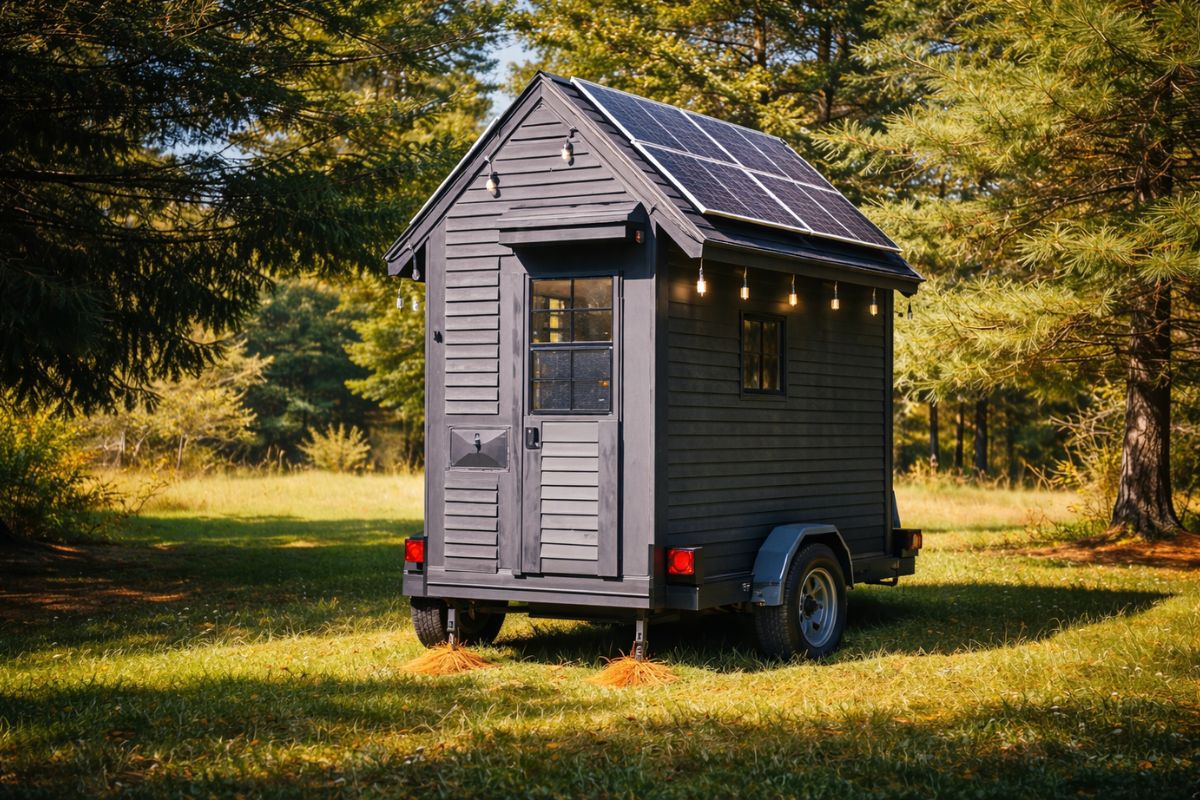


In Levi Kelly’s proposal, the smallest house in the world brings together, in a trailer structure, energy systems, climate control, food preparation, hygiene, and rest at a minimal scale. The result challenges the idea of comfort, shows real technical choices, and opens a debate about living with less in today’s world.
The smallest house in the world, presented by Levi Kelly in the United States in 2025, pushes the idea of compact housing to the limit without abandoning essential functions. At 19.46 feet long (about 5.92 meters), the design integrates solar energy in the ceiling, a foldable bed, a functional kitchen, refrigeration, climate control, and a complete sanitary solution.
More than a visual curiosity, the proposal highlights a practical question: how far can we reduce space without sacrificing daily operation, maintenance, and safety? The answer appears in high-efficiency technical decisions regarding volumetric efficiency, with a multifunctional layout, access for repairs, and systems designed to function both connected to power grids and off-grid.
Who Built The Micro House And Why It Became A Reference For Extreme Design

Levi Kelly is the author of the construction and is also responsible for documenting each step, from assembly to guided tours.
-
Detroit Microhouse Village Offers Former Homeless Residents Ownership After 7 Years: First 3 Tenants Receive Deeds

-
Brazilian Factory in Ivoti Produces 500 Modular Steel and Fiberglass Concrete Homes Following 2024 Floods, Securing $13 Million Contract
-
Brazilian Startup Develops Recycled Plastic Bricks, Cutting Construction Costs by 40% and Speeding Up Building by 90%

-
Tarcísio Opens New São Paulo Metro Line After 18-Year Wait, Offering Free Rides at 6 Stations and Aiming to Cut Commute to 23 Minutes for 633,000 Daily Passengers



He presents the unit as an experiment in compact engineering focused on real use, not just aesthetics. The central argument is simple: it’s not enough to be small; it needs to be truly livable.
The idea of “record” is linked to the reduced size and the set of functions gathered in the same volume.
According to the creator, the difference lies in maintaining a bed, kitchen, living area, shower, toilet, electricity, running water, and thermal control. In other words, the project attempts to prove that the smallest house in the world can exist without sacrificing what defines a functional home.
External Structure: Where It Is Mounted, How It Was Built, And What Guarantees Stability

The unit was mounted on a trailer, with a base designed to support a load greater than that of smaller options.

The position of the axle in the assembly required additional stability reinforcements, addressed with two extra rear supports to reduce sway. This structural decision is crucial in a house on wheels, as small oscillations compromise comfort and safety.

In construction, Levi uses a 2×3 wooden structure to save weight and internal space, with external cladding in cedar and a dark semi-solid finish that preserves the wood’s texture. The roof features conventional tiles and two solar panels totaling 400 W.

The exterior also includes four windows, an RV-style door, and an external shower with hot and cold water, a solution that frees up useful volume inside the cabin.
Internal Systems: Multifunctional Bench, Integrated Climate Control, And A High-Efficiency Kitchen

Right at the entrance, the three-seater bench serves more than one function: seating, technical compartment, and maintenance point. Beneath it are access passages to critical areas, including plumbing and the climate control system.
The EcoFlow Wave 2 air conditioning and heating unit has been embedded in the assembly, with airflow positioned for central distribution. The gain lies in the discreet integration, without losing reparability.
The electrical system was designed for hybrid operation: solar energy on the roof, battery, and an option for external power supply when the house is parked near a residence.

This “bypass” logic prevents unavailability and allows continuous use even without ideal solar exposure, an important technical choice for those alternating between camping and domestic support.
In the kitchen, every inch is treated as production area. The water system uses a 5-gallon clean water tank and a 5-gallon gray water tank, with a pump and filtration.
There is space for a compact heater, a retractable sink with a cutting board-style lid, a removable electric cooktop, and a mini fridge for essential items. The result is not a luxury of space; it is operational efficiency at minimal scale.
Sleep, Hygienize, And Maintain Thermal Comfort In Less Than Six Meters

The bed is in a retractable suspended module and descends with support from side wooden pieces, along with additional safety hooks.
The bed was sized to 5’10” (approximately 1.78 m), a measurement that coincides with the creator’s height. He reports real comfort for overnight stays but acknowledges one critical point: access requires body flexibility and using the counter as a support for ascent. It’s functional, yet clearly requires ergonomic adjustment.
The bathroom is resolved with a portable flush system by pump, installed in an external compartment with a locked lid, but transportable for internal use when privacy is needed.
This choice reduces fixed occupation inside the cabin and frees up space for circulation. The external shower, in turn, completes the hygiene cycle without requiring a permanent internal shower box, which is crucial in such a compact layout.
How Much It Cost, What Is Included, And What Limits Appear In Real Use
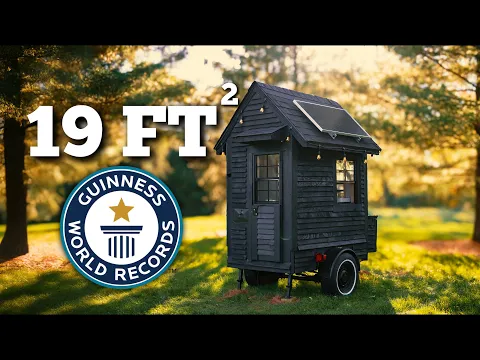

The reported cost for materials was around US$ 5,000, an amount that includes items such as wood, the climate control unit, and system components, but does not consider the already available trailer.
In projects of this scale, the unit cost per usable meter may seem high; however, a significant part of the investment goes into integrating systems, not to raw footage. Paying less for area does not mean paying less for complexity.
In practice, the smallest house in the world delivers basic autonomy for short stays and itinerant use but imposes objective concessions: less water reserve, limited cooling capacity, and more demanding ergonomics for simple tasks, such as accessing the bed.
Still, the project demonstrates that miniaturization does not have to mean improvisation; it can be a coherent technical strategy for specific contexts.
The smallest house in the world is not just a visual internet proposal: it serves as an applied study of compact architecture, electro-hydraulic integration, and transformable furniture design. The merit of the project lies in showing that reduced space can be planned with real-use logic, as long as each system has a clear function, possible maintenance, and well-defined operational priority.
If you had to adapt your routine to a micro house on wheels, which comfort would you not give up: easy access bed, larger water reservoir, fully internal bathroom, or complete climate control? And, in your case, what would be the minimum viable size to call a space home?