






 Portuguese
  Spanish


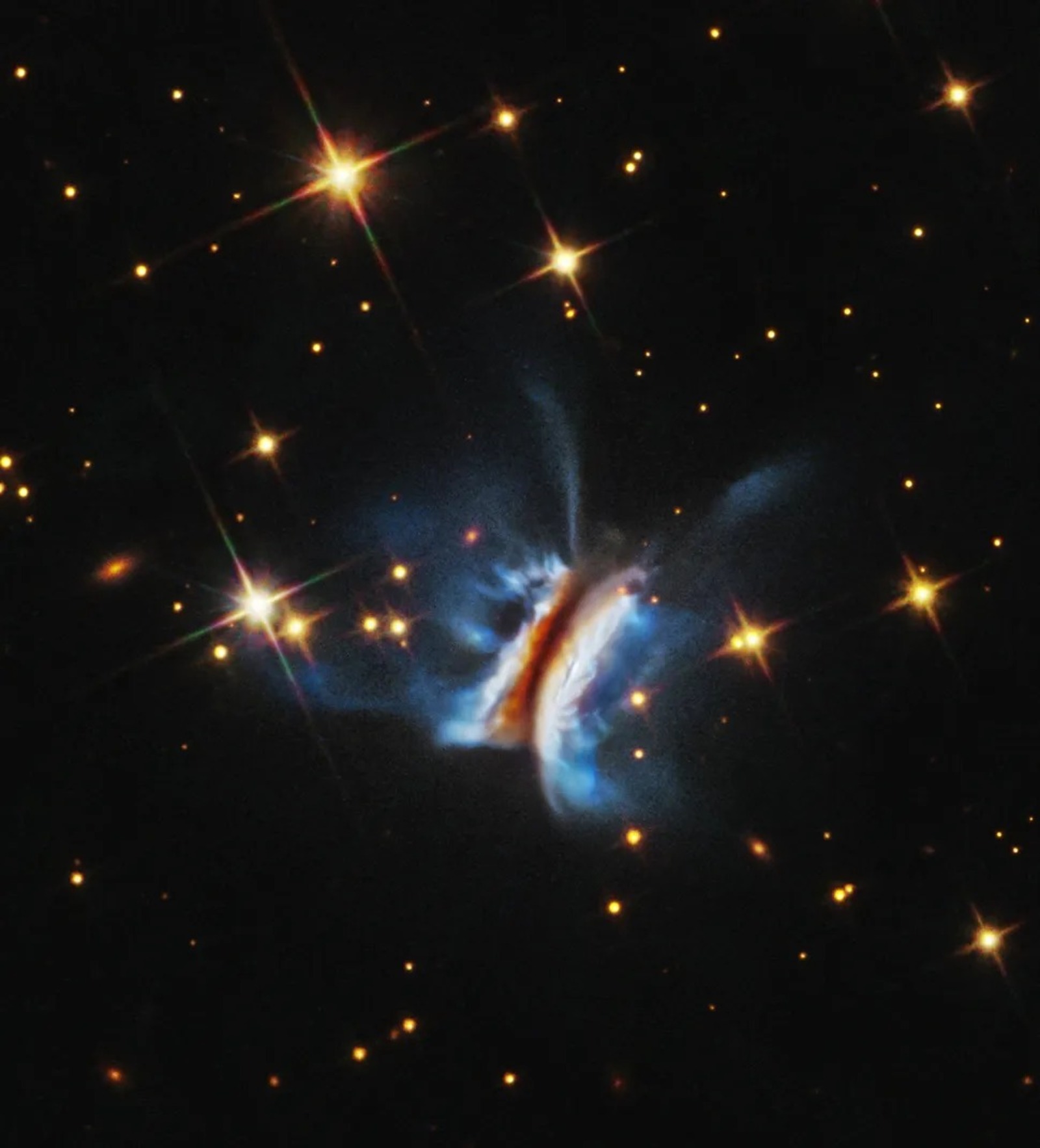


Nicknamed Dracula’s Kid Goat, the Protoplanetary Disk IRAS 23077+6707 Impresses With Extreme Size, Chaotic Structure, and Rare Details Observed Almost in Profile by Hubble
The Hubble Space Telescope captured a new image of a gigantic protoplanetary disk nicknamed “Dracula’s Kid Goat,” revealing a rare, extensive, and chaotic structure whose size and composition reinforce its potential to form multiple planets around a young star.
A Disk That Grabs Attention for Its Size and Shape
Rich in gas and dust, the object officially named IRAS 23077+6707 has an unusual appearance, with overlapping layers that resemble a sandwich seen almost in profile.
Protoplanetary disks are regions where planets form around young stars, including rocky worlds similar to Earth and gas giants comparable to Jupiter.
-
The Trap of Modern Technology: How Screen Overload and Digital Connections Can Impact Your Mental Health and Well-being

-
Wyoming Couple Grows Tropical Fruits Year-Round in -40°C Using Geothermal Greenhouse, Demonstrating Earth’s Heat Can Produce Oranges and Lemons in Snow Without Traditional Heating

-
Ship Returns from Brazilian Coast with Thirty Newly Discovered Life Forms
-
Nigerian Professor Invents Electricity-Free Refrigerator Using Clay Pots and Wet Sand, Extending Shelf Life of Vegetables to 27 Days; 7,000 Units Distributed in Energy-Deprived Villages



In the case of Dracula’s Kid Goat, the volume of available material theoretically suggests the possibility of a vast planetary system in development.
The nickname refers both to the layered appearance and to the origin of the researchers involved, linked to Transylvania in Romania and Uruguay.
The Uruguayan chivito, a national dish made of sliced meat, ham, mozzarella, tomatoes, and olives, inspired the visual comparison to the observed disk.


Extreme Dimensions and Scientific Confirmation
In an article published in The Astrophysical Journal, astronomers estimate that the disk extends nearly 640 billion kilometers, equivalent to 400 billion miles.
This extension corresponds to more than 100 times the diameter of the inner solar system, the region where all known planets orbit around the Sun.
Initially identified in 2016, the object has now been confirmed as a massive disk associated with active planetary formation processes.
The nearly profile inclination relative to Earth allows for the observation of rare structural details, enhancing the scientific value of the new image captured.
Chaotic and Asymmetric Internal Structure
The researchers believe that the disk houses a hot, massive star at its center, or possibly a pair of stars.
The structure is marked by bright filaments of material that extend far above and below the main plane of the disk.
According to scientists, this pattern reveals a dynamic environment, far from the idea of uniform and stable disks.
The system exhibits an evident asymmetry, with vertical filaments concentrated only on one side, while the opposite side displays a well-defined edge.
New Clues About Planetary Cradles
For the authors of the study, the level of detail observed is unusual in protoplanetary disks recorded so far.
The images indicate that these planetary cradles may be much more active and chaotic than previously thought.
Hubble provided a direct view of complex processes that shape disks during the formation of new planets, which are still not fully understood.
These observations pave the way for future studies on how asymmetric structures influence the birth and organization of planetary systems.
More Details About the Planet-Forming Disk
The protoplanetary disk Dracula’s Kid Goat stands out not only for its extreme size but also for the structural complexity revealed in recent observations.
The combination of gas and dust forms dense, visually separated layers that help researchers identify regions potentially linked to planetary formation.
The nearly profile inclination allows for the observation of the vertical distribution of material, something uncommon in records of protoplanetary disks around individual stars.
The bright filaments observed above and below the disk indicate intense movements of matter, associated with processes still poorly understood by current astronomy.
These structures suggest dynamic interactions between the disk and the central star, or possibly between two stars present in the core of the system.
The contrast between one side with vertical filaments and another with a well-defined edge reinforces asymmetry as a dominant characteristic of the object.
For astronomers, this pattern challenges traditional models that describe protoplanetary disks as relatively stable and homogeneous environments.
The detailed observation was only possible thanks to the sensitivity of the Hubble Space Telescope, capable of capturing fine nuances in the dispersion of material.
According to researchers, images with this level of definition offer a rare opportunity to track how planetary systems can organize.
The study reinforces that planet formation occurs in active environments, where instability and chaos are part of the natural process.
This data broadens the understanding of how massive disks evolve and helps contextualize the diversity observed in known planetary systems.
The information gathered serves as a basis for future analyses, deepening the understanding of the early stages of planet building.
With information from Live Science.





Eles não tem nada importante pra fazer, com tantas doenças no mundo.não são capazes de curar.e ficam observando o espaço.bando de ****.
Tu n tem uma Louça pra lavar não?