Portuguese
  Spanish


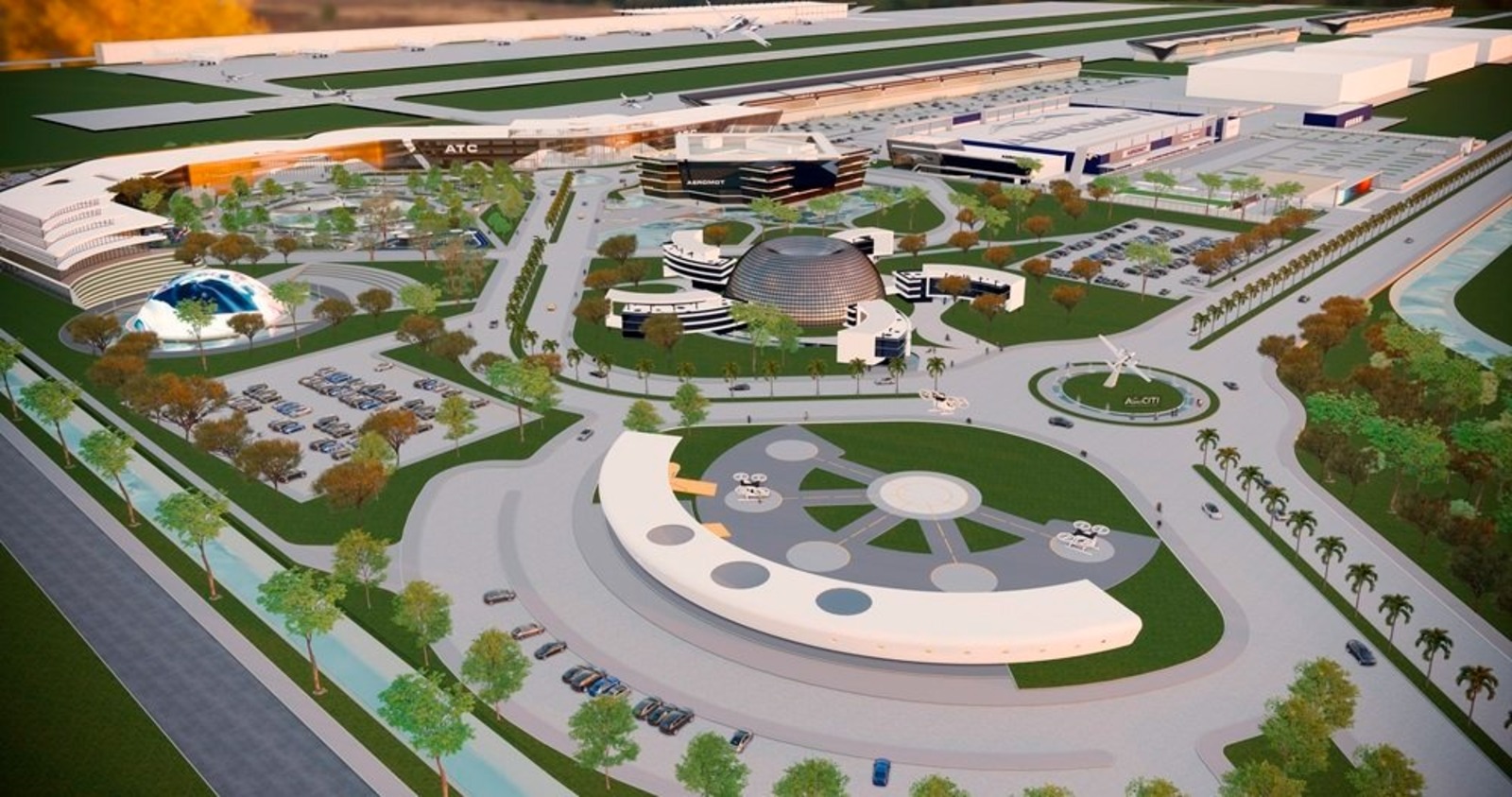


With An Investment Of R$ 3 Billion, The AeroCITI Complex In Guaíba Promises To Transform Rio Grande Do Sul Into An Aeronautical Hub And Produce The World’s First Ethanol-Powered Transport Airplane By 2032
The Rio Grande do Sul is preparing to receive a new industrial landmark. Aeromot, a Brazilian company in the aeronautical sector, announced the construction of a megaproject, a large complex in Guaíba, in the metropolitan region of Porto Alegre.
The space, named AeroCITI (Integrated Center for Technology and Innovation), promises to transform the region into an aviation hub in the country, with a total estimated investment of R$ 3 billion and a goal of producing 50 aircraft per year by 2032.
In addition to the factory, the project includes hangars, a research center, leisure areas, and even a Open-Air Airplane Museum.
-
SENAI Launches $36 Million Innovation Round to Boost Brazilian Manufacturing Productivity and Reduce Business Risks with R&D Projects by 2026

-
Indonesia Plans to Build 5,000 Suspension Bridges by 2026 to Connect Rural Communities to Schools, Health Centers, and Markets
-
U.S. Invests $75 Million in Projects to Extract Rare Earths, Gallium, Germanium, and Aluminum from Coal Waste
-
Eni Acquires 25% Stake in Chilean Lithium Project, Plans to Invest Up to $225 Million in Eco-Friendly Extraction Method




But the highlight is another: the development of the world’s first ethanol-powered transport airplane, a groundbreaking step towards decarbonizing aviation.
Megaproject In RS: The “Airplane Metropolis” In Guaíba
Aeromot’s megaproject will occupy an area of 540 hectares, with enough space for hangars of various companies, some of them funded by partner companies.
The infrastructure will also allow commercial landings in case of an emergency with Salgado Filho Airport in Porto Alegre.
The project has public support. The state government approved a law to donate part of the land, while the municipality of Guaíba granted tax incentives to attract investments.
According to Aeromot, AeroCITI will be more than just a factory: a center for innovation and technological cooperation.
The company’s CEO, Guilherme Cunha, stated that the complex will serve not only Brazil but also countries in the Mercosur.
“A Diamond has limited production capacity. We are working on a technology transfer strategy to create a base in South America and support all these countries,” he explained.
National Production And Reduction Of Deadlines
The first model to roll off the production line will be the Diamond DA62, a luxury twin-engine aircraft nicknamed the “SUV of the Skies,” with capacity for seven passengers.
Manufactured by Diamond Aircraft, an Austrian-Canadian company controlled by the Chinese group Wanfeng Auto Holding Group, the model has been imported by Aeromot since 2016.
Currently, the company has already brought to the country more than 100 units of the DA62, but now intends to manufacture them domestically. With this, the waiting time for an aircraft could decrease from 27 months to about nine.
The initial assembly is expected to begin in January 2027, still using imported components. The forecast is to produce three units in the first year, gradually increasing until the entire line is installed in the country by 2032.
Cunha believes that the new cycle could boost national financing and attract more buyers.
“Today, 90% of sales are made upfront. There is no incentive. The idea is to transform this model into a Brazilian product, with local financing,” he stated.
The Ethanol-Powered Airplane
While structuring the production of the DA62, Aeromot is working on another bold project: the first ethanol-powered transport airplane.
The research is being conducted in partnership with Finep (Funding Authority for Studies and Projects), an organization linked to the Ministry of Science, Technology and Innovation.
The model will be twin-engine and has been under development for over a year. Currently, ethanol is used almost exclusively in agricultural aircraft, but Aeromot wants to bring it to passenger transport within five years.
For the CEO, the investment is strategic. “Aviation is going to undergo a major transformation in the coming decades, and decarbonization is inevitable. We must be prepared for that,” he declared.
Partnerships With Universities And National Technology
Aeromot maintains partnerships with universities and research centers that will utilize the AeroCITI space.
Among them are UFMG, the BI0S Institute from Unicamp, Ulbra, UFRGS, the Technological Park of São José dos Campos, and PUC-RS.
These collaborations are expected to strengthen the integration between academia and industry, accelerating the development of solutions focused on sustainability and technological innovation.
The complex will also feature a 24,000 m² Airplane Museum, walking paths, and recreation areas, reinforcing the public and educational nature of the project.
Tradition And Experience In The Aerospace Sector
Founded 58 years ago, Aeromot has a long history in the aeronautical sector. In recent decades, it has focused on distribution and modification of aircraft, adapting models for missions in public safety, health, and aerial surveillance.
During the 2014 World Cup, the company collaborated with the air security and logistics system throughout the country.
Prior to that, between 1980 and 2000, Aeromot manufactured two proprietary models: the Guri and the Ximango, both capable of carrying up to two people and widely used by foreign air forces. Each model accounts for over 100 units sold.
Currently, the numbers are still small compared to other Brazilian manufacturers, such as Flyer Indústria Aeronáutica, with 2,300 aircraft produced in 40 years, and Embraer, the national leader, with hundreds of commercial airplanes manufactured per year.
AeroCITI Megaproject: Perspectives For The Future
With the AeroCITI megaproject, Aeromot aims to reposition Brazil on the executive aviation map, creating jobs, attracting new companies, and boosting technological development.
The project combines production, research, and sustainability, and stands out for its ambition to build the first ethanol-powered airplane, a milestone that could change the future of global aviation.
As CEO Guilherme Cunha summarizes, “it is a long-term project, but with an impact that goes far beyond the industry — it is about preparing the country for the future of air mobility.”
With information from Istoé Dinheiro.