Portuguese
  Spanish


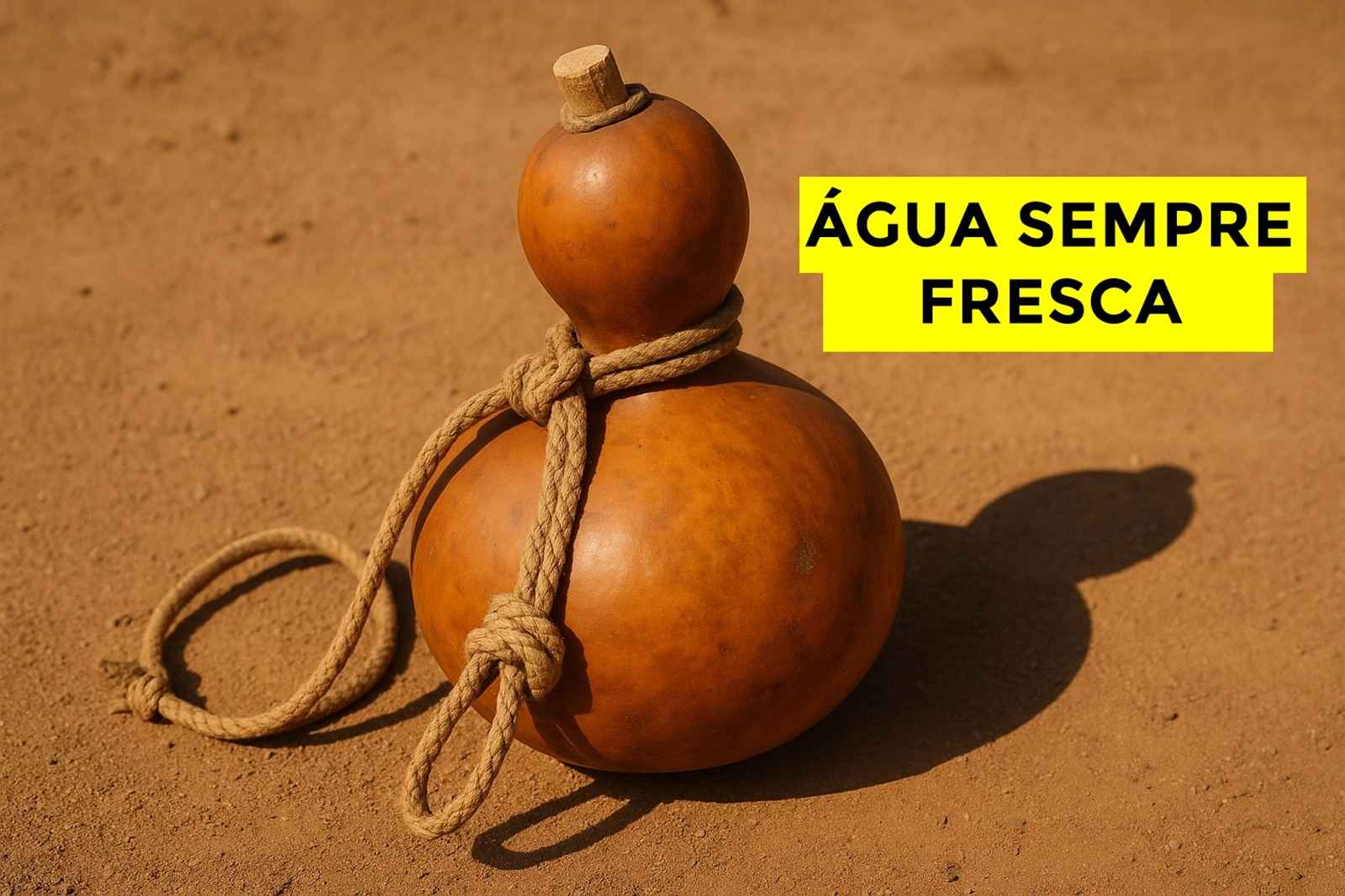


Before Modern Thermal Bottles Arrived in the Backlands, the Gourd Already Did the Work of Keeping Water Cool for Hours Under a Sun That Easily Exceeds 35 Degrees, Becoming One of the Most Important Objects in Northeastern Rural Life
The gourd, the fruit of Lagenaria vulgaris, assumed a role in the backlands that goes far beyond a container. For many, it was synonymous with survival in a territory marked by long distances, hard work, and extreme heat.
When ripe, it was left in the sun until it dried, losing its pulp and becoming completely hollow. This natural transformation produced a rigid, lightweight shell that was surprisingly efficient at preserving liquids.
The people in the backlands observed that the water transported in the gourd remained cool even during hours of walking between planted fields, hills, and pastures.
-
Bulk Carrier Docks at Brazil’s Coast, Marking First-Ever Cargo Unloading at Porto Piauí and Opening New Iron Ore Route to China After Over a Century of Logistical Challenges

-
Labor Shortage: Despite More Doctors Graduating in Brazil, Lack of Anesthesiologists Leads to Surgery Cancellations and Exposes Hidden Bottleneck in Hospitals
-
China’s Railway Marvel: A 1,956-Kilometer Journey Through Mountains, Frozen Lands, and High-Altitude Regions

-
Boeing Buys Back Spirit AeroSystems for $8.3 Billion After 737 Mid-Flight Door Incident


Cattlemen could cross entire fields while trailing cattle and, upon opening the container, still found pleasant water to drink. It was a simple and low-cost solution, but it fulfilled its role with precision.
Why It Was So Widely Used in the Northeastern Backlands
The gourd was a perfect combination of availability and utility. It was common to find the fruit in home gardens or in small cultivated areas around houses. Thus, any family could prepare their own container.
The process was artisanal: after drying, it was enough to remove the seeds, clean the inside, and seal the opening with a small cork made of wood or cloth.
Its reduced weight facilitated transport during long journeys. The shell’s durability prevented it from breaking with slight falls, allowing it to be tied to the waist, hung on the saddle, or carried by hand without worry. In addition, the gourd held up well to repeated use, lasting for months or even years.
In the Northeast, it also came to symbolize identity. It was seen in the fields, at fairs, during cattle events, and in walks seeking water from wells or reservoirs. Every family had their daily-use gourd, and many were decorated, polished, or shaped according to necessity.
The Science Behind the Gourd’s Efficiency
The effectiveness of the gourd in keeping water cold is not just tradition – it’s science. The shell has low thermal conductivity, which means it hinders the transfer of heat from the external environment to the inside of the container. Therefore, even exposed to the sun, the warming of the water occurs slowly.
Another crucial point lies in the internal structure of plant fibers. They contain microcavities of air, functioning as a natural insulator. Air, in itself, is one of the best thermal insulators, so these small pockets help further reduce heat transfer.
There is also the issue of natural porosity. In some gourds, a small amount of moisture dissipates through the shell.
This process generates evaporative cooling – the same principle that causes clay filters to make water cooler than the environment.
Combined with the opaque surface, which prevents heating from direct radiation, the gourd becomes a very efficient tool for the semi-arid climate.
A Symbol That Remains Alive
Even with modernization and the arrival of aluminum, plastic, and stainless steel bottles, the gourd has not lost its cultural value.
It remains present in craft fairs, in the production of musical instruments, and in the emotional memory of those who grew up in the backlands. It represents the creativity of a people who, in the face of the challenges of the semi-arid region, has always found intelligent solutions using the resources of their own land.