






 Portuguese
  Spanish


The Qinghai–Xizang Railway has been operating since 2006 and shows how Chinese engineering overcame obstacles that, for decades, were considered practically insurmountable
For those observing China’s great works, the question “what is impossible?” quickly ceases to be abstract.
It arises at stations, on bridges over deep valleys, and especially on the tracks that cross some of the planet’s most extreme regions.
In this scenario, few constructions represent this capability as well as the Qinghai–Xizang Railway, also known as the Qinghai–Tibet Railway.
-
Boeing Buys Back Spirit AeroSystems for $8.3 Billion After 737 Mid-Flight Door Incident

-
Nike’s Old Shoes Recycled into Courts, Tracks, Playgrounds, Gym Floors, and New Footwear in Program Transforming 67,000 Tons of Sports Waste into a Global Industry

-
Canadian Woman Who Donated Savings to Haiti Earthquake Victims at Age 5 Wins $48 Million in Lottery 13 Years Later
-
118-Year-Old Brazilian Man, Living in a Care Home for 55 Years, May Become World’s Oldest Man Pending Guinness Validation


The line connects Xining, in Qinghai province, to Lhasa, the capital of the Xizang Autonomous Region, known in Brazil as Tibet.
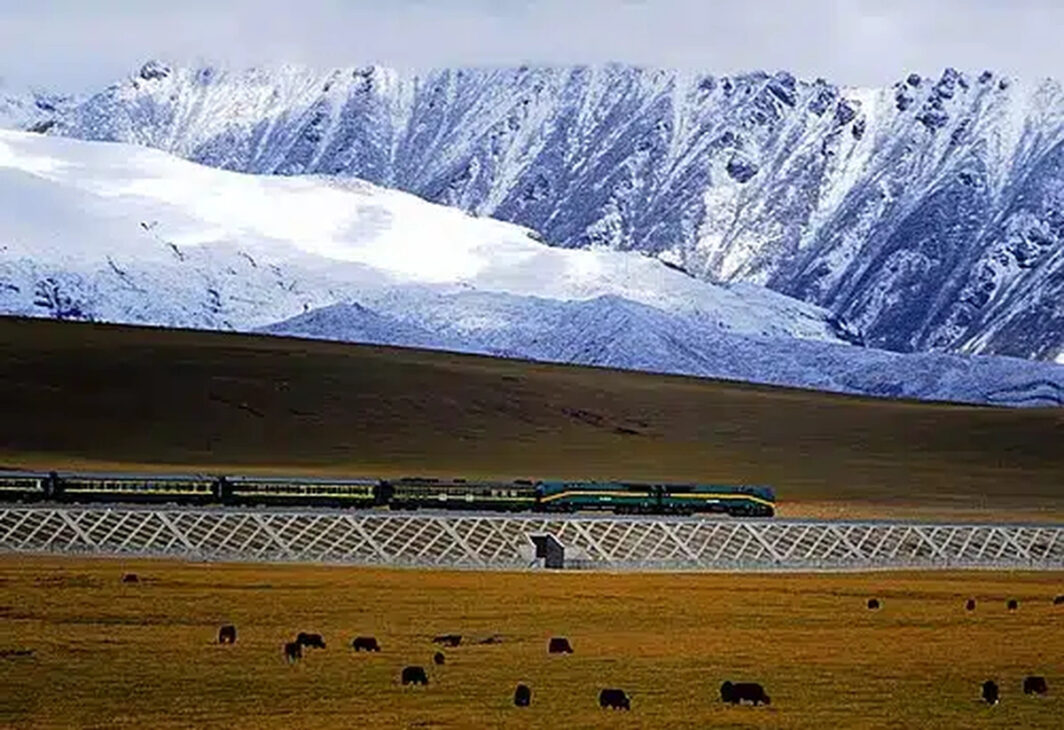
There are 1,956 kilometers of tracks, including approximately 960 kilometers installed above 4,000 meters. The highest point reaches an impressive 5,072 meters of altitude.
The railway that crosses the roof of the world
The scale of the work becomes apparent when the train begins to climb the plateau.
There, the tracks cross deserts, wetlands, snowy mountains, elevated fields and long stretches of frozen ground.
Therefore, the railway has become associated with the so-called “roof of the world”.
The construction was carried out in stages. Firstly, the section between Xining and Golmud was completed and began operation in 1984.
Subsequently, the section between Golmud and Lhasa was finalized in 2006.
Finally, full services began on July 1, 2006, according to the State Council of China.
Since then, the line has remained in continuous operation and is approaching two decades of service.
What the engineers had to face
The biggest obstacle was not just the distance.
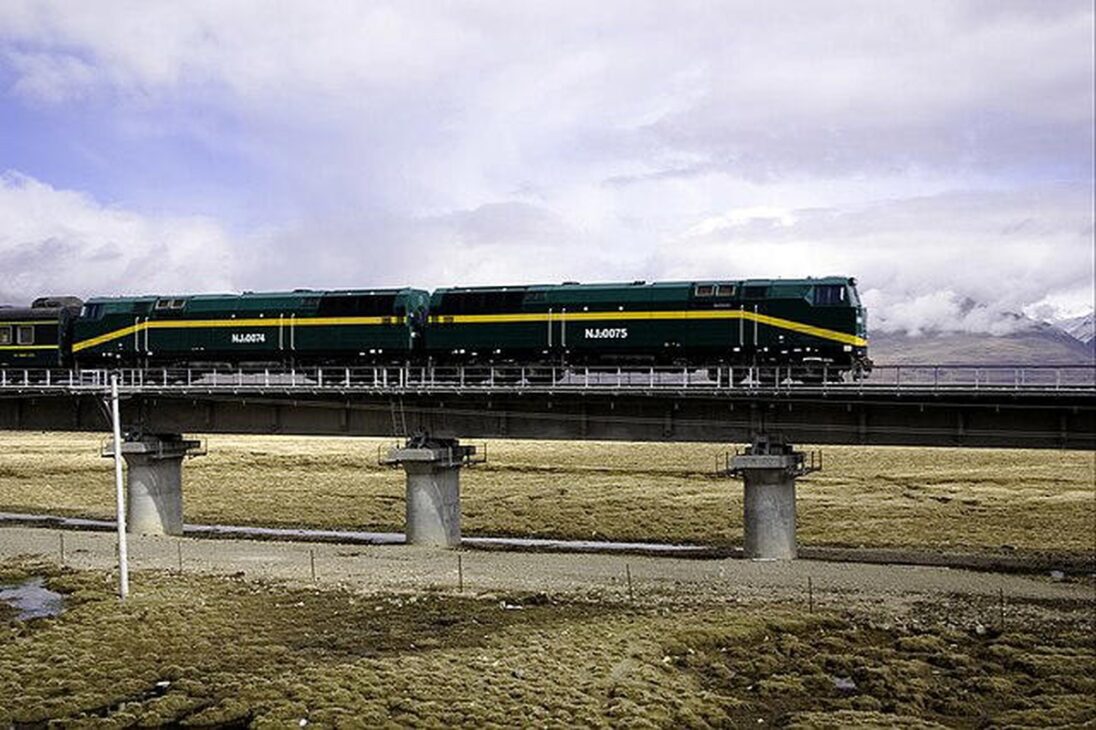
In practice, the workers had to build on permanently frozen ground, face extreme temperatures, and operate where there is low oxygen concentration.
Moreover, the environmental fragility of the plateau increased the complexity of the project.
Thus, each section required solutions capable of maintaining the stability of the tracks in a territory subject to severe thermal changes.
The main numbers help to understand the challenge:
- 1,956 kilometers between Xining and Lhasa;
- 960 kilometers above 4,000 meters;
- 5,072 meters at the highest point;
- 1,142 kilometers between Golmud and Lhasa;
- full operation started on July 1, 2006.

When engineering becomes a human story
The grandeur of this railway motivated the production of a video presented by Isabela, Xiaomiao Shi, and Rosana, Zhao Yan.
The work does not just show tracks, mountains, and technical structures.
Above all, the production addresses historical choices, time, scale, and human participation.
Even from a distance, there was also a small contribution to adapt the script to the Brazilian audience.
Thus, the video functions as a translation of different worlds and brings the viewer closer to an experience still little known in Brazil.
The discussion that reached South America
The impact of these works gained another dimension in 2025.
In that year, Brazil and China advanced in studies on a railway corridor between the Atlantic and Pacific oceans.
On July 7, 2025, the two countries signed a memorandum to develop studies on an integrated transport system.
According to the Ministry of Planning and Budget, the agreement includes a railway corridor between Brazil and Peru, with access to the Port of Chancay.
In this context, the debate also involves possibilities of integration with Peru, Colombia, and Chile.
Therefore, it’s not just about building tracks.
These routes can reorganize territories, economies, and connections between countries.
The Qinghai–Xizang Railway shows that some barriers disappear when knowledge, planning, and scale work together.
After all, often, the impossible is just the provisional name for what has not yet been accomplished.
And you, would you have the courage to travel on a railway situated over 5,000 meters above sea level? Tell us in the comments.


