Portuguese
  Spanish


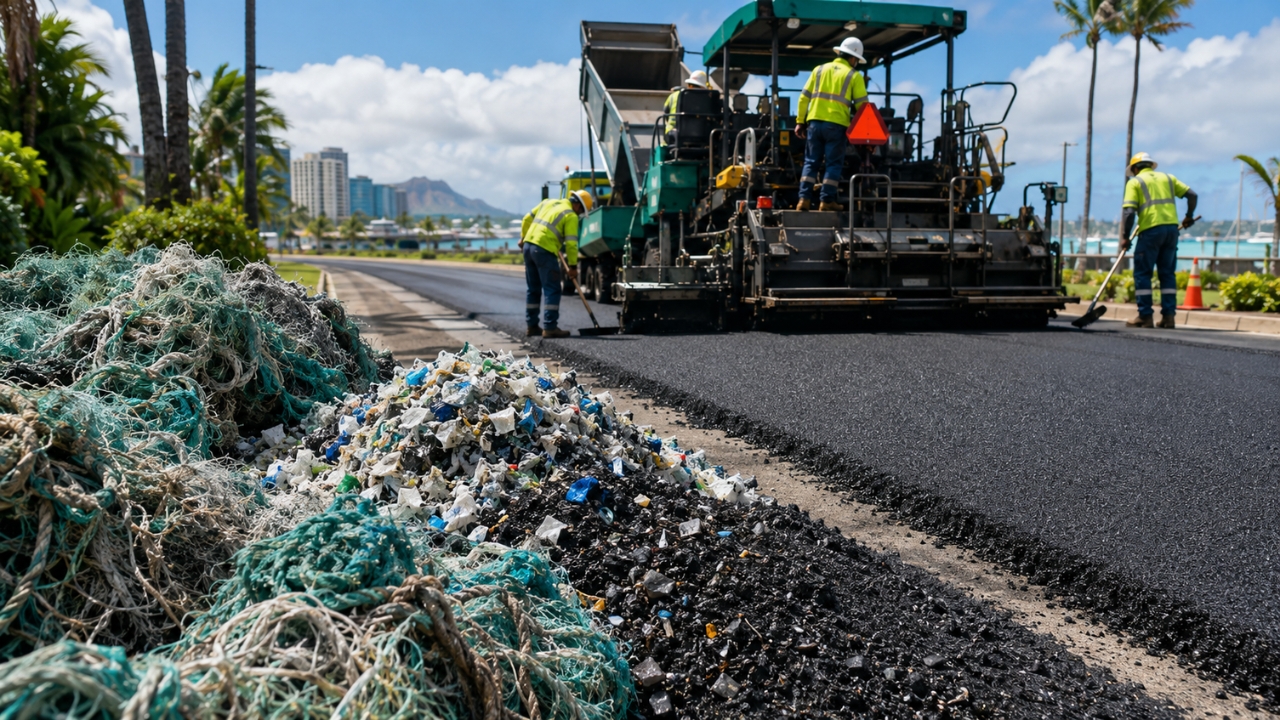

Researchers in Hawaii test an asphalt mixture made with recycled polyethylene from abandoned fishing nets and residential plastic waste, in an experiment that attempts to give urban use to materials difficult to reuse on the islands.
In Hawaii, researchers are testing an idea that seems to come from an impossible problem to hide: transforming abandoned fishing nets at sea and domestic plastic into part of the asphalt used on urban streets.
The research, presented by the American Chemical Society during the ACS Spring 2026 meeting, involves the Center for Marine Debris Research at Hawaiʻi Pacific University. The strongest point is not just in the reuse of waste, but in the initial result: after 11 months of traffic, the mixture with recycled polyethylene did not release more polymers than the traditional pavement analyzed as a control.
And there was another even more striking fact. According to the researchers, tire wear appeared as a much more dominant source of particles in road dust.
-
Is This the End of Smartphones? Mark Zuckerberg Unveils AI Glasses with Lens Display and Neural Bracelet Two Years Later, Shaking Up the Market Again

-
Astranis Builds Half-Ton Satellites, 20 Times Smaller and Cheaper, to Provide Internet to Alaska, Mexico, and the Philippines

-
General Motors Halts Self-Driving Car Service After $10 Billion Investment Following Pedestrian Incident in San Francisco
-
Scientists Discover Mysterious Black Fungus Thriving in Chernobyl for Nearly 40 Years, Challenging Extreme Radiation and Potentially Revolutionizing Space Missions


Abandoned nets and residential plastic enter the asphalt mixture
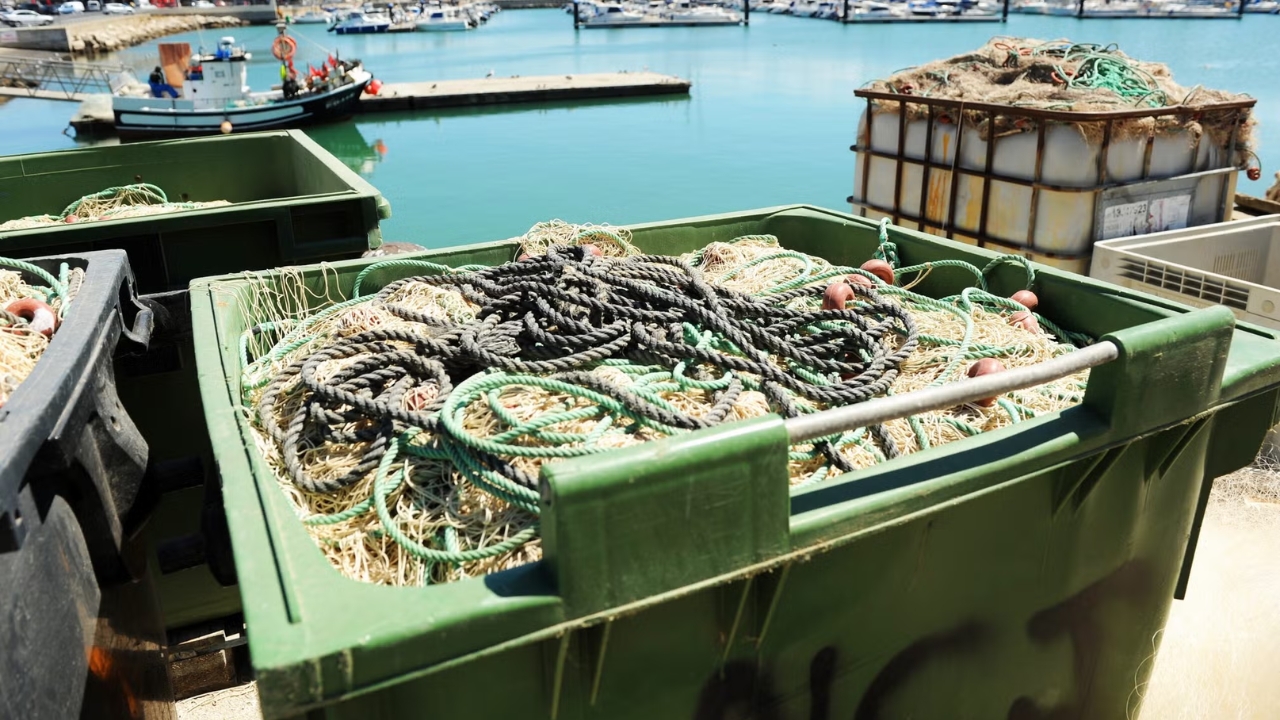
The project uses repurposed polyethylene from two main sources. One part comes from residential plastic waste collected in recycling containers in Honolulu. The other comes from fishing nets removed from the marine environment.
This material was processed by a U.S. company to be compatible with asphalt mixtures. It was then applied in experimental sections of a residential street on the island of Oahu, Hawaii.
The proposal is not simply to throw plastic on the road. The goal is to test whether waste that is difficult to recycle on the islands can have a longer and more useful destination, without increasing the problem of microplastics in the urban environment.
According to the American Chemical Society, since 2020 Hawaiian roads have predominantly used polymer-modified asphalt, known as PMA. The traditional formula uses SBS, a petroleum-derived copolymer, to improve elasticity, resistance to cracking, deformations, and water damage.
In Hawaii’s tropical climate, with heavy rain and constant wear, this type of performance is essential.
After 11 months of traffic, test did not indicate an increase in plastic particles
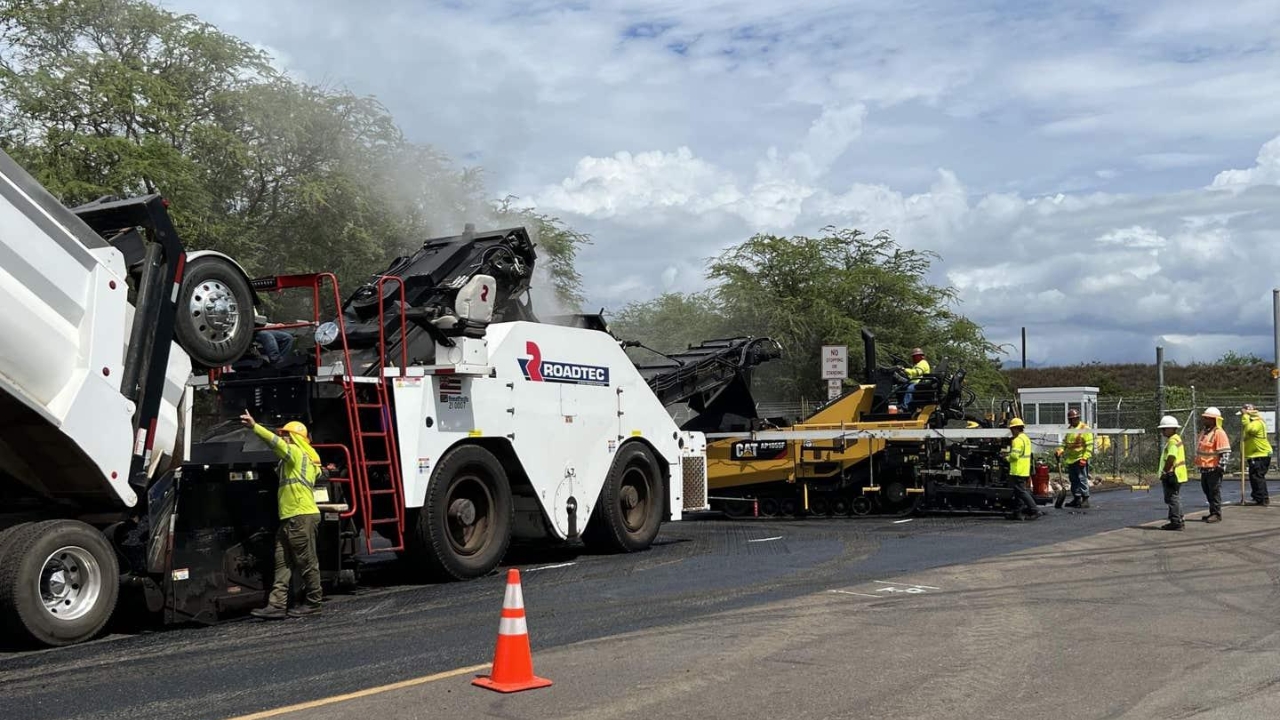
The big question was straightforward: if recycled plastic is placed in asphalt, can it come loose over time and become another source of pollution?
To answer this, researchers collected dust samples from the pavement after about 11 months of regular traffic. The comparison was made between sections with recycled polyethylene and control sections with SBS, the polymer used in traditional asphalt.
The first results released by the American Chemical Society indicated that pavements with recycled polyethylene did not release more polymers than the conventional pavement analyzed.
Simulations were also conducted with rainwater collected from the experimental sections. Researchers found particles in microplastic size, but few were identified as polyethylene, regardless of the type of pavement.
The team’s hypothesis is that the polymers are fused into the asphalt binder. Thus, the particles detached from the road would not be pure plastic, but a mixture of rock, binder, and polymer chains incorporated into the material.
Tires appeared as the dominant source in road dust
The most surprising data came from the comparison with the tires.
The team used a technique called Py-GC-MS, which combines pyrolysis, gas chromatography, and mass spectrometry, to identify polymers present in the samples.
According to Jennifer Lynch, a researcher cited by the American Chemical Society, the signal caused by tire wear overshadowed the polyethylene signal by orders of magnitude. In practice, tires appeared as a much stronger source of polymers in road dust than the recycled plastic itself incorporated into the asphalt.
This detail shifts the focus of the discussion. The initial concern was the reuse of plastic in pavement, but preliminary data pointed to a daily, silent, and constant source: the friction of tires with the asphalt.
Project began on Oahu road with the equivalent of 195,000 plastic bottles


Hawaiʻi Pacific University reported that the first experimental plastic road in Hawaii was tested in October 2022, on Fort Weaver Road, in Ewa Beach, on the island of Oahu.
In that pilot, 1,950 tons of modified asphalt were used. The amount of plastic added was equivalent to 195,000 plastic bottles. Still, the weight of the plastic represented only 0.05% of the final pavement.
After the application, researchers and students simulated rain over the pavement to collect surface runoff and investigate if microplastics or synthetic substances could be released.
The university highlighted that, visually, the road looked and behaved like a regular asphalt road in Hawaii.
Program removed 84 tons of abandoned fishing equipment
The experimental asphalt is also connected to the Bounty Project, an initiative of the Center for Marine Debris Research that pays licensed commercial fishermen to remove abandoned fishing nets and equipment in the Pacific Ocean.
According to the American Chemical Society, the program had already removed 84 tons of large abandoned fishing equipment from the ocean.
Hawaiʻi Pacific University detailed that, in just over three years, more than 185,000 pounds of equipment were collected, equivalent to about 84 metric tons. The project recorded more than 690 recovery events, involved 77 commercial fishermen, and totaled more than 2,100 hours of volunteer work.
Within the experimental project called Nets-to-Roads, 2,323 pounds of recovered equipment were shredded and recycled in Ewa Beach.
Hawaii tries to solve a problem that arrives by ocean
The challenge is greater because Hawaii is in the middle of the Pacific and receives debris brought by ocean currents.
Hawaii Sea Grant reports that hundreds of tons of damaged or abandoned nets become entangled in Hawaiian reefs or wash up on beaches every year. In a cleanup action carried out in 2021, near the Papahānaumokuākea Marine National Monument, a 50-ton mass of plastic, mainly formed by fishing nets, was removed.
The same source points out that many of these nets are not locally generated, which makes educational actions directly with those who discarded the material difficult.
Therefore, the plan involves a broader chain: detecting, documenting, removing, transporting, storing, separating, and reusing the debris.
Study shows that benefit depends on how plastic is used
A life cycle assessment study published in 2026 and cited by ScienceDirect analyzed strategies for abandoned fishing nets and post-consumer plastics in Hawaii.
The result indicated that local mechanical recycling reduces environmental impacts compared to processing on the mainland. For abandoned fishing nets, recycling on the islands reduced the global warming potential by about 75% compared to processing outside of Hawaii.
But there is an important caveat. The study also showed that partially replacing virgin SBS with recycled high-density polyethylene in the asphalt binder can reduce the global warming potential by up to 12.6%. However, simply adding recycled polymers without replacing virgin materials can increase impacts.
In other words, the solution does not just depend on using recycled plastic. It depends on how, where, and for what purpose it is used in the mix.
Test still needs to prove durability before growing
The American Chemical Society itself states that more research is needed to assess the durability of the pavement over time.
Science News also highlighted that the formula needs to be adjusted to the Hawaiian context, marked by tropical climate, heavy rains, and geological conditions different from those found on the mainland United States.
For now, what exists is a promising sign, not a definitive solution.