Portuguese
  Spanish





The River Sand Crisis Accelerates the Search for Alternatives, and a New Material Using Desert Sand Gains Strength by Withstanding Sulfate Attacks and Promising Application in Coastal Environments.
The construction industry may be on the brink of an important turnaround. River sand, the basis of traditional concrete, is increasingly questioned due to the environmental impacts linked to intensive extraction. This scenario fuels the search for alternatives that reduce pressure on ecosystems and supply chains.
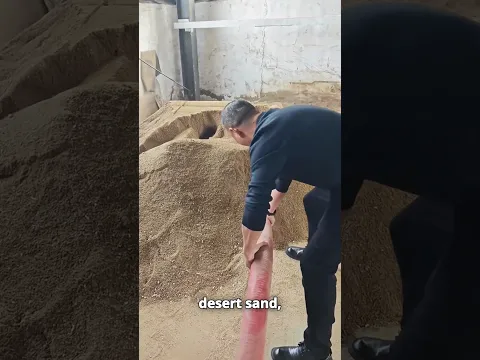
It is precisely at this point that desert sand enters, an abundant resource that has been underutilized on an industrial scale. Despite occupying vast areas on the planet, it has always been seen as “difficult” for concrete. The reason lies in how it is produced by nature: the wind leaves the grains ultra-fine and very uniform.
Why Desert Sand Has Always Been a Challenge
Those who explain this obstacle clearly are Ren Wei, a postdoctoral researcher in the Department of Civil and Manufacturing Engineering at NTNU. In a statement, he emphasizes that desert sand is often too fine to work well as a structural component in conventional concrete.
-
She spent 73 years breathing inside an iron lung, survived the aftereffects of polio, and became the last woman in the United States dependent on the equipment before dying at 78 years old.

-
Brazilian students created a $1 filter using pine bark, cotton, and 3D-printed parts to clean cassava wastewater, reduce the toxicity of a hazardous waste, and transform contaminated water into biofertilizer.

-
Astronaut from Artemis II steps down after mission to the Moon and decision surprises after a record of 406,771 km, a historic 10-day journey, and an unprecedented achievement for Canada.

-
A fossil kept for years in a small museum in Montreal concealed 450-million-year-old soft tissue, a discovery that has only happened once before in history.


According to Ren Wei (NTNU), when the material does not “fit” as it should, concrete can lose hardness and performance. This lack of angularity and texture makes it difficult for particles to interlock, reducing final strength. For this reason, the idea remained more in the realm of hypotheses than practical application for years.

What Changed: Engineering to “Tame” the Sand
The recent advancement comes from a more technical approach: instead of trying to use desert sand as it is, researchers began working with pre-treatment and grain size control. The proposal is to adjust the grain size distribution and combine the material with additives to enhance performance.
This line of research mentioned in the article indicates that, with the right adjustments, it is possible to obtain more efficient mortars and concretes. The credibility of this path, within the original text, is based precisely on Ren Wei (NTNU)’s explanation of the problem and the report of results obtained with new techniques.
Biotic Concrete: The Material That Replaces Cement
One of the central points of the study described in the article is the so-called “biotic concrete”. It is produced from finely ground sand powder, followed by hot pressing, and combined with wood. The proposal attracts attention because, according to the text, the process can be done without relying on traditional cement.
To assess whether the material actually works, researchers tested different formation conditions. The article reports variations in temperature, mixture proportions, applied pressure, and processing time, measuring how this impacts flexural strength and density. This set of tests is presented as the basis for asserting the potential of biotic concrete.
Tests, Microscopy, and Industrial Standards
The text also mentions that five types of sand were analyzed, including desert sand, to check how each one alters the result. To view the internal structure of the material, scanning electron microscopy was used. This allowed for the observation of microscopic details that help explain why the material behaves better under certain conditions.
According to the article, the results were sufficient to meet, in most scenarios, Japanese industrial standards for paving blocks. This type of reference is important because it brings the research closer to real-world market use. Nevertheless, the text does not provide the name of the scientific journal nor the DOI of the study.
When a “Defect” Becomes an Advantage
An interesting detail is that two characteristics previously viewed as negative can help in the performance of biotic concrete. The high fineness and alkalinity of desert sand, cited in the article, have begun to be interpreted as factors that enhance the bonding and performance of the material in this new format.
This interpretation is reinforced by the assessment of Maher Omar, a Civil Engineering professor at Sharjah University. In the article, Maher Omar (Sharjah University) reports tests under aggressive chemical exposure and describes the resistance of alkali-activated bricks.
Sulfate Resistance: A Strong Point for Coastal Areas
Maher Omar (Sharjah University)’s remarks draw attention for a practical reason: sulfate attack is a known problem in coastal and marine environments. According to him, alkali-activated desert sand bricks maintained integrity and, in key cases, outperformed cement-based bricks.
This information is relevant because sulfate-rich soils and groundwater can accelerate the deterioration of structures. By citing Maher Omar, the article attempts to demonstrate that the solution is not only sustainable but also resilient in challenging conditions. This helps enhance the credibility of the material’s potential.
Why This Could Change Construction in Arid Regions
The text points to biotic concrete as a sustainable and potentially cheaper alternative, especially in desert regions. In these areas, conventional materials may be scarce, expensive, or reliant on long supply chains. The idea of utilizing local resources makes the model more viable.
The article reinforces this view by mentioning that the production process tends to be relatively simple. Ren Wei (NTNU) appears again to emphasize that, in principle, the material could be produced in many places, as long as it undergoes additional testing. This observation brings the topic closer to potential large-scale application.
Agricultural Waste: The Next Most Promising Step
Another point projected for the future is the use of agricultural waste as raw material instead of wood waste. The text describes that agriculture in desert regions has evolved with new techniques and, at the same time, the accumulation of organic waste has become a problem. Burning this waste increases emissions and harms ecosystems.
By proposing the incorporation of this waste into biotic concrete, the article suggests a circular economy route. It is a way to reduce waste and pollution while creating a local input for construction. Although the idea still depends on studies, it is presented as a logical path for arid regions.
The Final Challenge Before Becoming a Reality
Even with promising results, the article makes it clear that there are still pending steps. Ren Wei (NTNU) states that further assessments will be necessary, including cold resistance tests, before the material can be used. This detail is important to keep the text realistic and trustworthy.
If the next tests confirm performance and durability, biotic concrete could become an example of sustainable innovation. The credibility of the account, in the original article, primarily relies on the nominal statements of Ren Wei (NTNU) and Maher Omar (Sharjah University). Consequently, desert sand could cease to be “useless” and become a protagonist in the construction of the future.