






 Portuguese
  Spanish


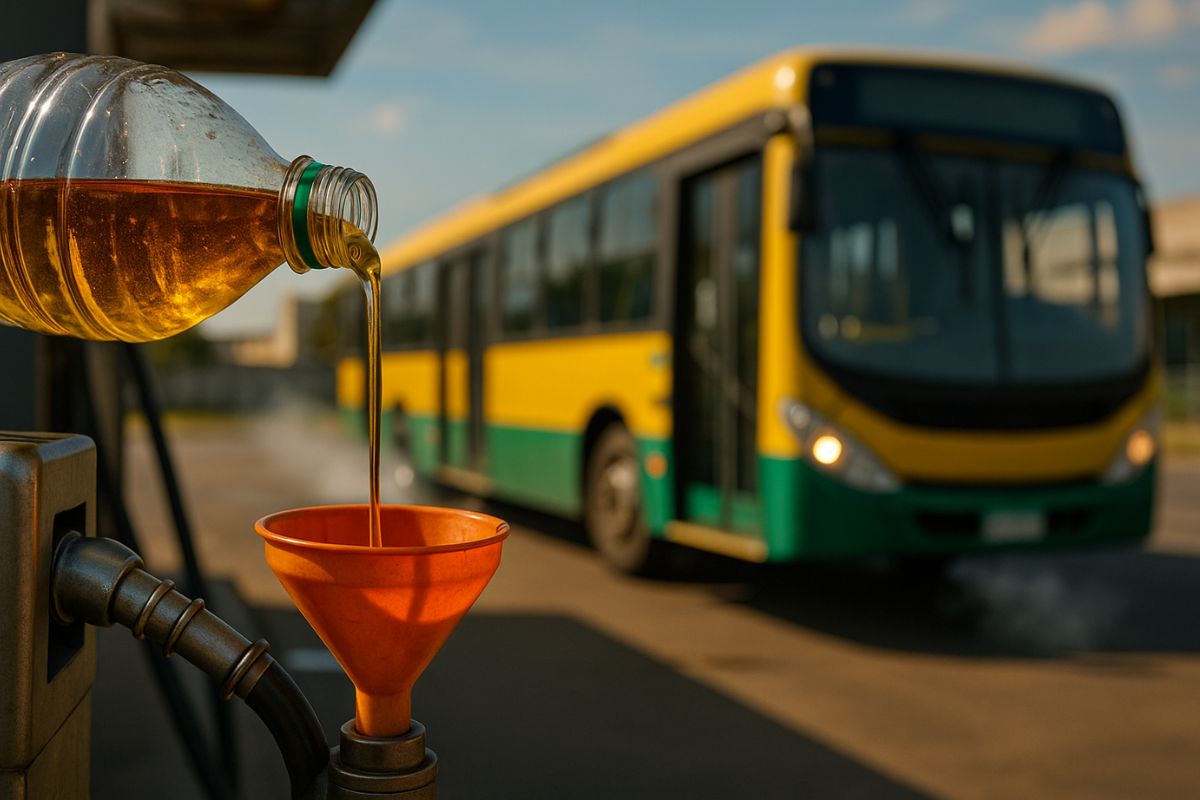


Initiative in Juiz de Fora Transforms Used Cooking Oil into Sustainable Fuel, Tested in Vehicles with Potential to Change the National Energy Matrix.
The used cooking oil is now being converted into fuel in Juiz de Fora (MG), thanks to a student initiative that combines environmental education, innovation, and sustainability. The project “De olho no Óleo,” developed by students from Senac in partnership with the Federal University of Juiz de Fora (UFJF) and the Regional Center for Innovation and Technology Transfer (Critt), has already transformed 77 liters of discarded oil into biofuel, used in municipal vehicles during a pilot phase.
The proposal goes beyond simple recycling: the produced fuel shows how household waste can be repurposed to generate clean energy, reducing urban pollution and creating new possibilities for the Brazilian energy matrix.
How Used Oil is Transformed into Fuel
The process starts with the collection of used cooking oil by students and the community.
-
Brazil’s Longest Train Journey Resumes: 664 km Overnight Trip Connecting Two States, 13-Hour Duration, Tickets at $17, Ends Near Beaches

-
Brastemp Unveils Revolutionary Appliance That Cleans Clothes and Phones, Uses Soap Monthly, Smooths Wrinkles, and Eliminates 100% of Dust Mites and 99.9% of Bacteria
-
Brazilian City Provides 296 Apartments Worth $62.9 Million to Families Living in High-Risk Areas, Ending Over 20 Years of Waiting for Decent Housing
-
Tourist Discovers Forgotten Joaquín Sorolla Painting Worth Up to 60,000 Euros While Strolling in Seville


Often incorrectly discarded in sinks and drains, this waste can pollute up to 20,000 liters of water per liter discarded.
Instead, the material is sent to a mini biofuel plant installed at the technological park of UFJF.
The experimental production is the result of a partnership with the EPROS Institute of environmental education.
The oil undergoes chemical processes that transform it into biodiesel, a renewable fuel capable of partially replacing fossil diesel.
This technology is already used in European countries and is beginning to gain ground in Brazil, demonstrating that household waste can be strategic resources.
Education, Citizenship, and Social Engagement
In addition to the technical aspect, the project also has an educational character.
Students mobilized peers, teachers, and staff to collect oil from their homes.
The goal is to show that small individual actions can generate large collective transformations.
According to Aline Nascimento, campaign coordinator, the experience reinforces the role of education in changing habits.
“When the student understands that the oil they brought from home can become fuel for a city vehicle, they realize their power of transformation. This experience generates belonging and environmental awareness,” she explained to Tribuna de Minas.
Environmental and Economic Impacts of the Initiative
The environmental impact is immediate: preventing used oil from reaching the sewage system means reducing blockages, maintenance costs, and, most importantly, protecting water resources.
Economically, initiatives like this can create new markets, generate jobs, and stimulate businesses related to reverse logistics and renewable energy.
The initiative also involved a sustainable fair with local entrepreneurs from the group “Só Delas,” showing how the green economy can connect with other sectors and create income opportunities in urban communities.
Does the Future of Energy in Brazil Depend on Biofuels?
Brazil is already a world reference in the use of biofuels, especially with ethanol. But recycled oil opens new perspectives.
The country is one of the largest soybean producers in the world, the basis for much of the oil consumed internally.
If applied on a large scale, repurposing this waste could diversify the energy matrix, reduce emissions, and decrease dependence on fossil fuels.
Scientists and experts argue that, with institutional support and appropriate public policies, projects like the one in Juiz de Fora can be replicated in other Brazilian cities.
The integration between universities, schools, businesses, and society is seen as key to transforming local experiences into national solutions.
A Change That Can Start in the Kitchen
What started as a test with only 77 liters of oil already serves as an example of sustainable innovation.
Transforming household waste into fuel is not just an environmental solution, but also a model for economic and social development.
And you, do you believe that fuel made from used cooking oil can truly change the future of energy in Brazil? Would you participate in a similar project in your city? Leave your opinion in the comments — your perspective can enrich this debate.





No rio grande sul já tem em pelotas