





 Portuguese
  English
  Spanish
  3 min of reading
  0 comments


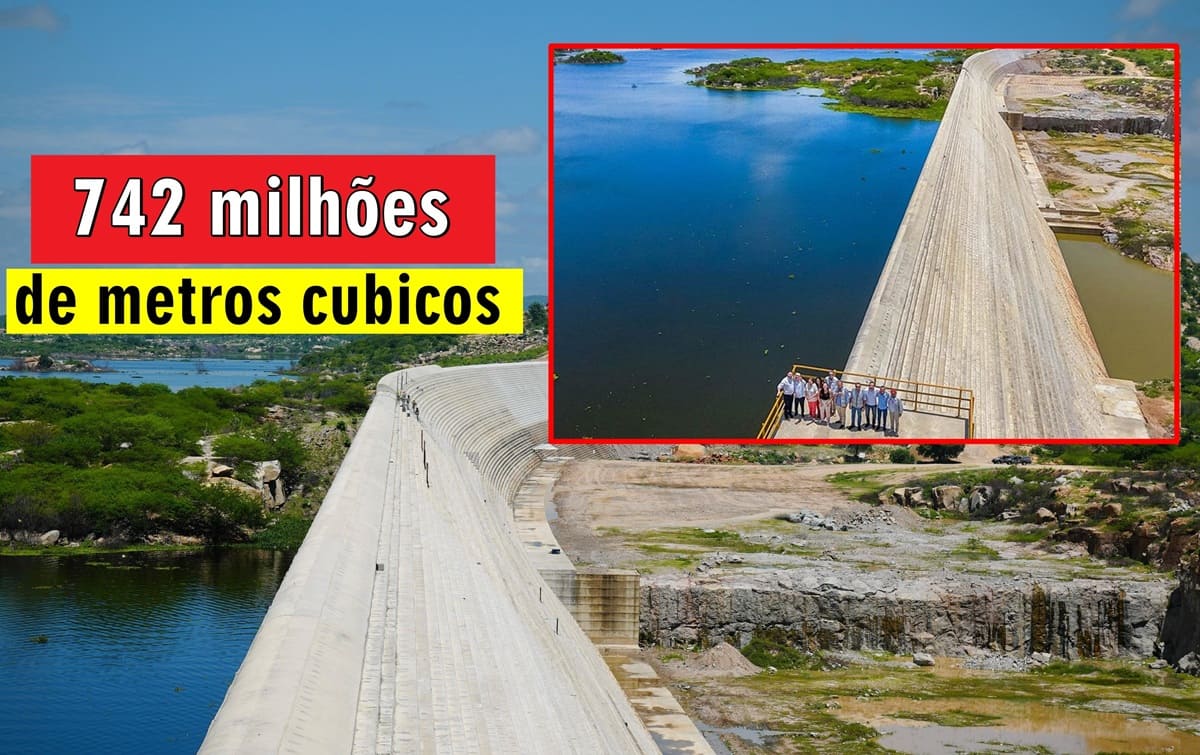
Meet the Recently Inaugurated Dam With an Investment of R$ 893 Million — Capacity of 742 Million m³ Promises Regional Water Security.
A long concrete strip nearly five kilometers long cuts through the arid landscape of the Potiguar caatinga. This is the new scenery of the Seridó region in Rio Grande do Norte, where the Oiticica Dam was recently inaugurated, one of the largest water projects in the state.
After 12 years of construction and decades of planning, the reservoir is now operational with the capacity to benefit up to two million people.
A Project That Crosses Generations
The idea of building the dam first emerged in 1952, when the National Department of Works Against Droughts (Dnocs) developed the initial project.
-
Retiree who returns to work loses the INSS benefit? See when it is possible to accumulate retirement with other benefits without having the payment blocked

-
Two gigantic and ancient masses, one beneath Africa and the other beneath the Pacific, have rested at the bottom of the Earth’s mantle for at least 500 million years, and one of the most fascinating hypotheses suggests that they are remnants of the planet that collided with Earth and formed the Moon.

-
A giant brown band visible from space, approximately 8,850 kilometers long, connected Africa to America in the Atlantic Ocean, and satellites revealed that it is neither land nor pollution, but the largest accumulation of seaweed in the world, which broke records in 2025.
-
Up to R$ 10,000 is what some ads are asking for the golden and extremely rare Cristiano Ronaldo sticker from the 2026 World Cup album, an exclusive edition from the United States and Canada that has become a coveted item among collectors on the eve of the tournament.



However, it wasn’t until 2013 that official construction started. It was many years marked by technical challenges, bureaucratic hurdles, and protests from local communities.
During execution, the project underwent various adaptations to meet the needs of the affected population.
The construction mobilized 249 workers over more than a decade. An essential part of the São Francisco River Integration Project (PISF), the Oiticica Dam was finally inaugurated on March 19, 2025.
Water for the Semiarid
The structure was built in the bed of the Piranhas-Açu River, in the municipality of Jucurutu.
The dam’s primary purpose is to ensure water security for the Seridó region, known for its long droughts and semiarid climate.
According to Dnocs, the reservoir can supply water to up to 2 million people and already directly benefits 294,000 residents from 22 municipalities.
Currently, the reservoir is at 10% of its total capacity, holding about 74.7 million cubic meters of water. With the closure of the central section and the completion of the spillway, its total capacity increased from 75.56 million to 742 million cubic meters.
In financial terms, the project received R$ 893 million in historical values. Of this total, R$ 161 million came from the New PAC. In 2024, the Federal Government invested R$ 46 million to complete the remaining 5% of the work.
Development for the Region
The dam will boost various economic activities in Seridó.
The revitalization of 750 hectares in the irrigated perimeters of Itans, Sabugi, and Cruzeta is planned.
The irrigated perimeter of Mendubim will also be implemented, covering about 3,000 hectares. Besides agriculture, the structure is expected to promote fish farming, electricity generation, and tourism.
The new dam is now the second-largest reservoir in the state, surpassed only by the Armando Ribeiro Gonçalves Dam.
Its operation will be fundamental for water balance in the Potiguar semiarid region and for coping with the effects of climate change.
Social Impact and Resettlement
The construction required the resettlement of around 4,000 people, including residents of the former community of Barra de Santana.
They were relocated to Nova Barra de Santana, a village built near the dam wall, complete with housing, a school, a health center, and leisure areas.
The transition was not easy. During the process, there were protests and mobilizations from residents demanding better living conditions before the move. After years of negotiations, the new village was delivered in 2022.
Additionally, the Oiticica Complex includes other projects, such as the Agrovila de Jucurutu, which has already been completed, and the Agrovilas de Jardim de Piranhas and São Fernando, which are still pending. The construction of the Adutora do Agreste Potiguar is also planned, with the service order already signed.
Reinforcement to the São Francisco Integration Project
The strategic importance of the Oiticica Dam is also highlighted by its direct connection to the São Francisco River Integration Project.
The dam helps to distribute the waters of the São Francisco more efficiently, ensuring water security not only for Rio Grande do Norte but for the entire northeastern semiarid region.
The water intake from the São Francisco Transposition has already been completed as part of the Oiticica Complex. This connection strengthens the reservoir’s role in supplying communities and controlling floods.





-

2 people reacted to this.