






 Portuguese
  Spanish


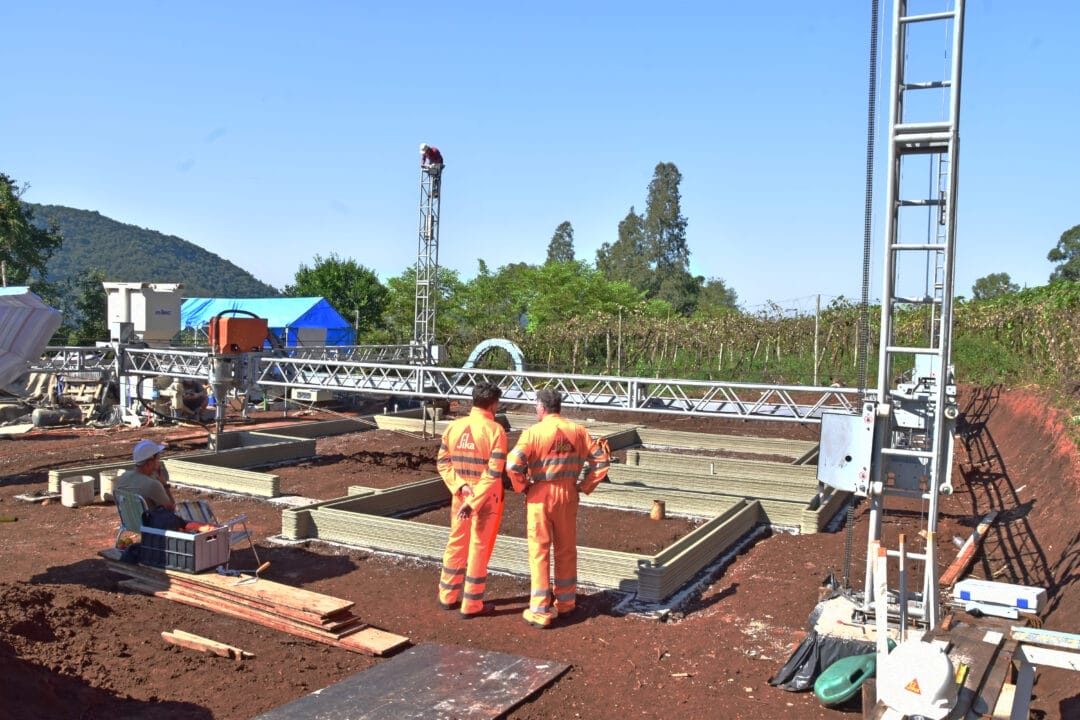

3D Printed Concrete House in RS, Using SikaCrete® 3D. Sustainable Project, 30% More Affordable, with Thermal Insulation, Built in 60h.
A concrete house entirely built in 3D was erected in Rio Grande do Sul, using SikaCrete® 3D microconcrete. This innovative and sustainable project involved a partnership among three Brazilian companies, resulting in a building that is 30% more affordable and has excellent thermal insulation properties. The construction was completed in just 60 hours.
This 3D construction project, an advanced form of additive manufacturing, stands out for the application of microconcretes specifically developed for microconcrete line. Sika, a global leader in the sector, has once again demonstrated its commitment to innovation and sustainability. More efficient procedures and high-quality materials were key to the success of this cutting-edge project.
Innovations in the Construction Industry
Sika is a company specialized in chemical products, being the leader in the development and production of fastening, sealing, damping, reinforcement, and protection systems and products in the construction sector, as well as in the automotive industry. It has subsidiaries in 103 countries and over 400 plants worldwide. With a team of more than 33,000 employees, the company generated annual sales of CHF 10.49 billion in 2022. In Brazil, the company also holds brands such as Baucryl®, BR Massa®, Ciplak®, LigamaxGold, PortoKoll®, Quartzobrás®, and Qualimassa®, offering complete solutions for construction, from the foundation to the finishing.
-
99Food Under Investigation by Brazilian Consumer Protection Agency for Lack of Price Transparency, Faces Potential $2.8 Million Fine

-
U.S. City Builds Tiny Home Village on Water Company Land to House 136 Homeless People: Inside the Social Housing Units

-
Woman Turns Shipping Container into Home, Embraces Rural Life to Cut Monthly Expenses to Just Over $330
-
France Revamps 530 Social Housing Units with Large Balconies and Glass Facades Without Demolishing Existing Buildings




3D Construction Project in Rio Grande do Sul
Located in the rural area of Caxias do Sul, Rio Grande do Sul, a single-story house of 80 square meters was built. This residence has two bedrooms, a bathroom, a living room, a kitchen, and a laundry area. Manfredo Belohuby, Regional Manager of Innovation and Digitalization at Sika, commented on the construction: ‘The first construction is a success. The house was completed in about 60 hours and did not use wood, nails, or reinforcements to raise the 4.5-meter-high walls. Only one worker was needed to supervise the printing’. He also highlighted that this method is faster and more economical compared to traditional construction methods, promoting savings in labor, materials, and time.
Partnership and 3D Printing Equipment
The residence was built using a specific 3D printer for construction, developed by the gaucho company 3D Printek, based in Caxias do Sul. This robotic technology is combined with a control system that ensures the technical quality of the concrete during printing. m-tec, a company from Indaiatuba, São Paulo, provided the pumping and dosing system. The 3D printing structure is a truss that deposits the concrete layer by layer, saving material and minimizing waste.
Use of Microconcrete and Sustainability
For the construction of the house in Caxias do Sul, about 20 tons of concrete were used, all controlled by computer. Sika Brazil provided the specific raw material for printing, SikaCrete® 732 3D. This microconcrete was developed for fast, precise, and economical printing. It is a cementitious powder with fibers and polymers, a one-component material that only needs to be mixed with water, providing high compressive strength, high printing speed, and adjustable setting time. Furthermore, the 3D construction process is more sustainable, reducing waste and environmental impact compared to traditional concrete blocks and bricks.
Advantages of 3D Construction
In addition to material savings, there is practically no waste in the process, as stated by Manfredo Belohuby: ‘You practically have no material waste, once you put the right amount in the equipment, you don’t lose any material’. The house in Caxias do Sul was about 30% cheaper in terms of masonry, compared to a house of the same size built by traditional methods. Other advantages include better thermal and acoustic insulation and lower maintenance costs. In addition to the walls, the foundation was also printed with the same digital printing technology. The electrical and plumbing installations, as well as the finishing, are done according to the preferences of the owner or the construction company.
Growth of 3D Printing Technology
The technology of additive manufacturing, popularly known as 3D additive construction, is emerging as a transformative innovation in the construction industry. Entrepreneurs and institutions are exploring this technology to revolutionize the construction of houses, buildings, and various infrastructures. In Franca, in the State of São Paulo, new houses will be built using the same technology. The company Free Form has acquired a printer from 3D Printek, along with a pumping and dosing system from m-tec and products from the SikaCrete® 3D line to build ten houses that are already sold.
Future Potential of 3D Construction
Manfredo Belohuby sees great potential in additive construction for affordable housing, such as the Minha Casa Minha Vida projects, aimed at reducing the housing deficit. Other applications include urban furniture and infrastructure. 3D construction offers endless possibilities, allowing for the creation of curved rooms and custom objects, which are unfeasible with traditional methods. From smaller components, such as urban furniture, to large buildings and civil infrastructure, this technology can transform construction as we know it.
Feasibility and Benefits of 3D Construction
The house in Caxias do Sul was an example of the advantages of additive construction: labor savings, material efficiency, rapid construction, and design freedom. Additionally, sustainability is heightened due to waste reduction and lower environmental impact. These innovations promise to transform the industry, making housing construction more accessible and efficient, especially for affordable and low-income housing.
Manfredo Belohuby, Regional Manager of Innovation and Digitalization at Sika, stated: ‘The process is faster and cheaper than traditional construction methods.’ This statement sums up the revolution that 3D construction is bringing to the industry, with significant economic and sustainability gains.
Source: francine@comunic.com.br









Quero mais informações
Tenho interresse em construir sala comercial neste metodo!
Gostaria de conhecer esta casa.
Poderia me fornecer o endereço da casa ?