






 Portuguese
  Spanish


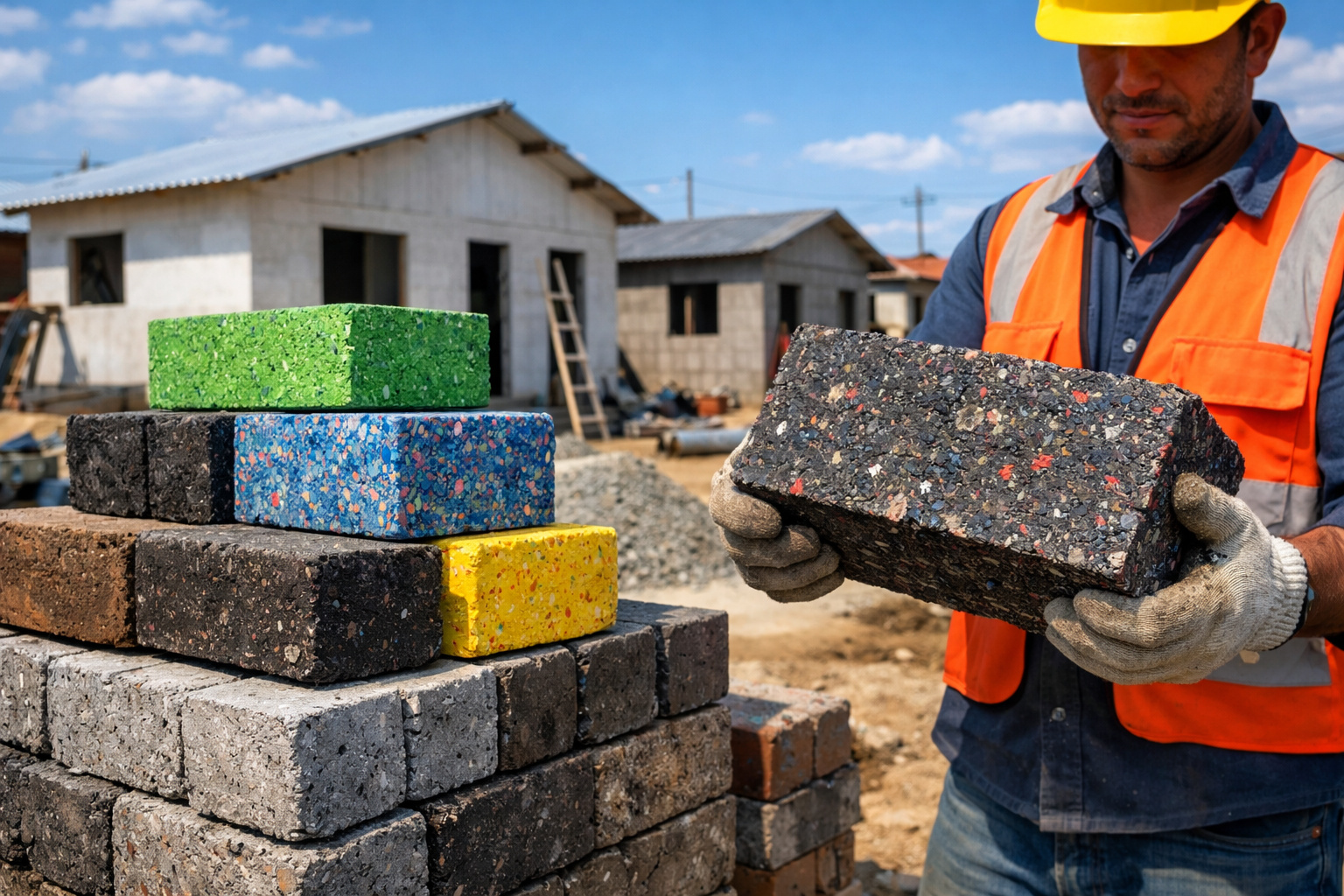


Blocks Made From Recycled Plastic and Industrial Waste Are Already Being Used to Build Cheaper, Faster, and More Sustainable Houses in Brazil and Worldwide.
In Carapicuíba (SP), Brazil, in projects that began in 2019, houses started to be built with blocks made of recycled plastic, replacing conventional ceramic bricks and drastically reducing the use of Portland cement. The initiative involved the NGO TETO Brasil, the company Fuplastic and institutional partners, with technical support and coverage by media outlets such as Revista Casa Abril. At the same time, similar experiences were advancing in countries such as Colombia, South Africa, the United States, and Mexico, supported by universities, engineering startups, and international housing and sustainability organizations.
These projects are not conceptual: they involve real houses, inhabited, built from plastic waste, industrial ash, slag, and materials previously discarded, now transformed into modular structural blocks.
The Structural Problem of Traditional Brick and Portland Cement
The construction industry accounts for about 37% of global CO₂ emissions, according to UN data. One of the main contributors is Portland cement, whose manufacturing process involves the calcination of limestone at high temperatures, releasing large volumes of carbon dioxide.
-
21-Year-Old Moves Back to Parents’ Home in Arizona, Finds New Private Apartment in Converted Garage as Families Tackle U.S. Housing Pressures

-
Innovative Container Studio in Brazilian Beach Town Thrives with High Demand and Plans for Expansion
-
30-Square-Meter Container Home with 2 Bedrooms, Living Room, Kitchen, and Bathroom Sold for $12,000 in Brazil, Tour Reveals Project Details

-
Brazilian Couple Builds Eco-Friendly Brick House, Saves 41%, and Shares Simple Test to Check Soil Suitability


Furthermore, traditional ceramic bricks:
- Require firing in high-temperature kilns
- Consume large amounts of energy
- Depend on continuous clay extraction
- Cause significant losses during transportation and laying
In countries with high housing deficits, these costs make formal housing expensive, slow, and environmentally burdensome.
How Blocks Made From Recycled Plastic and Industrial Waste Work
The alternative blocks used in these projects are not improvised. They follow well-defined materials engineering principles.


Recycled Plastic Blocks
Companies such as Fuplastic (Brazil) and Conceptos Plásticos (Colombia) utilize:
- Post-consumer plastics (PET, HDPE, PP)
- Crushing, washing, and controlled melting
- Molding into modular blocks with interlocking
These blocks:
- Do not require traditional mortar
- Function through an interlocking system
- Reduce construction time by up to 60%
- Are resistant to moisture, fungi, and insects
Use of Ashes, Slag, and Mineral Waste in Construction
In addition to plastic, several projects incorporate industrial waste:
- Fly ash from thermoelectric plants
- Blast furnace slag from steel production
- Processed mining waste
These materials act as bonding agents or aggregates, replacing part of the cement. Research published in databases such as ScienceDirect shows that hybrid blocks exhibit:
- Mechanical resistance compatible with affordable housing
- Better thermal insulation
- Lower water absorption
Institutions such as MIT D-Lab, universities in India and Latin America, and UN-Habitat are monitoring these developments.
Documented Real Cases in Brazil
Carapicuíba (SP)
Houses built with recycled plastic blocks have been constructed for low-income families, with:
- Significant reduction of plastic waste sent to landfills
- Construction completed in weeks, not months
- Lower costs than traditional masonry
Source: Revista Casa Abril, TETO Brasil.
Academic Research
Brazilian federal universities have been testing:
- Bricks made with plastic and sand waste
- Blocks with industrial ashes
- Low-impact construction components
These studies are published in technical journals and presented at civil engineering and sustainable architecture conferences.
International Experiences That Reinforce the Trend
Colombia
Conceptos Plásticos has built houses, schools, and community centers with blocks made from recycled plastic, including for displaced populations.
United States
The company ByFusion Global developed blocks produced from non-recyclable mixed plastic, converting 1 ton of waste into 1 ton of building material, without chemical additives.
South Africa and India
Pilot projects use plastic and industrial waste to reduce housing costs in dense urban areas.
Why These Constructions Are Gaining Ground Now
Three factors explain the acceleration of this trend:
- Environmental Crisis: Reducing emissions and waste has become a global priority
- Housing Deficit: Quick and affordable solutions are urgent
- Technical Advancement: Alternative materials have reached structural maturity
What was once seen as “experimental” is now entering real housing programs, with technical standards being adapted.
Limits, Challenges, and Technical Precautions
Despite the advantages, experts warn:
- Each material needs local certification
- Structural performance varies according to climate
- Zoning regulations remain conservative in many countries
Therefore, the most successful projects are those that combine:
- Academic research
- Professional engineering
- Institutional support
A New Chapter in Global Affordable Housing
The use of blocks made from recycled plastic and industrial waste does not completely eliminate cement nor replace all traditional techniques. But it opens a new path: building houses that are faster, cheaper, and more sustainable, using what was once merely treated as trash.
In a scenario of accelerated urban growth and environmental pressure, these solutions cease to be a curiosity and begin to integrate the central debate about the future of housing.




Casas nas favelas periferias bairros cidades para pessoas pobres carentes moradores de ruas idosos deficientes jovems
Bom a ideia é boa mas um pouco preocupante com a camada de ozônio acidente de incêndio e a fumaça do fogo de uma casa de tijolo de plástico a fumaça é tóxico é perigoso a contaminação do solo e da água e a inalação da fumaça podem tirar vida tanto humana como ****.
A resina utilizada na compactação desses matériais são anti chamas, o que garante quase zero absorção de umidade, resistência termica e alta eficiência em pressão peso na obra e leveza no manuseio e instalação.
Muito bom, como faço para saber preço e se entrega em outro Estado?