Portuguese
  Spanish


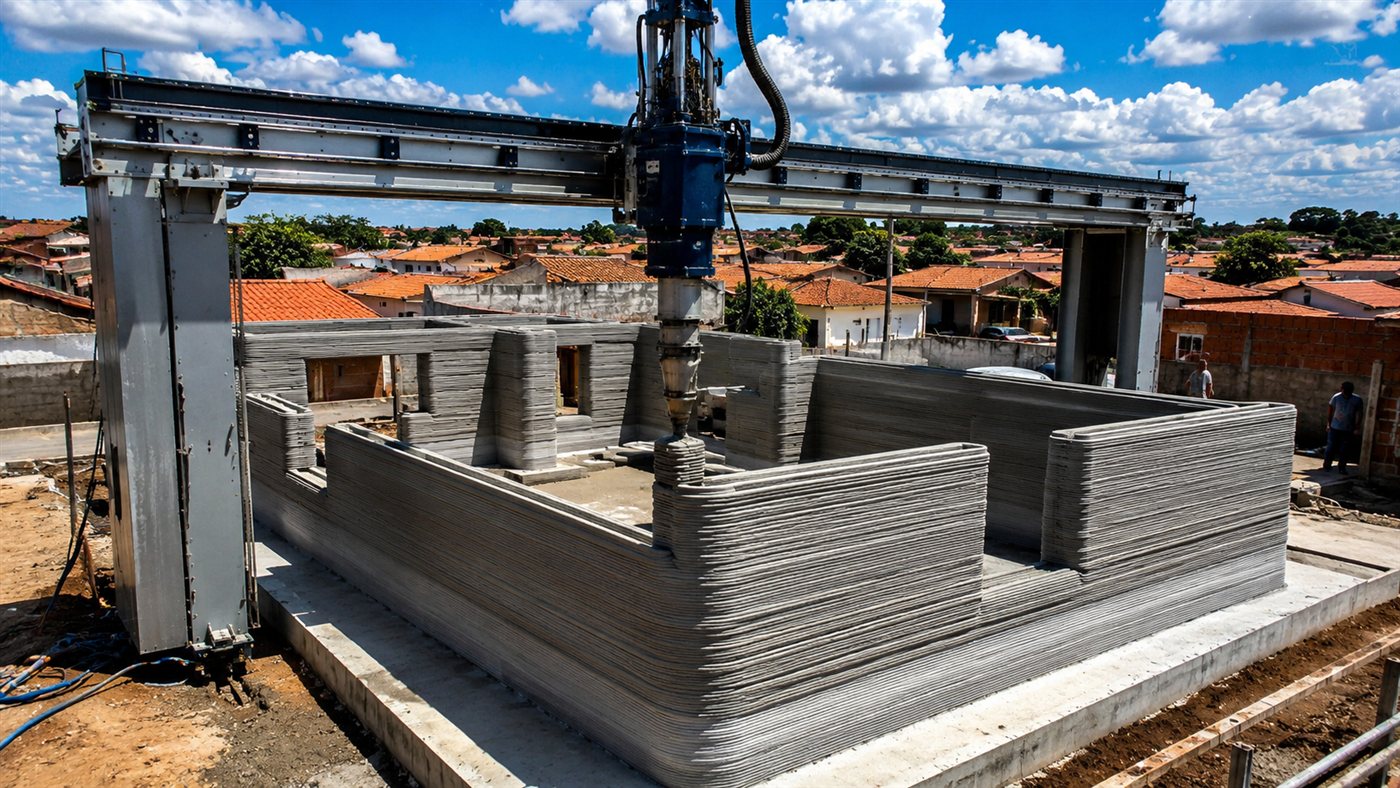
An entire house being born inside a warehouse, without bricks, without plaster, and with three people chatting while the machine works. According to the channel Gustavo Pozzato, in a video published on April 7, 2024, which has amassed over 62,000 views, the Brazilian construction company Cosmos prints the wall modules of a residence on a 3D printer in about 48 hours, within a process that delivers a house of 50 to 90 square meters in around 10 days.
The model has a technical name and industrial logic. The factory is modular and offsite: the house is entirely built off-site and then transported by truck to the land, where it is simply assembled, as Gustavo Pozzato explains in the tour. The content creator, specialized in modular construction, summarizes the impact in the first sentence of the video: in his view, the profession of bricklayer as we know it will end.
The 3D printer that builds houses inside a warehouse
The scene resembles more a parts industry than a construction site. According to Gustavo Pozzato, the Cosmos warehouse houses the printer, a prototype house assembled for visitors, and rows of wall modules in different stages, in addition to the tests that the team keeps to document the evolution of the material.
-
Brazilian Community Raises $1.4 Million, Builds Bridge in 138 Days, and Lets Residents Decide on Surplus Funds

-
Taiwan Unveils 914-Meter “Impossible” Bridge by Zaha Hadid, Cutting Travel Time by 25 Minutes and Withstanding Severe Earthquakes

-
Engineering Feat in Brazil: 6.4 km Tunnel and Powerful Pumps Overcome 200-Meter Elevation to Save São Paulo’s Cantareira Water System

-
Engineering Students Build Off-Grid Tiny Home with Sustainable Features and Offer Free DIY Guide


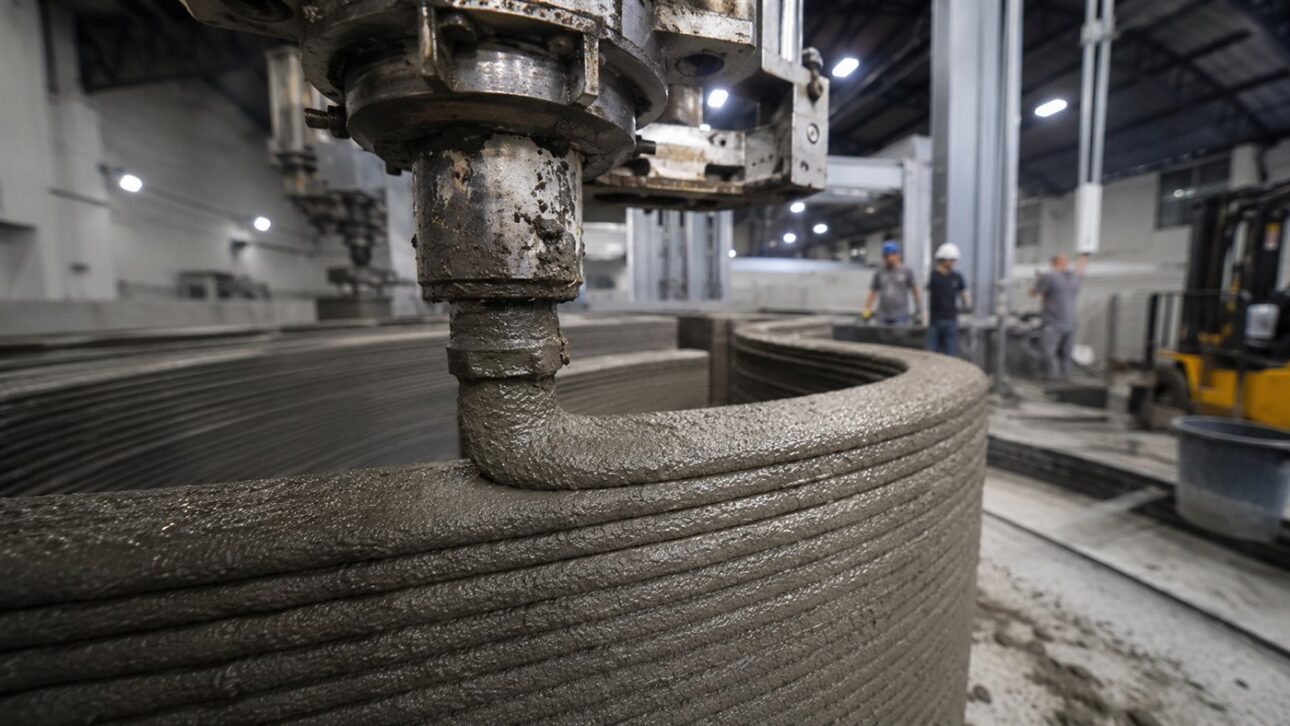
The machine itself is a foreigner with a Brazilian brain. The 3D printer came from Spain, but all the technology of the concrete mix that forms the walls was developed in Brazil, as the Gustavo Pozzato channel on YouTube shows. The equipment works on three axes, moving sideways, forward, and upward, and dispenses the mix through an injector nozzle that draws the walls on the warehouse floor, layer by layer.
48 hours of printing and 3 people in operation
The process numbers reshape the spreadsheet of any construction company. According to Gustavo Pozzato, in less than 48 hours all the wall modules of a house are printed, and the complete operation involves 3 people: two collaborators assisting in the general operation and a mechanical engineer specialized in 3D printing.
The speed deceives the eye of the viewer. The machine prints 120 millimeters per second, which means about 1 meter of wall every 10 seconds, as Gustavo Pozzato notes in the conversation with the team. It seems slow in detail and is extremely fast overall: a day and a half of continuous work leaves the entire house in modules, ready to receive electrical and plumbing installation still in the warehouse.
The secret of the 1.40-meter modules
The height of the walls has a limit that is pure physics of fresh concrete. According to Gustavo Pozzato, each module is printed up to 1.40 meters high, because above that the weight of the mass itself compromises the curing, and the full ceiling height is achieved by stacking a complementary module on top of the first, connected by interlocking.
The internal structure is a lesson in lean engineering. The modules are hollow inside, with strips that prevent the wall from opening during printing and rebar that serve as structure and lifting points, as Gustavo Pozzato details, also showing the pillar prototypes where the internal gap receives concrete and rebar. Each 1.40-meter module weighs around 600 kilos, similar to an equivalent masonry wall.
The wall comes out in a spiral, not in layers
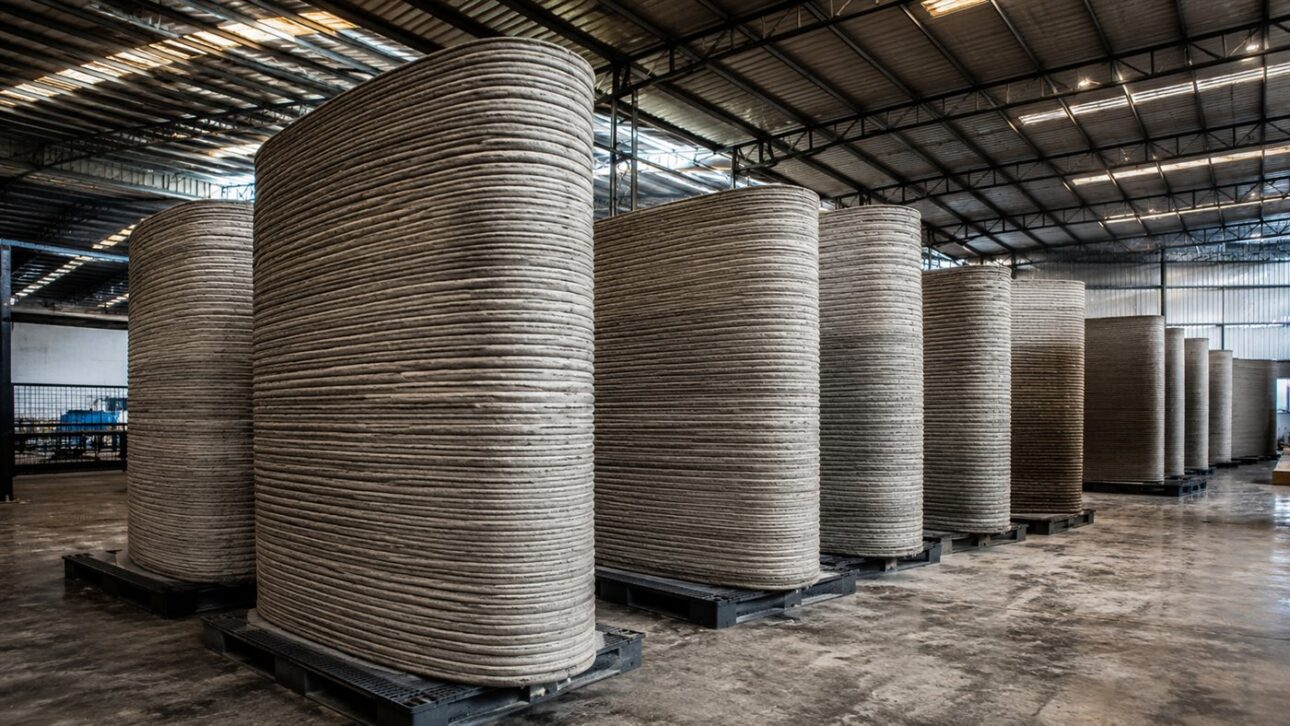
The most beautiful technical curiosity of the video is in the pattern. According to Gustavo Pozzato, the printing is not done layer upon layer closed: the machine rises in a continuous spiral, like a spring, which eliminates seams and gives the walls the appearance of stacked segments that the team compares to a soft-serve ice cream.
The finish has evolved to the point of becoming a selling point. The layers come out symmetrical, about 2 centimeters each, and the walls have rounded shapes, without sharp edges, as Gustavo Pozzato observes in the prototype. Those who want the traditional look can plaster or apply coating; those who like the design of the rows simply leave the wall exposed, and the plaster becomes a film of at most 3 millimeters, because the surface is already smooth.
250 tests and a 100% national mix
None of this worked out right the first time, and the factory makes a point of keeping the evidence. According to Gustavo Pozzato, the Cosmos team had already gone through 250 material tests since the start of development in June of the previous year and displays in the warehouse the pieces that went wrong: planters bulged by weight, crooked walls, and the subsequent versions, increasingly uniform.
The central learning was chemical, not mechanical. The biggest challenge of the project was finding the right mix, and all the material was developed in Brazil, while the printer is the simplest item in the set, as Gustavo Pozzato reports citing the conversation with the company’s CEO. The rule that the team repeats in the video applies to the entire sector: the secret to success lies in the material and the software that controls it, not in the arm that prints.
R$ 900 to R$ 1,200 per square meter: the honest account
The video does not hide the current weak point of the technology. According to Gustavo Pozzato, the structure of a printed house costs between R$ 900 and R$ 1,200 per square meter and is not yet competitive with traditional masonry because Brazilian labor is very cheap.
The benefits that justify the price are in another column of the spreadsheet. Short deadline, exclusive aesthetics, drastic waste reduction, clean construction site, and near-zero accidents in a controlled factory environment, as Gustavo Pozzato lists. It’s the same reasoning for all industrialized construction: the square meter is not cheaper today, but the schedule, waste, and rework reduce the total project cost.
Waste becomes gravel and surplus becomes park bench
The factory’s circular economy closes the cycle within the warehouse itself. According to Gustavo Pozzato, the only significant waste is the start of the mass injection, and all discarded material is crushed and becomes gravel, reused in the foundation that receives the house on the land.
The printer also doesn’t just live on walls. Cosmos prints urban furniture, such as planters, benches, and even the legs of the prototype’s kitchen counter, as Gustavo Pozzato shows, including a bench project for the city hall. Transport is another advantage of the compact design: the modules of a 60 to 80 square meter house travel in a conventional truck, already organized in the assembly order.
Will the bricklayer end? What the video really shows
The catchphrase that opens the tour deserves a full reading. What the video advocates is not the end of the construction worker, but the change of role: instead of laying bricks in the sun, the professional is trained to operate the machine, control the mass machining, and assemble the modules on the site.
The detail that supports the argument appears behind the scenes. While the 3D printer works, the team performs quality control and programming, a lighter, safer, and more technical service, as Gustavo Pozzato records when filming the operators. The question that remains for the Brazilian sector is not if automation arrives, but who will train today’s bricklayers to be tomorrow’s printers.
Watch the tour of the factory
The video goes through the warehouse, shows the 3D printer in action, the tests that went wrong, and the complete prototype house, with bathroom, kitchen, and office.


The Cosmos factory is a snapshot of the current stage of house printing in Brazil: the technology already works, the aesthetics already captivate, and the cost still competes with the cheapest labor in the world. Tell us in the comments: would you bet on a printed house coming out of a warehouse in Belo Horizonte?