






 Portuguese
  Spanish


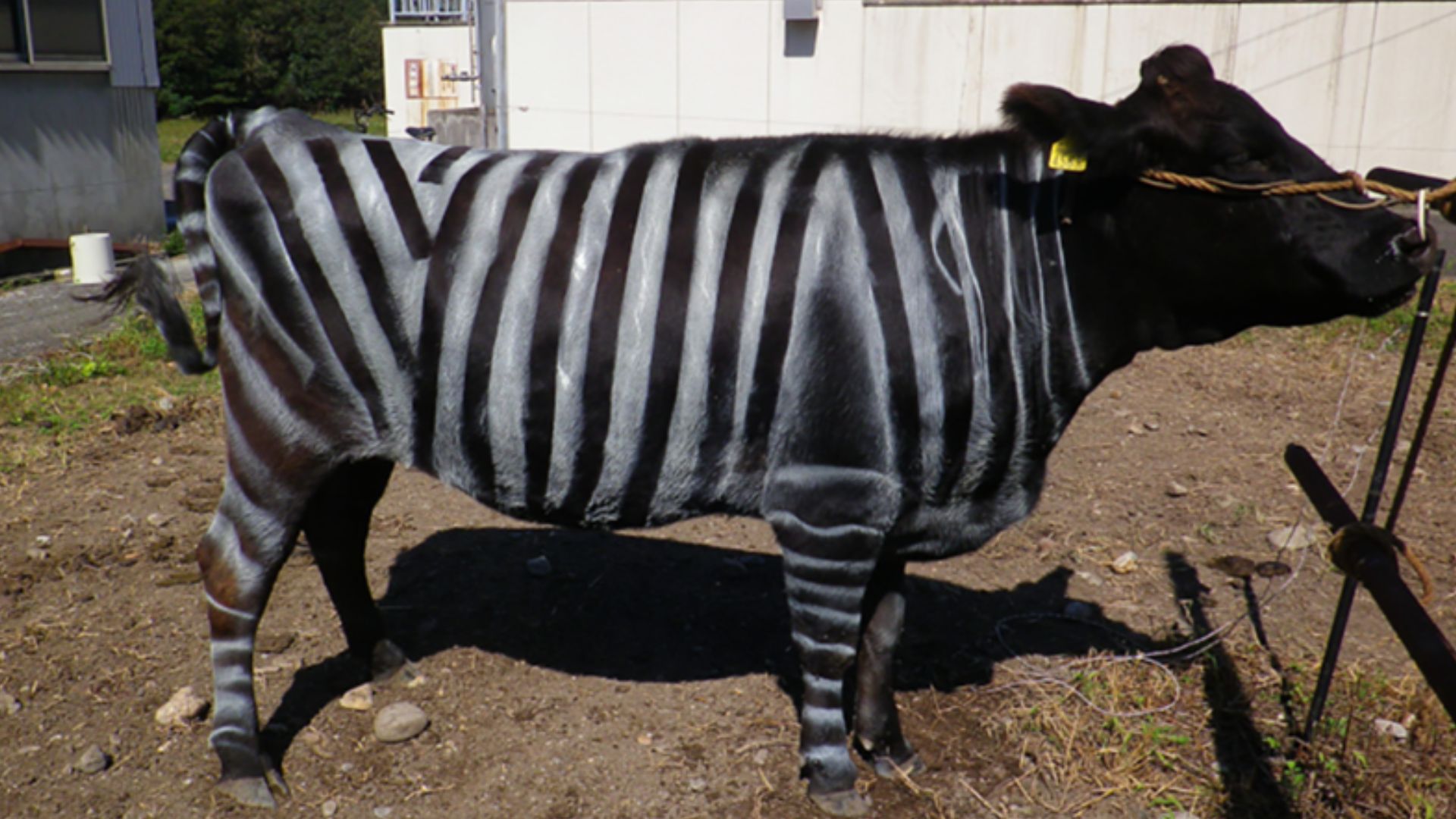


Simple Painting with Zebra Stripes Reduced the Presence of Biting Flies in Cows and Diminished Irritation Behaviors in the Herd, According to Peer-Reviewed Study. Low-Cost Visual Strategy Gained Attention for Dispensing Chemicals in Part of the Management and Offering a Practical Alternative for Producers.
A simple visual change on the cattle body was enough to significantly reduce the discomfort caused by biting flies in a herd.
When receiving white stripes that imitated a zebra pattern, cows attracted fewer biting insects and displayed fewer signs of irritation in an experiment conducted by Japanese researchers and published in a peer-reviewed scientific journal.
Zebra Stripes and the Global Problem of Biting Flies
The idea stems from a well-documented observation in biology: animals with contrasting stripe patterns, like zebras, tend to be less “inviting” to certain types of blood-feeding flies.
-
Producer receives news and had to cull almost the entire herd, bounced back with the help of compensation, and is now producing 450 liters of milk per day in SC.

-
Quail Eggs Reveal a “Secret Code” on Their Shells Explaining Unique Patterns and Colors

-
Rare Tropical Fruit Canistel, with Egg Yolk Color and Caramel Flavor, Gains Interest from Researchers and Small Producers in Brazil
-
Brazilian Farmers Develop Wheeled Metal Lever to Ease Cassava Harvesting Without Heavy Machinery




In livestock farming, these insects are not just a temporary nuisance.
By repeatedly landing and biting, they cause stress, disrupt the animal’s rest and grazing, can cause wounds, and increase the chance of pathogen transmission, translating into economic losses and worsened welfare.

How the Experiment Was Conducted with Japanese Black Cows
To test if a similar pattern could work on domestic cattle, the study evaluated Japanese Black cows, common in high-value beef production in Japan.
Instead of relying on chemical products, the method consisted of applying a stripe design directly on the coat, creating a contrast that resembles the “zebra effect” when viewed from a distance.
The experiment was structured to compare the effect of the stripes with two control conditions.
In one, the cows received no markings; in the other, they were painted with a pattern that did not imitate the zebra, allowing separation of the impact of simply having “paint on the body” from the specific impact of the striped design.
This way, the researchers sought to answer an objective question: would the visual change alone be capable of decreasing the number of flies landing to bite?
Reduction of Flies and Less Agitation in the Herd
The observations focused on flies that, in practice, represent a recurring problem in raising environments.
Among them, the study mainly registered the stable fly, a species known for frequently biting and bothering herds in different countries, as well as other biting flies in smaller proportions.
To measure the difference between the groups, researchers quantified the presence of flies around and on the animals and monitored typical behavioral signs of discomfort, such as head movements, ear flicks, stamping, skin twitches, and tail flicks.
The results indicated a substantial reduction in insect pressure on cows with the striped pattern.
The study described that the number of flies landing to bite the “striped” animals fell to about half compared to the control groups.
At the same time, the cows with stripes exhibited a lower frequency of defensive behaviors, precisely the repetitive movements that typically indicate discomfort and energy expenditure trying to fend off bites.
Why the Design Matters More Than Just “Having Paint on the Body”

An important aspect of the experiment is that it did not limit itself to a simplistic comparison.
By including a group with markings that did not reproduce the zebra pattern, the research reinforced that the observed effect related to the design and contrast, and not just to smell, texture, or the fact that the animal was painted.
This type of control is essential for interpreting what is actually being measured, especially when the proposed solution seems “too simple” for such a common problem in the field.
What Science Says About the “Zebra Effect”
A detailed explanation of the mechanism was not treated as absolute certainty, because the main objective of the work was to measure the practical effect on cattle, not to definitively solve why zebras are less attractive to flies.
Still, the research relies on previous evidence from the scientific literature that high-contrast stripes may disrupt fly landing, making it harder for the insect to complete the approach and settle on the animal’s body.
This type of visual effect is consistent with how these insects use light and contrast cues during flight and in the final landing phase.
Animal Welfare, Economic Loss, and Management in the Field
On the farm, the consequence of the problem is clear and everyday.
A cow under constant attack from flies tends to stop grazing frequently and spend part of the time in defensive movements.
When this happens repeatedly, the herd’s routine changes.
In addition to stress, the act of shooing flies may increase energy expenditure and reduce rest periods, components associated with productive performance and animal welfare.
By decreasing the number of bites and agitation, an non-invasive intervention gains interest not only for scientific curiosity but for its potential impact on management.
Alternative to Insecticides and Limits of the Method
It is at this point that the study draws attention for proposing an alternative that, in certain situations, may reduce reliance on insecticides.
Chemicals continue to be used in different production systems to control flies and ticks, but their use involves costs, reapplications, and concerns about pest resistance, in addition to safety and management requirements.

A solution based on visual patterns does not eliminate the need for sanitary and control measures in all scenarios but suggests an additional tool, low-cost and easy to test in the field, especially where fly pressure is high and the producer seeks to reduce chemical interventions.
The method of application used in the experiment also deserves attention.
The researchers painted the stripes directly on the coat, in a procedure that, by its nature, requires maintenance as the design wears off over time, whether by rain, dust, or friction.
The proposal, therefore, is not a “definitive trick” for any herd, but a method with verifiable logic: changing the animal’s visual signal to reduce landings of biting flies.
Another point that strengthened the topic’s impact was the unusual nature of the test and its ability to be observed with the naked eye.
The stripe pattern facilitates before-and-after images and videos, which contributes to the general public’s interest in simple solutions, without the text needing to appeal to impossible promises.
However, what supports the story is the objective measurement, published in a scientific journal, with a description of the experimental design and comparison between groups.
Practical Application and Scope of the Study
Even with significant results, practical adoption depends on the context of each region and the type of prevailing pest.
The research focused on specific species recorded at the experiment site, meaning that the effect should be interpreted within the tested scope.
For producers, technicians, and researchers, the main message is that behavioral and perception interventions, when well evaluated, can open unexpected pathways for old problems in the field, including complementing traditional integrated management strategies.
If a paint pattern can reduce bites and herd agitation without immediately resorting to chemicals, what other simple visual “signal” changes are still going unnoticed in livestock farming?


Essa notícia é realmente curiosa! 🐄 O estudo, realizado por pesquisadores japoneses, mostrou que as listras brancas aplicadas sobre o corpo escuro das vacas confundem o sistema visual das moscas 🪰, que não conseguem pousar com precisão.
“Depois dessa descoberta, o pessoal lá no interior do Rio Grande do Sul está interessado: agora que pintar listras na **** espanta as moscas, a ideia é que, se pintarem as cores do Grêmio 🔵⚫⚪, os jogadores do time adversário também não consigam chegar perto para marcar!”
Y el hombre xk no se pinta el ,me parece súper cruel .Q no se te olvide q los animales también sufren tienen lo mismo q nosotros un sistema nervioso .
Será nas pessoas também funcionam