Portuguese
  Spanish


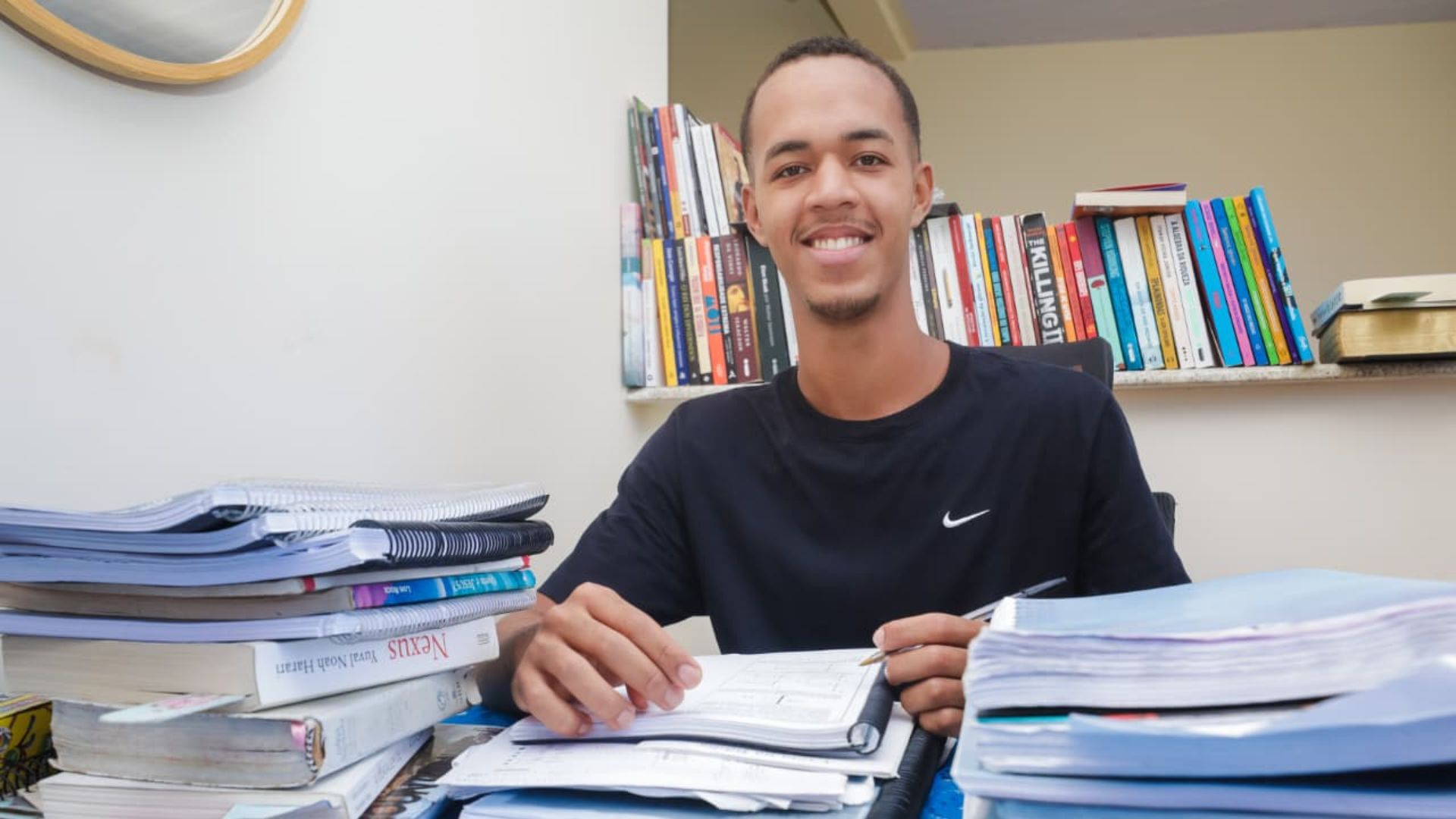

Journey marked by family work, self-study, and discipline leads a young man from a public school in Bahia to secure two spots in Medicine at prestigious universities, mobilizing teachers, peers, and expanding the debate on access to higher education in Brazil.
Davi Rocha, 19 years old, a graduate of the state education system in Bahia, was accepted into Medicine at the Federal University of Bahia and also at the University of São Paulo, at the Ribeirão Preto campus, after studying independently throughout 2025.
Living in Arembepe, in Camaçari, he completed high school in 2024 and returned to the public school where he studied to reconnect with teachers and administrators, accompanied by his parents, during a visit that transformed his achievement into a symbol of identification for other students.
Approval in Medicine at UFBA and USP gains attention
The dual approval drew attention due to its academic weight and the journey to the result.
-
Forgotten Map Leads Diver to Shipwreck with Gold, Rare Jewels, and Secrets Hidden for Nearly 350 Years

-
Furong: The 2,000-Year-Old Chinese City Built on a 60-Meter Waterfall Becomes a Global Tourist Phenomenon

-
YouTube Inventor Dubbed “Real-Life Tony Stark” Builds Robotic Legs for Father’s Day, Creating a Wheelchair That Conquers Stairs and Rough Terrain
-
Brazilian Scrap Dealer Processes 3,000 Tons of Ferrous Scrap Monthly, Paying $0.09 to $0.70 per Pound, Reveals Why a Hidden Cylinder Costs 1,500 kg Discount




Son of a Bahian acarajé vendor and a welder, Davi grew up in a routine marked by family work and direct experience with public schooling.
The journey gained attention because it combines two elements that rarely appear dissociated in the debate about access to higher education: high performance in a highly competitive course and a popular background sustained by daily work, discipline, and persistence in the public system.
In the case of UFBA, the student ranked first in the LI-EP category, reserved for students from public schools, regardless of family income.
The spot at USP, in Ribeirão Preto, came through the second call of Sisu 2026, announced on February 3.
The combination of the two results expanded the reach of the story because it placed the name of the young Bahian in two of the most competitive institutions in the country in the same admission process.
Study without a prep course and preparation for the Enem
The preparation took place far from an idealized scenario.
After leaving the State College Professor Nadir Araújo Copque, in Arembepe, Davi attempted to enter Medicine with the score obtained in the 2024 Enem, but did not reach the necessary score.
Instead of interrupting the project, he reorganized his routine, studied alone throughout 2025, and maintained enough regularity to arrive at Sisu 2026 in a position to compete for the spots he desired.
This stage of the story helps explain why the approval was received with such emotion within the school.
Davi’s return to the unit, on February 4, 2026, occurred during the Pedagogical Journey of the state network and was treated by the administration as something that transcends individual success.
Routine between work, studies, and family support
The relationship between study and work appears as one of the most consistent traits of the trajectory.
From an early age, Davi helped his mother, Gerusa dos Santos Rocha, known as Geu, in the production and sale of acarajés.
On weekends, this participation was integrated into the household routine, while he kept his focus on preparing for higher education.
The experience does not emerge as a peripheral detail of the biography, but as part of the environment in which the project to pursue Medicine was sustained.
On the paternal side, the story also carries clear marks of social origin.
Ednaldo Alves de Oliveira, the student’s father, was raised in the rural area of Mata de São João, with little access to school and a childhood marked by work in the fields.
In relating his son’s victory to his own journey, he summarized the generational dimension of the achievement by stating that he always believed that his children could go further.
Interest in Medicine and academic profile
The interest in Medicine, according to the Bahia Department of Education, matured during the school period and was driven by a love for studies, intellectual curiosity, and the search for a field that required continuous learning.
When explaining his choice, Davi stated: “I wanted a profession that challenged me and made me evolve constantly.”
The statement helps to position the decision less as an idealization and more as a long-term project built with regularity.
The routine described by the Bahia government agencies also dispels the simplified image of a student isolated only in books.
In addition to study hours, Davi maintained a practice of physical activities to preserve emotional balance and continued collaborating with his family.
When talking about the preparation period, he summarized the process in a short phrase: “Difficulties are part of it, but the essential thing is to maintain the attitude.”
Recognition of public school and social impact
At school, the memory left by the former student already pointed to this profile even before the Sisu results.
Director Guilhermina Silva Souza associated the approval with personal effort, family support, and the work of the public school.
Geography teacher Rafael Mattos Araújo highlighted a recurring characteristic in the classroom by saying that he “always went beyond what was asked.”
The two evaluations help to understand why the visit to the unit had an immediate impact among students and teachers.
The reunion with the educators, however, was not only of emotional value.
Upon returning to school after being accepted into Medicine, Davi provided the school community with a rare image of continuity between daily effort and concrete results.
In many cases, the promise of mobility through education appears only in institutional discourse; there, it gained a face, origin, address, and a trajectory recognizable by those who share similar conditions within the same education network.
For this reason, the story resonates beyond Bahia.
The success of a young person who studied in a public school, helped his mother at work, faced the frustration of a previous attempt, and reached two prestigious universities engages with a national discussion about access, retention, and opportunity.
This case does not erase the inequalities that shape the competition for places in Medicine, but it shows, with identifiable data and real characters, how this path can be constructed when a solid educational foundation, persistence, and family support come together.
In this sense, the episode experienced in Arembepe is not merely an isolated celebration.
It brings together, in a single sequence of events, the grassroots work of a family, the education provided by a state school, the insistence after an insufficient result in the Enem, and the acceptance into two Medicine courses through Sisu 2026.
It is this combination, more than any attempt to transform the journey into a heroic exception, that explains why the name Davi Rocha has begun to circulate as a reference for identification among students who see public school as the main possible path for educational advancement.