






 Portuguese
  Spanish


Fernanda Abra was recognized by the Wayfinder Award 2026 after developing suspended passages that reconnect forests and allow safe crossing for primates and other arboreal animals
The expansion of roads through the Amazon facilitates the transport of people and goods, but it also creates an almost invisible disruption for wildlife. When a highway separates two forest areas, animals living in the treetops need to descend to the ground, cross the asphalt, or remain isolated in increasingly smaller fragments.
A Brazilian solution created to tackle this problem has just received international recognition. Conservation biologist Fernanda Abra was announced on June 9, 2026, as one of the 15 winners of the Wayfinder Award, an annual award granted by the National Geographic Society to professionals with outstanding performance in science, conservation, education, technology, and communication.
The recognition was granted for the researcher’s work in road ecology, especially in the implementation of canopy bridges over Amazon highways. These structures function as suspended walkways between the trees and allow monkeys, marsupials, rodents, and other animals to cross the roads without coming into contact with vehicles.
-
In the Caucasus Mountains, a Community Preserves a Language So Rare Few Outsiders Can Understand It

-
Slovakia’s Ice Cave Holds Over 110,000 m³ of Frozen Wonders, Boasts Walls Up to 27 Meters Thick, and Was Among the First Electrified Caves Globally

-
Street Cleaner Accidentally Receives $200,000 Transfer, Returns Unexpected Fortune to Rightful Owner
-
Australian Space Agency Investigates Six Mysterious Metal Spheres Found on Queensland Beach, Isolating Area Over Possible Space Debris Risk



According to information from O Eco, the award also grants Fernanda the title of National Geographic Explorer, a grant of US$ 50,000, and access to an international network of researchers, institutions, and potential funders. The support could help expand a technology that has already recorded more than 20,000 safe animal crossings.
Canopy bridges reconnect forest areas separated by asphalt
Canopy bridges are structures installed above the roads, usually linking trees or supports positioned on both sides of the highway. They aim to reproduce elements found in the forest, such as branches, trunks, and vines, facilitating recognition and use by the animals.
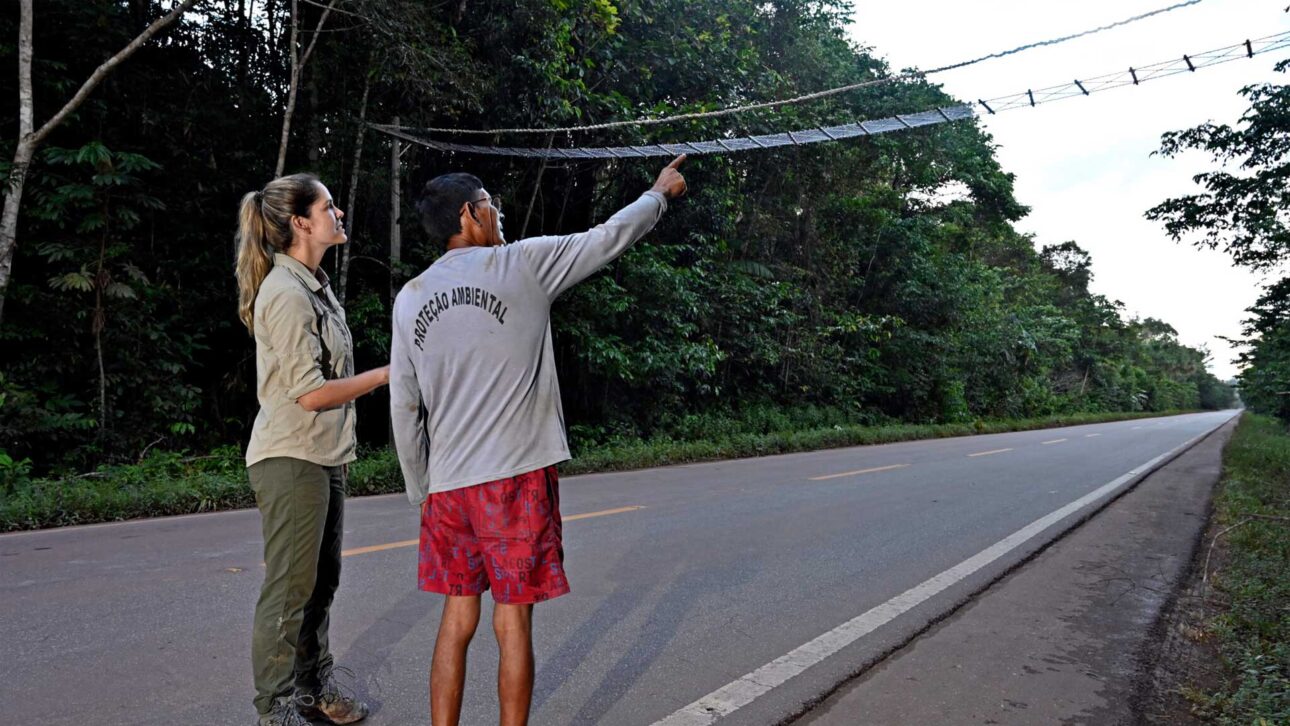
The measure is especially important for arboreal species. Many of these animals spend a large part of their lives in the treetops and avoid descending to the ground, where they are more exposed to traffic accidents, predators, domestic dogs, and other risks associated with urbanized areas.
In Alta Floresta, in the north of Mato Grosso, the project developed a model with different levels of crossing. According to the Smithsonian’s National Zoo and Conservation Biology Institute, the design was conceived to meet distinct locomotion patterns, allowing the passage of primates, marsupials, and small rodents.
Automatic cameras installed near the structures show which species use the crossings, at what times, and how frequently. This monitoring is essential because a seemingly well-constructed bridge may not work if it is in the wrong location or if the material is not suitable for the behavior of the region’s animals.
Brazilian project already counts thousands of safe crossings
The work that led to the award is related to the Reconecta Project, an initiative created to reduce the effects of roads on biodiversity and to restore the connection between forest sections separated by highways, streets, and other infrastructure works.
Since 2021, the teams involved have been installing and monitoring canopy bridges at strategic points in the Amazon. The project reports that more than 20,000 safe crossings have already been recorded, a result that demonstrates that animals can recognize and incorporate the structures into their movements.
One of the main areas of operation is the BR-174, a federal highway that connects Manaus, in Amazonas, to Boa Vista, in Roraima, and crosses the Waimiri-Atroari Indigenous Land. In this section, 32 canopy bridges were installed, with the participation of indigenous community members in choosing the locations and monitoring the fauna.
Traditional knowledge was combined with field research to define formats and materials closer to the elements naturally used by animals. Reconecta itself highlights that its methodology seeks to unite science, technology, and indigenous knowledge in building a road infrastructure less harmful to the forest.
The initiative also received, in 2024, the Whitley Award, an international recognition awarded to conservation leaders. On that occasion, the work was highlighted for the development of low-cost bridges primarily aimed at protecting Amazonian primates threatened by the effects of highways.
Alta Floresta recorded almost 15,000 crossings in 15 months
The most significant results were recorded in Alta Floresta, a municipality surrounded by areas of high biodiversity, but also marked by urban expansion and vegetation fragmentation. Seven monitored bridges accounted for almost 15,000 crossings in just 15 months.
Among the species observed is the Alta-Floresta titi monkey, scientifically known as Plecturocebus grovesi. The primate was described by science in 2019 and is classified as critically endangered, making the reconnection between forest areas especially important for its survival.
Capuchin monkeys and Schneider’s marmosets were also recorded using the structures. The images even show females crossing the bridges with their young, indicating that the corridors have become part of the groups’ daily movements.
The Institute for Ecological Research reported that local monitoring involves camera traps and the participation of students and researchers from universities in Mato Grosso. The initiative also promotes environmental education actions to explain to the population how urban circulation can affect animals.
Wildlife roadkill represents an environmental and safety problem
Highways do not only cause direct deaths. They can divide territories, make it difficult to find food, prevent encounters between groups, and reduce the genetic diversity of isolated populations.
An estimate from the Brazilian Center for Road Ecology Studies, released by ICMBio in 2014, indicated that 475 million wild animals could be killed by vehicles each year in Brazil. The calculation mainly included small vertebrates, such as frogs, snakes, and birds, which represent the largest share of affected animals and often do not appear in official records.
Since this is an estimate published over a decade ago, the number should not be presented as a current and exact count. However, it remains a reference to demonstrate the potential scale of the problem and the difficulty of monitoring the entire Brazilian road network.
Roadkill also threatens drivers and passengers, especially when involving large animals. Surveys presented by the Senate showed that collisions can cause injuries, deaths, vehicle damage, and costs related to medical care, cargo removal, and mobilization of emergency teams.
Animal crossings need to be part of road planning
The construction of canopy bridges does not replace forest preservation but can reduce one of the impacts caused by existing roads. For them to work, each structure needs to be planned according to the species present, the state of the vegetation, the areas of highest traffic, and previous roadkill records.
Other solutions may be necessary for terrestrial animals. Tunnels under the roads, guiding fences, speed reduction, restoration of ecological corridors, and continuous monitoring should be evaluated according to the characteristics of each section.
Fernanda Abra’s journey in this field began during her studies in Biology. The organization Future for Nature notes that she has been working with road ecology since 2009 and has participated in dozens of projects aimed at reducing collisions and restoring habitat connectivity.
The challenge now is to turn successful local experiences into permanent infrastructure practices. Building a highway without considering wildlife movement can create an environmental cost that will last for decades, while measures incorporated from the planning phase tend to be more efficient than adaptations made after the construction is completed.
International recognition can expand the solution developed in Brazil
The Wayfinder Award places Brazilian technology in a global network of conservation projects. The award not only represents an individual achievement but also draws attention to an area that for many years received less visibility than other environmental issues.
The advancement of canopy bridges demonstrates that relatively simple constructions can produce measurable results when guided by scientific research. The thousands of crossings recorded by cameras show that wildlife uses the structures and that there is a concrete possibility of reconciling human mobility with biodiversity protection.
The recognition also comes at a time when Brazil is discussing new investments in roads, railways, and transmission lines. Incorporating wildlife passages, monitoring, and forest connectivity into projects can prevent infrastructure growth from further increasing habitat fragmentation.


