






 Portuguese
  Spanish
  3 min of reading
  0 comments


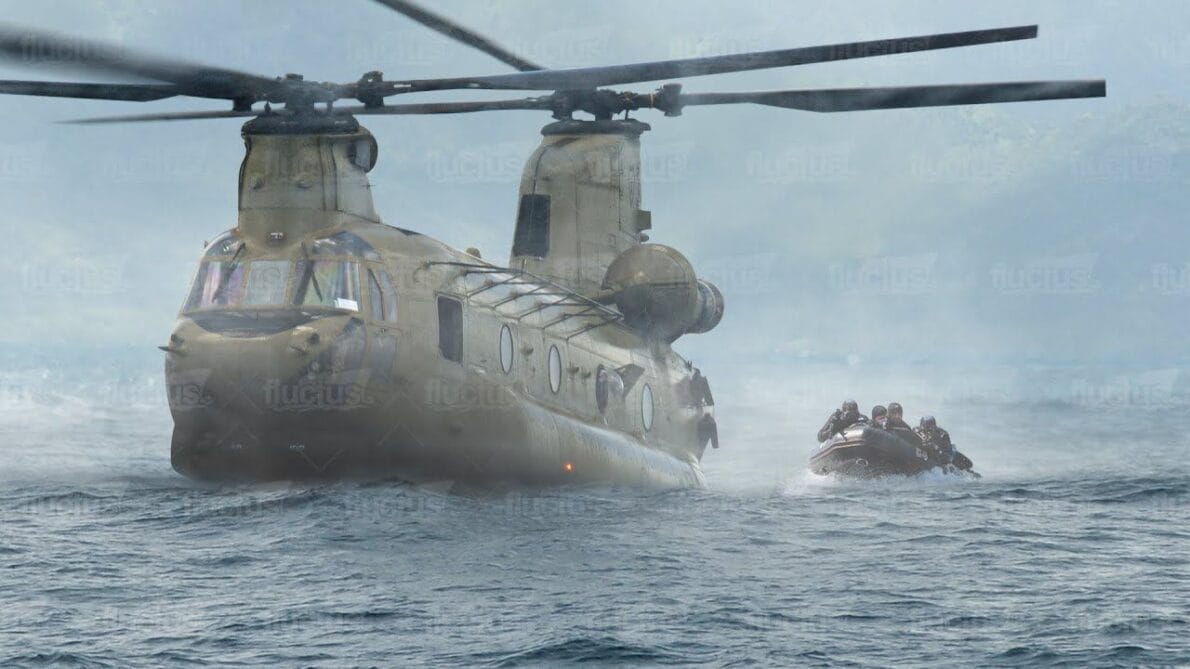
The US CH-47 Chinook, created by Boeing, is essential for the rapid extraction of special forces in dangerous areas. This helicopter features technologies and techniques that allow for efficient rescues, even in challenging maritime environments.
In enemy territory missions, extracting troops quickly and safely is crucial. At sea, this task is even more complex. The US CH-47 Chinook stands out by combining speed and payload capacity, facilitating the safe evacuation of special forces.
With its twin rotor system and large payload capacity, the Chinook can transport up to 55 soldiers or heavy loads, such as vehicles and equipment, making it vital for maritime rescue operations.
US CH-47 Chinook, Developed by Boeing

Since the beginning of naval warfare, the rapid and stealthy extraction of troops has always been a challenge. With the advancement of helicopter technologies, such as the US CH-47 Chinook, developed by Boeing in the 1960s, this challenge has been overcome.
-
Why can the crane operator only obey the correct signalman on the construction site: among dozens of workers, a hand raised by the wrong person can confuse the maneuver and turn a load of tons into an immediate risk.

-
What changes with the new public transportation rules that can reduce pressure on fares and pave the way for zero fare in Brazil?
-
Offshore air transport soars in Brazil, surpasses 2.5 million passengers, and reveals how oil has transformed Rio’s airports into key pieces of national logistics.

-
Latin America becomes the “global champion” of aviation taxes, tickets may become more expensive in Brazil, and IATA’s warning exposes risk for flights, tourism, and passengers.

The Chinook, at 30 meters long, can carry up to 13 tons of cargo. Its twin rotor system, which provides 10,138 horsepower, enables it to transport large loads in hard-to-reach areas. Moreover, it can fly at nearly 300 km/h, ensuring rapid extractions.
Maneuvering is Crucial in Situations Where Speed is Essential
In maritime operations, the Chinook utilizes a special technique. The pilot hovers the helicopter at water level, allowing the crew and the boat to be quickly winched into the aircraft. In a matter of seconds, everyone is on their way to safety. This maneuver is crucial in situations where speed is essential to avoid detection or enemy attacks.
The helicopter can also perform “sling loading,” where heavy loads, such as vehicles and supplies, are suspended and transported. This technique is risky, as soldiers need to connect the load to the helicopter while it hovers just a few meters above. However, it is extremely effective for quickly moving important equipment.
It Can Remain Stable and Take Off or Land Vertically
In addition to transporting troops and supplies, the Chinook is often used for medical evacuations. It can remain stable and take off or land vertically, making it ideal for rescuing people in hard-to-reach locations, such as oil platforms or ships at sea. During these operations, the helicopter hovers about 15 to 20 meters above the site, and the rescued individuals are safely winched aboard.
Boeing, the company responsible for developing the Chinook, equipped the helicopter with various armaments and advanced systems, allowing it to operate in extreme conditions and complete critical missions efficiently. The versatility and capability of the US CH-47 make it an invaluable resource for special forces in maritime operations.
Thus, the US CH-47 Chinook combines advanced technology and specialized techniques to carry out rapid and safe extractions at sea. Its payload capacity, speed, and maneuverability make it indispensable for military operations and rescues under adverse conditions.




-

-

4 people reacted to this.