Portuguese
  Spanish


Discovered by accident by MIT engineers in September 2019, the ultra-black material of carbon nanotubes was born from research on aluminum, not jewelry. The institute itself avoided claiming an absolute record, and the work with the diamond was a collaboration between art and science.
The ultra-black material that became famous for making a diamond disappear was presented by the Massachusetts Institute of Technology, MIT, on September 13, 2019. Made of vertically aligned carbon nanotubes, it captures at least 99.995% of the light that hits its surface, making it, according to the institute, ten times darker than any other coating reported until then. The work was led by Brian Wardle, professor of Aeronautics and Astronautics at MIT and director of the necstlab, alongside resident artist Diemut Strebe.
The discovery, however, was a laboratory accident. The team was not searching for the world’s deepest black, but rather ways to grow carbon nanotubes on chlorine-treated aluminum to improve electrical and thermal properties. The optical result surprised the researchers themselves and became an art installation called The Redemption of Vanity, in which a natural yellow diamond of 16.78 carats, valued at $2 million, about R$ 10.3 million at the current exchange rate, was covered by the material and exhibited at the New York Stock Exchange.
A laboratory accident that produced the most extreme black
The starting point of the project had nothing to do with color.
-
Berries, Strawberries, and Blueberries Could Transform Agriculture in Northeastern Brazil, New Tests Reveal

-
Danish Resident Discovers Six Viking Gold Bracelets Weighing 762.5 Grams, Third Largest Gold Treasure in Denmark

-
Over 200 Cities in Southern Brazil on Storm Alert as Cyclone Near Uruguay Brings Heavy Rain, Hail, and Winds Up to 100 km/h

-
Archaeologists Discover 2,300-Year-Old Beer in Sealed Bronze Vessel from Ancient Chinese Tomb




According to MIT, Brian Wardle’s group was studying ways to grow carbon nanotubes on conductive materials like aluminum, with the aim of enhancing the electricity and heat conduction of these systems.
It was while preparing the aluminum with a chlorine-based treatment and growing the nanotubes on it that the team noticed an unusual darkening.
Wardle described the result as unexpected, comparable to a legitimate scientific discovery.
In the institute’s promotional material, the researcher reported that the goal was to create a new way to grow the nanotubes and that, upon obtaining a new material, its properties can reveal surprises.
He also noted that his group does not usually focus on the optical properties of materials, but the parallel collaboration with Diemut Strebe ended up bringing art and science closer in that specific case.
How a Forest of Nanotubes Swallows Almost All Light
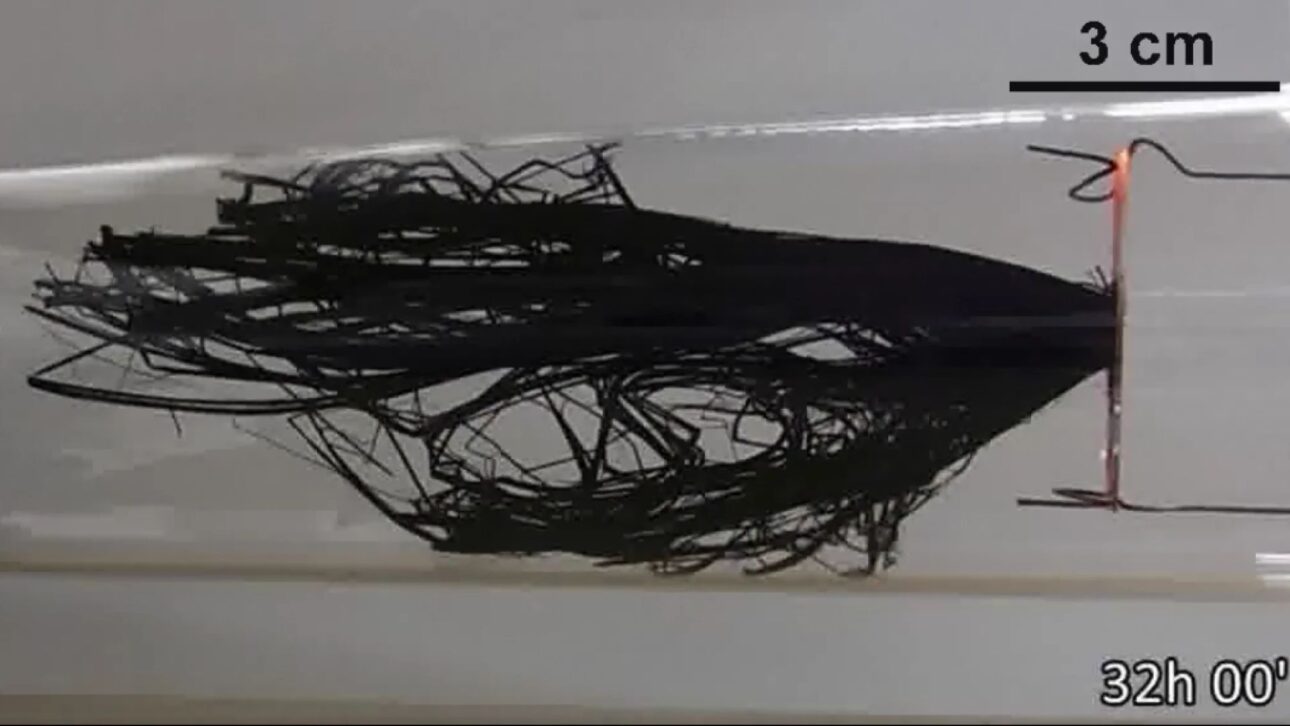
These microscopic filaments grow aligned like a vertical forest of tiny trees, and the resulting structure is composed of about 99% empty space.
When a beam of light enters this tangle, it bounces repeatedly between the tubes and is progressively absorbed as heat, instead of returning to the observer’s eyes.
To measure the effect, the team evaluated the reflected light not only from above but from all possible angles.
The result showed an absorption capacity of over 99.995% regardless of the observation direction.
In practice, this means that reliefs, curves, cuts, and textures cease to be perceived because the light that would normally reveal these contours simply does not return.
A three-dimensional object covered by the material starts to look like a flat cut-out stain.
The $2 Million Diamond Turned into a Shadow
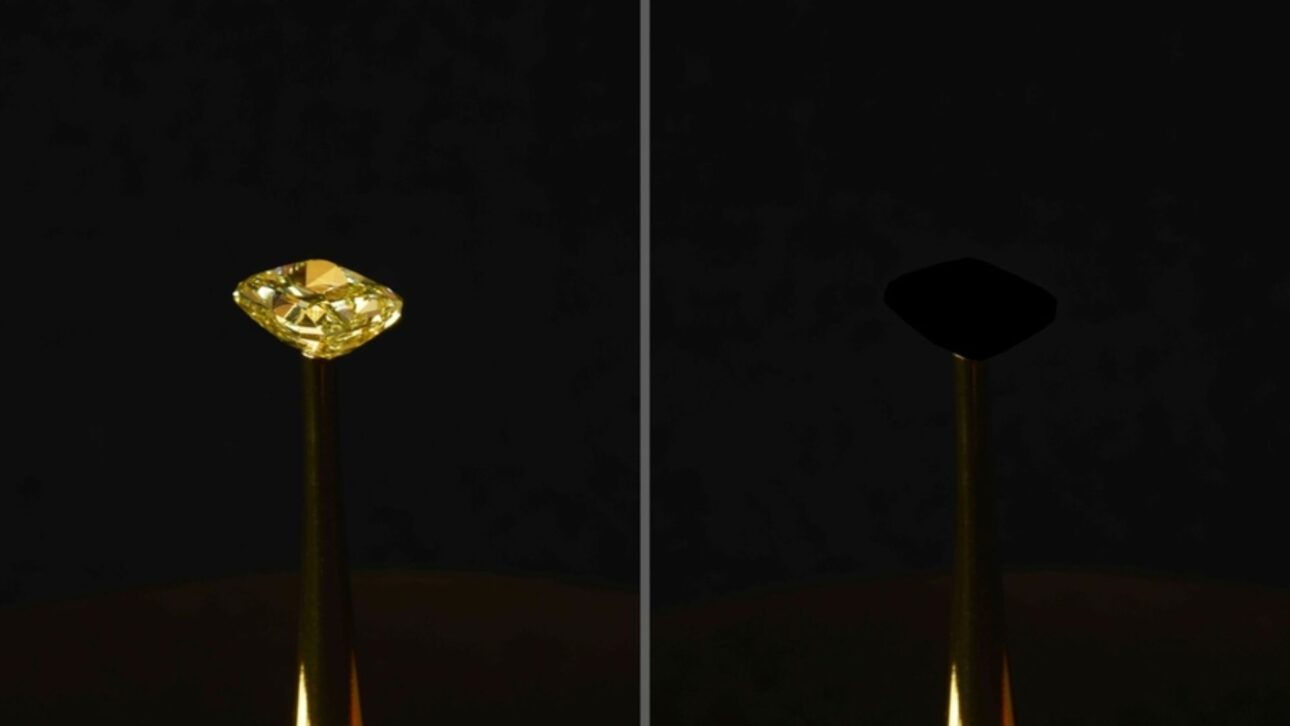
In the work The Redemption of Vanity, artist Diemut Strebe, resident at MIT’s Center for Art, Science and Technology, covered a natural yellow diamond of 16.78 carats, valued at $2 million and loaned by the jewelry store L.J.
West Diamonds, from New York. The piece, normally valued precisely for its brilliance and faceted surfaces, completely lost its contours and turned into a dark silhouette with no apparent volume.
The installation was on display at the New York Stock Exchange from September 13 to November 25, 2019.
According to Strebe, the proposal was to present the literal devaluation of a high economic value object and question the mechanisms of the art market.
The project, carried out with Wardle and researchers Luiz Acauan and Estelle Cohen, was also described by MIT as a response to the purchase, by British artist Anish Kapoor, of the exclusive artistic rights to use Vantablack.
The team made a point of emphasizing that they used a different composition of nanotubes, open to any artist.
What changes in comparison with Vantablack
The comparison with Vantablack needs context to avoid exaggerating the achievement.
Vantablack, developed by the British company Surrey NanoSystems, absorbs about 99.965% of visible light.
The MIT material absorbs at least 99.995%.
Since the difference lies in the small fraction of light that still escapes, reducing this residue from about 0.035% to near 0.005% multiplies the visual effect, and this is what supported the expression ten times darker used in the announcement.
MIT itself, however, was cautious in announcing the result.
The institute accompanied the phrase the darkest ever recorded with an asterisk and avoided claiming a permanent record, precisely because there is no single universal standard for measuring blackness.
Wardle even commented that the scientific interest was less in the race for a title of darkest and more in the electrical and thermal properties of the material.
In materials science, labels like the darkest in the world tend to be provisional, as new coatings can surpass them.
From galleries to telescopes, where the material can reach
Despite the visual impact, the material is not a common paint that you buy in a can or spray.
It depends on the controlled growth of carbon nanotubes on a previously prepared surface, in laboratory conditions, which currently limits its domestic or decorative use on a large scale.
Confusing it with wall paint would ignore the complexity of the process that generates it.
The real value of the material lies in the engineering of light.
Coatings that eliminate almost all reflection are of interest to precision optical instruments, such as telescopes, cameras, and sensors, where scattered light hinders measurements.
By showing that it is possible to approach zero reflection, the nanotube mesh paves the way for applications where seeing better paradoxically depends on reflecting less.
In this case, art served as a showcase for a property with concrete scientific utility.
More than a visual trick, MIT’s ultrablack material is a reminder of how our perception depends on the light that returns to us.
By swallowing almost all the lighting, it makes the brain lose depth cues and turns even a shining diamond into a cut-out shadow.
The story also shows that remarkable advances sometimes happen by chance, in the midst of research on something else, and that superlatives like the darkest in the world deserve to be read with due caution.
And you, what do you think of a material capable of visually erasing the shine of a $2 million diamond? Do you think turning a jewel into pure shadow is a valid artistic provocation or a waste? Leave your opinion in the comments, respecting different views, and share this article with those who are enchanted by science, technology, and art.