Portuguese
  Spanish




Labor court decision on dismissal due to retirement reignites discussion on ageism in employment, limits of the power to dismiss, and criteria used by companies in restructuring processes, especially when older workers or those eligible for retirement are included among those dismissed.
The 1st Panel of the Regional Labor Court of the 2nd Region unanimously upheld the ruling that annulled the dismissal of a worker due to age discrimination and ordered his reinstatement to the job, with payment of wages and benefits for the period of absence.
The compensation of R$ 15,000 for moral damages was also upheld, set due to the criterion used by Dataprev to justify the employee’s dismissal.
The case involves the Social Security Technology and Information Company, Dataprev, which claimed organizational restructuring to explain the dismissals made in its workforce.
-
Court Upholds Just Cause Dismissal of Employee for Posting Social Media Videos During Work Hours

-
Work less and produce more? Nobel Prize in Economics explains why shorter workdays can increase productivity

-
Unions are growing again in Brazil after more than a decade, but they face an urgent challenge to win back digital workers and maintain relevance.
-
From the typewriter to the home office: how work has changed and why new generations think differently




Despite the justification presented, the technical note used by the company explicitly indicated as a criterion the fact that employees were retired or eligible for retirement due to length of contribution or age.
In the panel’s assessment, the company’s justification did not remove the discriminatory nature of the dismissal recognized in the ruling.
The Panel understood that the pension condition and age could not be used as determining factors to exclude workers from the workforce, even if the company claimed modernization and specialization of the team.
TRT recognizes ageism in worker’s dismissal
The case’s rapporteur, judge Daniel de Paula Guimarães, stated in the judgment that the motivation presented by the company proved incompatible with the principles of human dignity and the social value of work.
According to the magistrate, the objective criteria adopted by Dataprev revealed the discriminatory intent of the dismissal, especially because they linked the dismissal to the employee’s retirement or the possibility of retirement.
The argument that the measure was merely part of an internal reorganization was rejected in the court’s analysis.
Although companies can adopt administrative changes and review their personnel structure, the judgment pointed out that these processes do not authorize the selection of workers based on age, retirement, or proximity to retirement.
The center of the controversy was how Dataprev defined the employees affected by the dismissals.
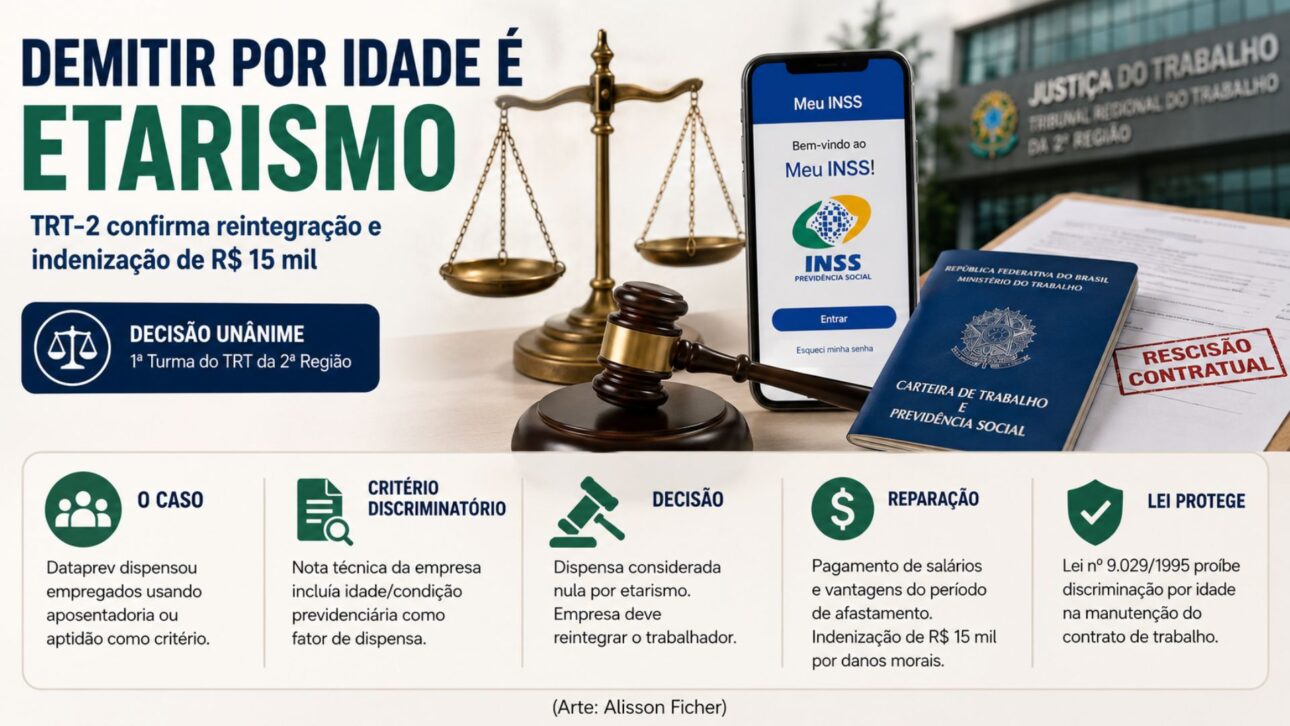
By recording, in an internal document, that retirement or the ability to retire would be parameters for termination, the company linked the dismissal to a characteristic protected by labor and constitutional law.
The judgment also addressed the so-called “distinguishing” in relation to Topic 1022 of the Supreme Federal Court.
According to the rapporteur, public companies must justify the dismissal of employees hired through competitive exams, but this justification needs to be reasonable and cannot assume a discriminatory nature.
Retirement criteria cannot justify discriminatory dismissal
For the 1st Panel, the obligation to justify the dismissal does not transform any reason presented by the company into a legally valid motive.
When the motivation relies on a discriminatory factor, according to the ruling, it ceases to fulfill its function and highlights the illegality of the act practiced by the employer.
The decision noted that age and retirement status were used as determining factors for the dismissal.
Based on this interpretation, the panel considered the dismissal unlawful, as it treated older workers or those close to retirement as a preferential group for cuts.
Law No. 9.029/1995 prohibits discriminatory and limiting practices for access to or maintenance of the employment relationship, including due to age.
The regulation also provides consequences for discriminatory conduct in the employment relationship and serves as a legal basis for protection against exclusion criteria without lawful grounds.
In this context, retirement was not treated by the court as a neutral aspect of the employee’s functional life.
According to the decision, the pension condition functioned as an exclusion filter, which led the panel to classify the conduct as ageism, a practice associated with discrimination based on age.
Reinstatement to employment and compensation of R$ 15,000
With the nullity of the dismissal, TRT-2 ordered the reinstatement of the worker to the previously held position.
The company must also pay the salaries, benefits, and other advantages corresponding to the period during which the employee remained away due to the dismissal considered discriminatory.
The measure has the effect of restoring the employment bond by invalidating the termination.
For this reason, in addition to returning to work, the conviction includes the economic installments that the employee failed to receive during the absence.
The compensation for moral damages, set at R$ 15,000, was also upheld by the Panel.


According to the panel, in cases of discriminatory dismissal, the damage is presumed, or “in re ipsa”, an understanding that dispenses with specific proof of moral damage when the illicit conduct itself affects personality rights.
This point of the decision focuses the analysis on the discriminatory practice recognized in the process.
By considering that the worker’s choice was marked by age or pension criteria, the court understood that the moral damage resulting from undue exclusion was configured.
Limits on the power to dismiss in business restructurings
The decision does not establish an absolute impediment to the dismissal of retired employees or those close to retirement.
The understanding established in the case is that this condition cannot be used as a direct or indirect reason to select workers in layoff processes.
Employers are still authorized to promote internal reorganizations, reduce staff, or alter administrative structures, as long as they observe the legal limits applicable to labor relations.
Even so, the criteria adopted need to be objective, lawful, and compatible with protection against discrimination in the professional environment.
When age or pension status appears as a central element of the dismissal, the business decision may be subject to judicial review.
In the case analyzed by the 1st Panel of TRT-2, the panel confirmed the nullity of the termination and upheld the reparations determined in the sentence.
The judgment also highlights the relevance of internal documents, technical notes, layoff plans, and restructuring programs in investigating business motivation.
These records can demonstrate the criteria used by the company and, when they reveal discrimination, serve as a basis to invalidate the dismissal.
Dataprev alleged the need for modernization and specialization of the staff, but the court understood that this justification did not hold up in light of the criteria adopted.
For the rapporteur, the motivation proved to be unlawful and legally questionable by using the condition of being retired or eligible for retirement as a decisive factor for termination.
The decision was unanimous and upheld the ruling that recognized ageism in the dismissal.
As a result, the reinstatement, payment of the installments for the period of absence, and compensation for moral damages in the amount of R$ 15,000 remain.