






 Portuguese
  Spanish


MIT Researchers Develop Device Capable of Transforming Dry Air into Drinking Water. Device Can Produce Up to 5 Liters of Water Per Day, check it out!
The search for innovative techniques to solve the scarcity of drinking water has led researchers to develop devices capable of capturing moisture from the air, even in extremely dry regions. One example of this innovation is a new technology that uses fins coated with absorbent materials and a copper sheet between layers of foam. This approach promises to be an effective and affordable solution for obtaining drinking water in arid areas.
Check Out the Details About the Device Capable of Transforming Dry Air into Drinking Water
The foams are coated with zeolite, a commercially available crystalline aluminosilicate. The combination enables efficient and rapid availability of drinking water.
Details about the device capable of transforming dry air into drinking water were published in the journal ACS Energy Letters by researchers from the Massachusetts Institute of Technology (MIT) led by Xiangyu Li and Bachir El Fil. The device represents a new hope for arid areas and communities with limited access to safe water sources.
-
Digital Transformation Essential in Energy, Oil, and Gas Industries, But IT Infrastructure Often Overlooked

-
Brazilian Students Repurpose Clay Tea Cups to Create Cooler That Lowers Room Temperature by Up to 10°C Without Air Conditioning or Fans
-
353-Year-Old Mystery Deepens as Archaeologist Arrested with Teeth and Bone Fragment Possibly Linked to d’Artagnan, the Real Musketeer Behind Alexandre Dumas’ Inspiration

-
16-Year-Old Invents CoolTowel, a Fitness Towel That Stays Cold for Up to 2 Hours, Wins Global Alibaba Competition with Over 15,000 Participants, Earning $1 Million




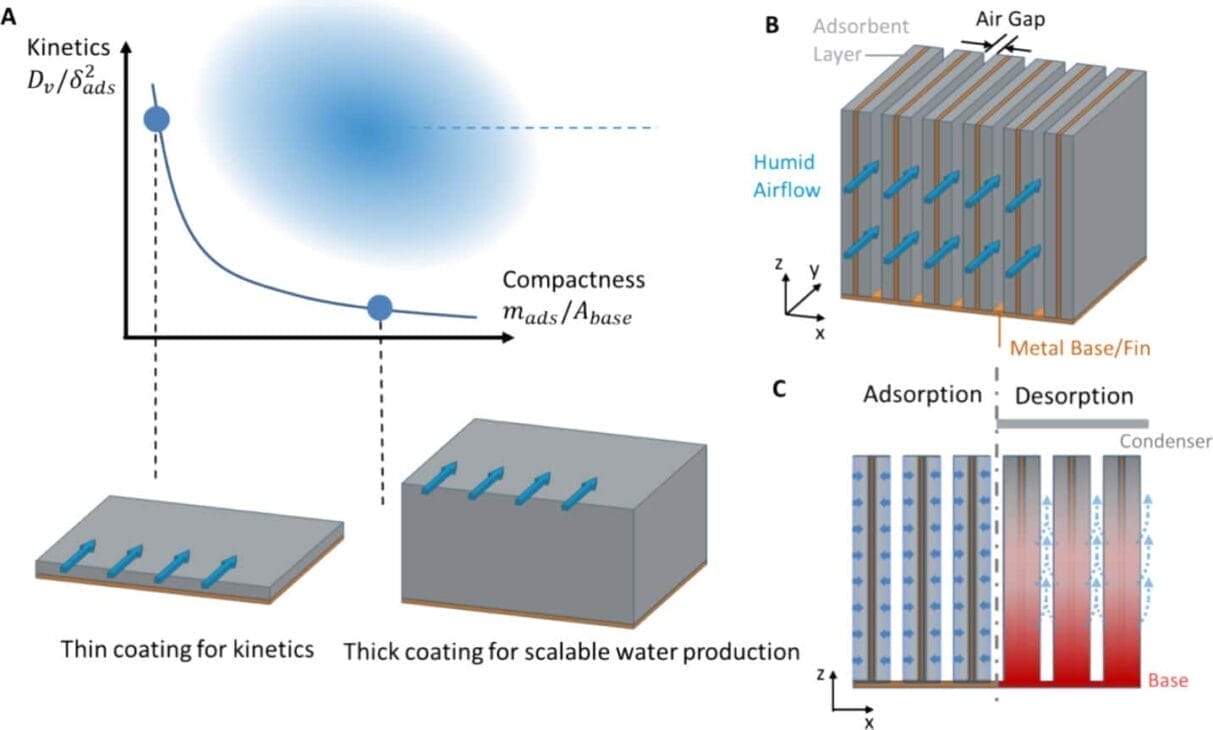
After the fins absorb moisture from the air, they are heated so that the device releases drinking water. In proof-of-concept tests, the device capable of transforming dry air into drinking water was equipped with 10 adsorbent fins arranged side by side on a copper base, separated by a distance of approximately 2 millimeters.
This configuration maximizes moisture capture from the air, even in desert conditions with only 10% relative humidity. In just one hour, the fins absorbed moisture from the air, and when the base reached 184 °C, they released the retained water.
Device Capable of Transforming Dry Air into Drinking Water Can Generate Up to 5 Liters Daily
If the cycle is performed 24 times a day, the device capable of transforming dry air into drinking water can produce up to 1.3 liters of drinking water daily from the adsorbent coating, in air conditions with 30% relative humidity.
The production capacity can increase to 5.8 liters of water per day per kilogram of material used, a quantity sufficient to meet the daily needs of several cities in arid regions. This is a volume two to five times greater than previously developed devices.
The only downside is that the system requires energy to release the water, necessitating that the base of the device capable of transforming dry air into drinking water reaches 184 °C. However, the researchers assure that the device can use waste energy or heat from other systems, such as buildings or vehicles, to operate more sustainably.
According to the researchers in a statement, the work identifies a key opportunity for rapid moisture capture and water collection from the dry air several times a day. With further development, this system could be integrated into existing infrastructures that produce waste heat, such as buildings or transport vehicles, to provide a cost-effective option for generating drinking water in arid regions.
Other Devices That Follow the Same Theme
Another device capable of transforming dry air into water is the Kara Pure, created by Cody Soodeen. This is a drinking water dispenser that promises to revolutionize the way we obtain drinking water. It is not only a response to current concerns about water quality but also an anticipation of future needs.
Soodeen, inspired by his experience in a city where drinking water was contaminated by harmful bacteria, developed the Kara Pure to extract water from atmospheric moisture, transforming it into alkaline mineral water.
This device has the capacity to dispense up to 10 liters of water per day, enriching it with seven rare natural minerals and raising its pH to 9.2+, providing not only hydration but also body purification.


