Portuguese
  Spanish


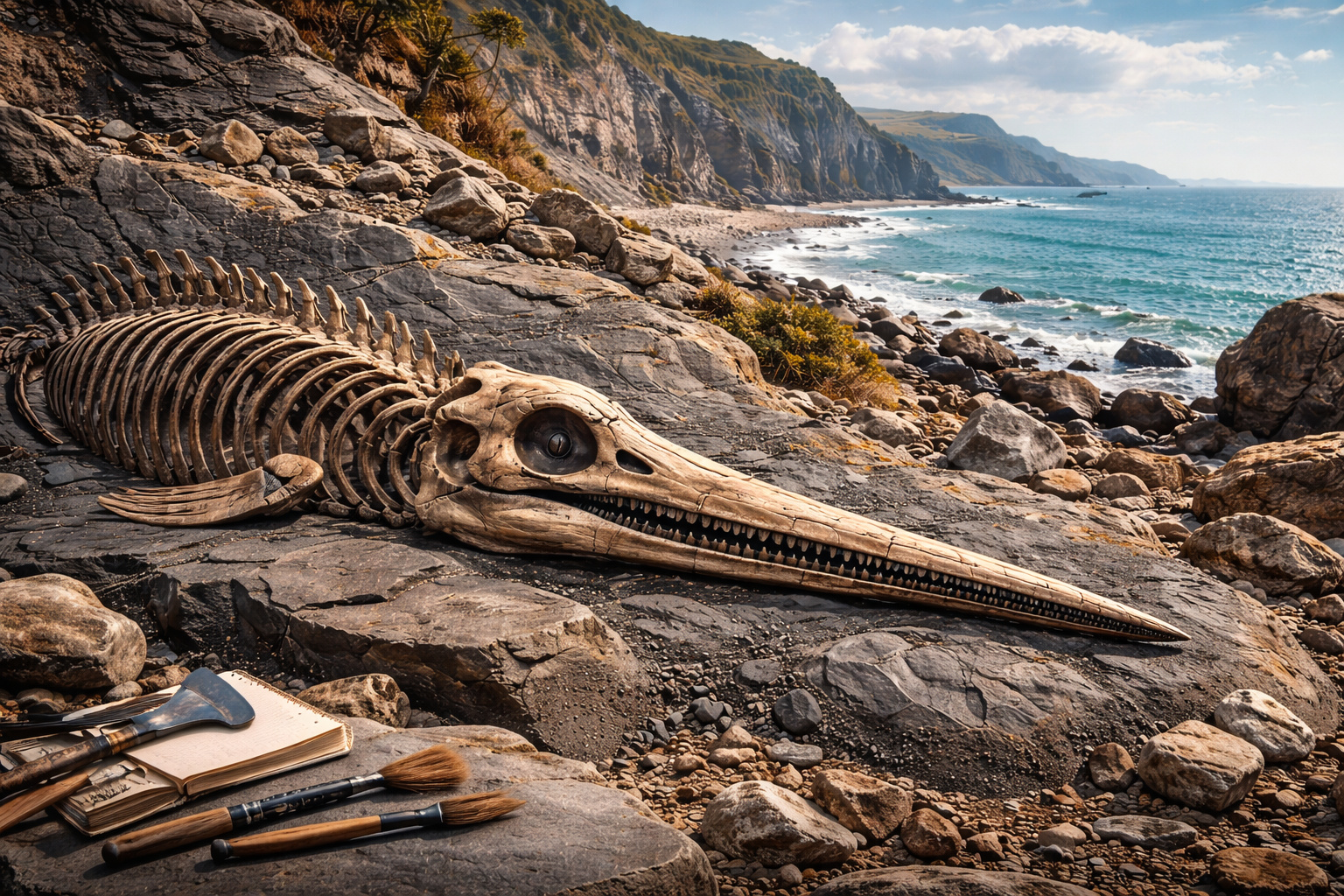


Fossil of Marine Reptile With Sword-Shaped Snout Reveals New Clues About the Evolution of Ocean Giants 190 Million Years Ago.
A newly identified fossil in the United Kingdom is drawing the attention of the scientific community. It is a ichthyosaur about 190 million years old, nicknamed the “Sword Dragon of Dorset”, which had a long, narrow snout resembling a sword. The discovery may reshape our understanding of the diversity and evolution of these prehistoric marine reptiles.
According to a study published in February 2026 by the website ScienceDaily, the fossil exhibits anatomical features never seen so clearly in ichthyosaurs from this period. Moreover, the unusual shape of the snout suggests hunting strategies different from what scientists had previously imagined.
A Rare Fossil Found on the English Coast
The animal remains were found in the Dorset region of southern England, an area known for its rich fossil deposits from the Jurassic period. Although fragments of ichthyosaurs have been discovered there before, this specimen stands out due to the preservation of the skull and, especially, the elongated snout.
-
Brazilian Researcher Develops Protein Supplement from Tilapia Waste, Combining Innovation and Sustainability with Economic Potential

-
Women in São Paulo Unknowingly Tracked by Coin-Sized Tags Hidden in Cars and Belongings, Raising Stalking Concerns
-
Near a $750 million AI data center in Brazil, a resident’s well runs dry, leaving her unable to afford the $25,000 needed for repairs.

-
16-Year-Old from Brazil’s Sertão Wins Young Scientist Award for AI Predicting Rainfall with 94.5% Accuracy to Aid Farmers


According to researchers, the sword-shaped “snout” was not just an aesthetic curiosity. On the contrary, it indicates a functional adaptation, possibly used to strike at prey, reduce water resistance, or catch agile fish.
Thus, the fossil expands the known repertoire of body shapes among ichthyosaurs.
What Makes the “Sword Dragon” Different
Until now, many ichthyosaurs were described as hydrodynamic-bodied animals, similar to modern dolphins. However, the new fossil shows that there was a greater diversity of shapes and ecological niches.
The extremely elongated snout resembles structures seen in some modern swordfish. Therefore, scientists propose the hypothesis that the animal used quick head movements to strike prey.
Additionally, the study indicates that this adaptation arose earlier than previously thought. In this way, the fossil suggests that the evolutionary radiation of ichthyosaurs was quicker and more complex.
Impact on Understanding Marine Evolution
Ichthyosaurs dominated the seas for much of the Mesozoic era. Nevertheless, many details of their evolution remain in debate. The discovery of the “Sword Dragon of Dorset” helps fill important gaps.
According to the study’s authors, the fossil indicates that evolutionary experiments occurred soon after major extinctions, when the oceans offered new ecological opportunities. Thus, innovative body shapes arose rapidly.
This pattern reinforces the idea that marine environments favored an explosion of diversity among prehistoric large predators.


Why the Discovery Draws So Much Attention
The find is impressive not only for its unusual appearance. It also highlights how new discoveries continue to challenge established models of paleontology.
Furthermore, the fossil shows that even regions studied for centuries, such as the English coast, still hide key pieces of the history of life on Earth.
For researchers, the “Sword Dragon” serves as a clear reminder: the fossil record still has much to reveal about the evolution of large marine animals.
Next Steps in Research
The scientific team now aims to conduct more detailed analyses of the skull and bone structure. With this, they hope to better understand how the animal fed and moved.
Additionally, comparisons with other fossils may reveal whether the sword-shaped snout was exclusive to this species or more common than previously thought.
While new answers are still awaited, the “Sword Dragon of Dorset” already occupies a prominent place among recent paleontological discoveries, demonstrating that the history of prehistoric seas is still far from being fully told.