Portuguese
  Spanish


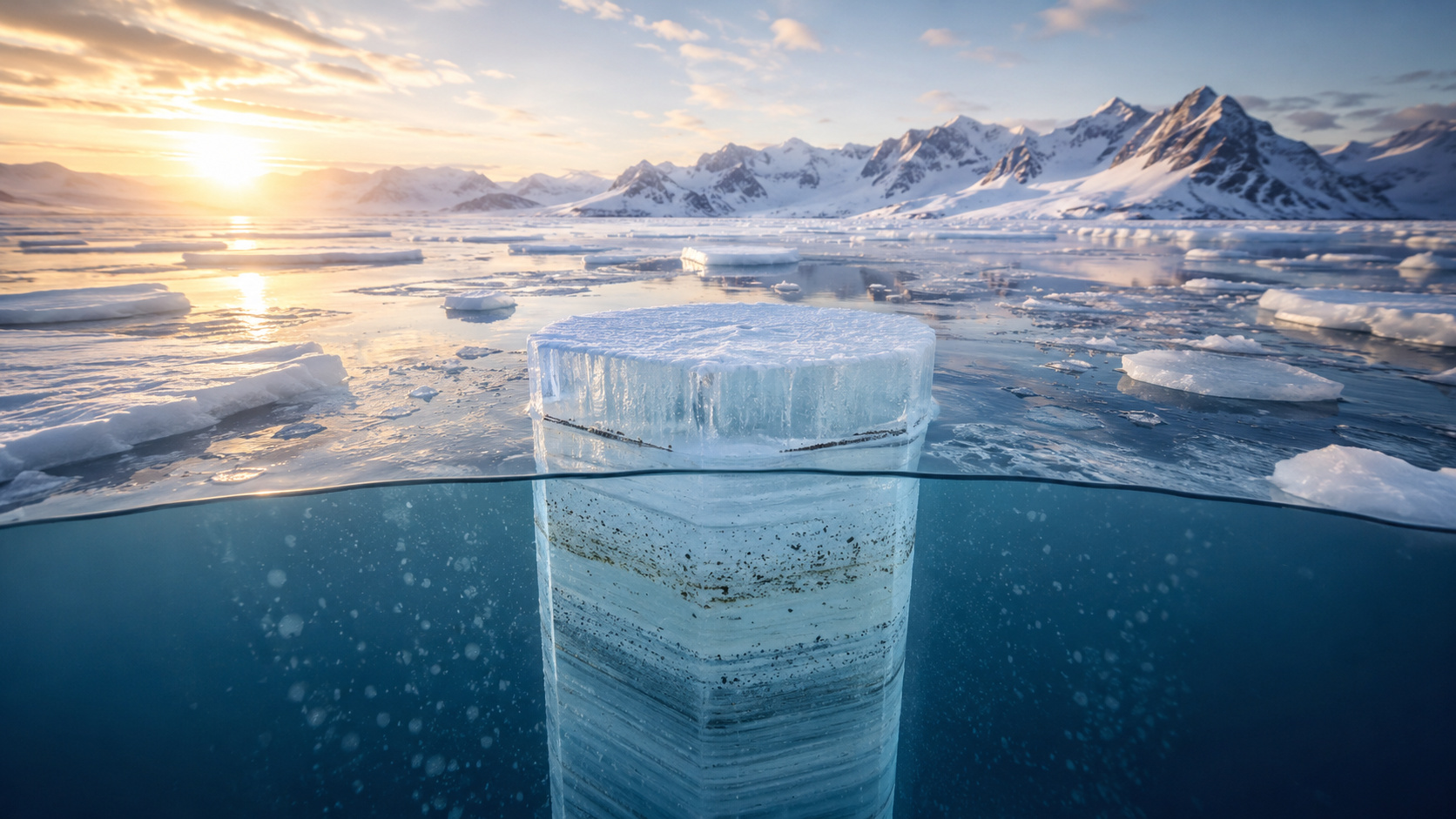

Study uses cosmic dust and helium-3 to reconstruct 30,000 years of Arctic sea ice and indicates unprecedented retreat in the modern era.
According to the University of Washington, a study published on November 6, 2025 in the journal Science reconstructed 30,000 years of Arctic sea ice history with an unprecedented method: measuring the amount of cosmic dust accumulated on the ocean floor. The research was led by isotopic geoscientist Frank J. Pavia, with participation from scientists at the University of Massachusetts Boston, the U.S. Geological Survey, and Caltech.
According to the University of Washington, the logic of the method is simple and powerful. When the ocean is covered by ice, the cosmic dust is trapped on the frozen surface and does not sink to the seabed. When the water is free of ice, this dust normally deposits in the sediment. By measuring the concentration of helium-3, a rare isotope carried by this dust, the researchers were able to identify when certain areas of the Arctic Ocean were covered by ice and when they were open.
Helium-3 allows reconstruction of Arctic sea ice history beyond the satellite era
According to the University of Washington, monitoring of Arctic sea ice by satellite began in 1979, during which time the summer ice extent has fallen by more than 42%. A study cited by the research also projects that the Arctic may record its first completely ice-free day within this decade.
-
Brazilian Researcher Develops Protein Supplement from Tilapia Waste, Combining Innovation and Sustainability with Economic Potential

-
Women in São Paulo Unknowingly Tracked by Coin-Sized Tags Hidden in Cars and Belongings, Raising Stalking Concerns
-
Near a $750 million AI data center in Brazil, a resident’s well runs dry, leaving her unable to afford the $25,000 needed for repairs.

-
16-Year-Old from Brazil’s Sertão Wins Young Scientist Award for AI Predicting Rainfall with 94.5% Accuracy to Aid Farmers


The problem is that less than 50 years of satellite images represent a very short interval on the climate scale. To know if the current ice loss is part of a natural cycle or something truly exceptional, scientists needed a much longer reference. This is precisely where helium-3 changes the game.


According to the University of Washington, helium-3 is practically not produced on Earth in relevant quantities. It arrives on the planet associated with cosmic dust and acts as a clear signature of the amount of material that reached the seabed in each period.
Measuring this concentration in sediment columns allows for direct inference of how much surface was covered or free of ice above that point.
Three sites in the Arctic Ocean revealed different ice patterns over 30 thousand years
According to the University of Washington, researchers chose three sites that represent a gradient of modern ice coverage.
The first is near the North Pole and remains covered year-round. The second is at the seasonal edge of the ice in September. The third was permanently covered in 1980, but today it is seasonally free.

At the site closest to the North Pole, the sediments show consistently low helium-3 over the last 30 thousand years, indicating that ice blocked dust deposition for almost the entire period, with significant interruption only in the early Holocene, between about 8 thousand and 10 thousand years ago.
The second site showed alternation between periods of high and low helium-3, reflecting cycles of ice advance and retreat.
The third, however, presented the most disturbing signal: the location that was permanent ice in 1980 is now seasonally open, and the sedimentary record shows that nothing comparable had happened in the previous 30 thousand years.
The last glaciation shows that the Arctic was once more frozen, but the current change is much faster
According to the University of Washington, during the last glacial maximum, about 20 thousand years ago, the three analyzed sites showed very low levels of helium-3, indicating that the central Arctic was covered with ice year-round, without the seasonal variation observed today.
Then, starting about 15 thousand years ago, the concentration of helium-3 began to rise at all points, showing that the ice began to retreat.

The early Holocene, between 8,000 and 10,000 years ago, recorded even higher levels of helium-3 in some sites, suggesting that the Arctic once had less ice during natural warming phases.
The critical difference, according to the University of Washington, is in the speed. The natural warming of the Holocene occurred over millennia. The current warming is happening in decades, and it is this acceleration that makes the recent loss of sea ice an especially concerning event.
Less sea ice in the Arctic changes the light, the phytoplankton, and the entire food chain
According to the University of Washington, the discovery is not just about the ice itself, but also about the life that depends on it. When ice covers the sea surface, it blocks sunlight, limiting the photosynthesis of phytoplankton, the base of the marine food chain.
When the ice retreats in summer, the increase in light triggers phytoplankton blooms that feed zooplankton, fish, seals, polar bears, and also human populations that depend on fishing in the Arctic. According to researchers, the study documented this relationship directly. Where there was more helium-3, and therefore less ice, there were also more markers of nutrient consumption by phytoplankton.
This means that the retreat of Arctic sea ice alters not just the landscape, but the entire ecological dynamics of the ocean.
The change in the rhythm of water coverage and exposure reorganizes the productive base of the food chain in one of the planet’s most sensitive regions.
Cosmic dust could become the new historical measure of Arctic sea ice
According to the University of Washington, the greatest contribution of the method developed by Frank J. Pavia is not only in what it has already shown, but in what it may still reveal. The study analyzed three sites over 30,000 years, but well-preserved sediments can go back 100,000 years or more in some parts of the Arctic.

With longer series and new collection sites, scientists will be able to reconstruct multiple glacial cycles and more accurately understand the spatial and temporal patterns of sea ice loss. According to Pavia, this can help improve projections on warming, food chains, fishing, and geopolitical changes.
The geopolitical dimension is also direct. A seasonally ice-free Arctic opens maritime routes between the Atlantic and Pacific, shortens trade routes, and expands disputes between the United States, Russia, Canada, Norway, and Denmark.
Stardust and comets, silently falling on the planet for billions of years, have become one of the most precise tools for measuring the speed at which this new ocean is emerging beneath the ice.