Portuguese
  Spanish


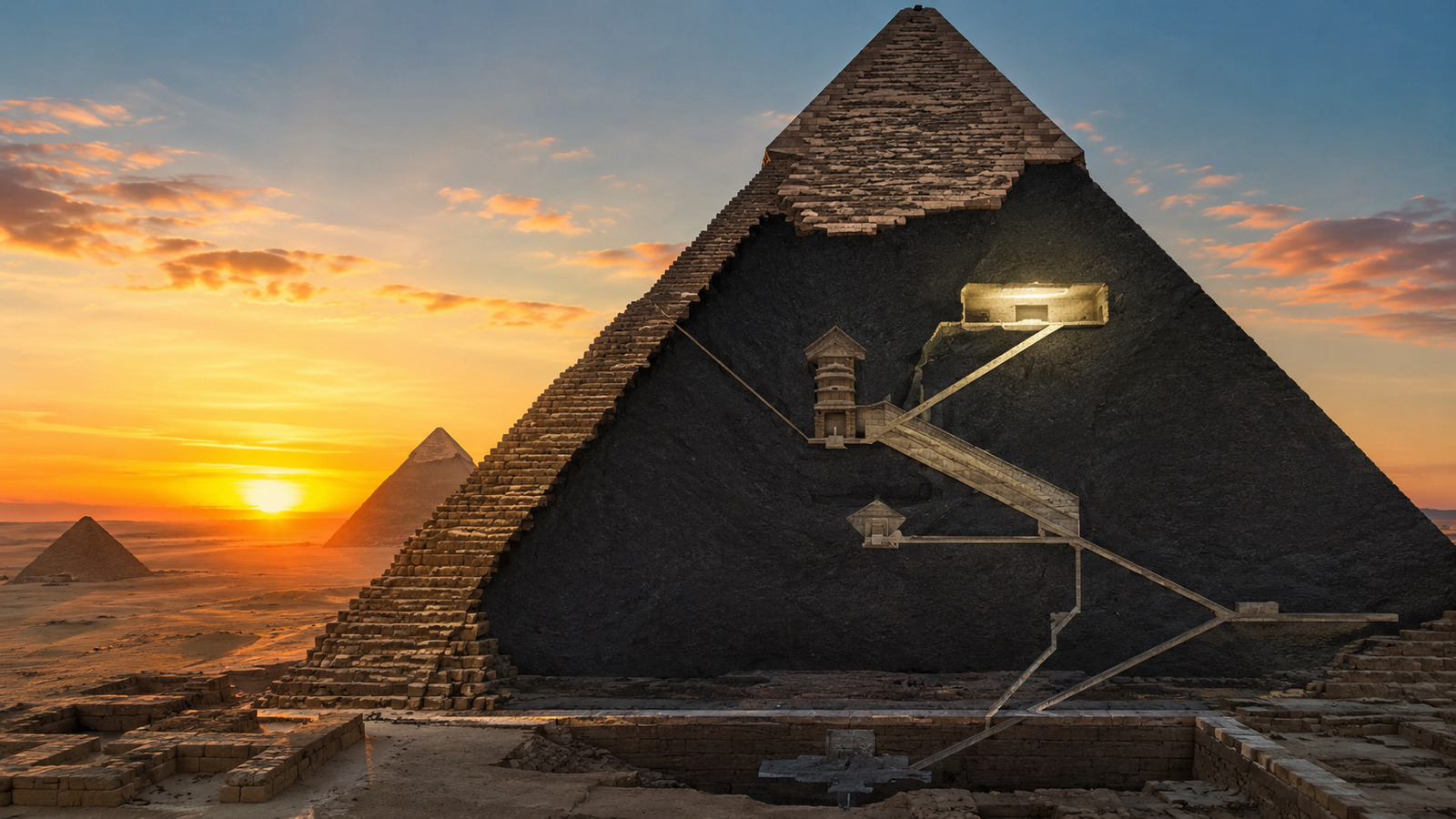

Egypt prepares for 2026 the revelation of a 30-meter chamber in the Great Pyramid, discovered by non-invasive technology after more than 4,500 years closed
The secret chamber, about 30 meters long, inside the Great Pyramid of Giza is expected to have its contents revealed in 2026 by Egypt, after remaining closed for over 4,500 years.
Hidden space raises global anticipation
The announcement gained momentum after statements by Egyptologist Zahi Hawass, former Minister of Antiquities of Egypt, during the Sharjah International Book Fair in the United Arab Emirates, in November 2025.
Hawass stated that what lies behind the door “will rewrite the history of the pyramids.” He said that researchers found “a 30-meter chamber inside the Pyramid of Khufu, with a door at the end.”
-
How Much Does Starlink Satellite Internet Cost for Cars, Trucks, and RVs? Prices for Antenna, Accessories, and Plans

-
Scientists Convert Food Waste into Aviation Fuel, Successfully Test 50% Blend with Conventional Kerosene to Cut Emissions and Promote Sustainable Flights
-
OnePlus N6 Smartphone to Launch in India with 8,000mAh Battery and 45W SuperVOOC Charging, Lasting Up to Three Days
-
Scientists Plan to Release Air Bubbles Underwater to Protect Antarctica’s “Doomsday Glacier” from Melting




The Egyptologist added that, next year, the world will know what is behind that door. The prediction placed the secret chamber at the center of attention for archaeology related to Ancient Egypt.

Big Void identified without excavations
The structure is known to scientists as the “Big Void.” It was originally identified in 2017 by the ScanPyramids project, in a study published in the scientific journal Nature.
The space is located above the Grand Gallery, one of the pyramid’s most impressive corridors. The location was determined using modern technologies, without the need for excavations inside the structure.
Researchers used muography, a technique that analyzes cosmic particles capable of penetrating stone. With radar and ultrasound, it was possible to create a kind of X-ray of the pyramid’s interior.
Three independent teams arrived at the same result, which reinforced the credibility of the discovery. Researcher Christian Große stated that the chamber is large enough to accommodate several people.
Before the announcement of the Big Void, only five large internal spaces of the Great Pyramid were officially known. The discoveries of 2017 and 2023 were the first major structures found in the monument since the 19th century.
Hidden corridor reinforced confidence in exploration
In 2023, the same team revealed another important find: a hidden corridor about nine meters long concealed behind the pyramid’s north face.
Scientists accessed the site with a small endoscope inserted between stone blocks. The operation recorded unprecedented images of the structure’s interior.
The success of this action increased researchers’ confidence in the possibility of exploring the larger secret chamber planned for 2026. The experience showed that the investigation can proceed with care and technology.
Despite global anticipation, Hawass stated that any revelation will first depend on detailed scientific analysis. The investigation will be conducted with technical studies and non-invasive sensors.


Hypotheses range from tomb to architectural structure
Among the hypotheses discussed by experts are a possible hidden burial chamber, a structure created to relieve weight on the Grand Gallery, or an architectural space still unknown to archaeology.
Hawass also commented on personal desires related to the discovery. He declared his hope of discovering the tomb of Imhotep, architect of the first pyramid, and the tomb of Queen Nefertiti.
The whereabouts of Imhotep’s tomb have never been officially confirmed. Nefertiti also remains among the most mysterious figures of Ancient Egypt, with her burial place unknown to this day.
Pyramid brings together history, tourism, and research
The Great Pyramid was built during the reign of Pharaoh Khufu, known as Cheops, around 2600 BC. The monument consists of approximately 2.3 million stone blocks.
Originally, the construction reached 146 meters in height. The possible opening of the secret chamber is also seen by the Egyptian government as an opportunity to boost archaeological tourism.
International interest grew after the inauguration of the Grand Egyptian Museum in 2025, a complex that brings together thousands of pieces from Tutankhamun’s treasure.
So far, the scientific report promised for 2026 has not yet been released. The official opening date should be confirmed by Egyptian authorities and those responsible for the ScanPyramids project.
With information from Correio 24 Horas.