






 Portuguese
  Spanish


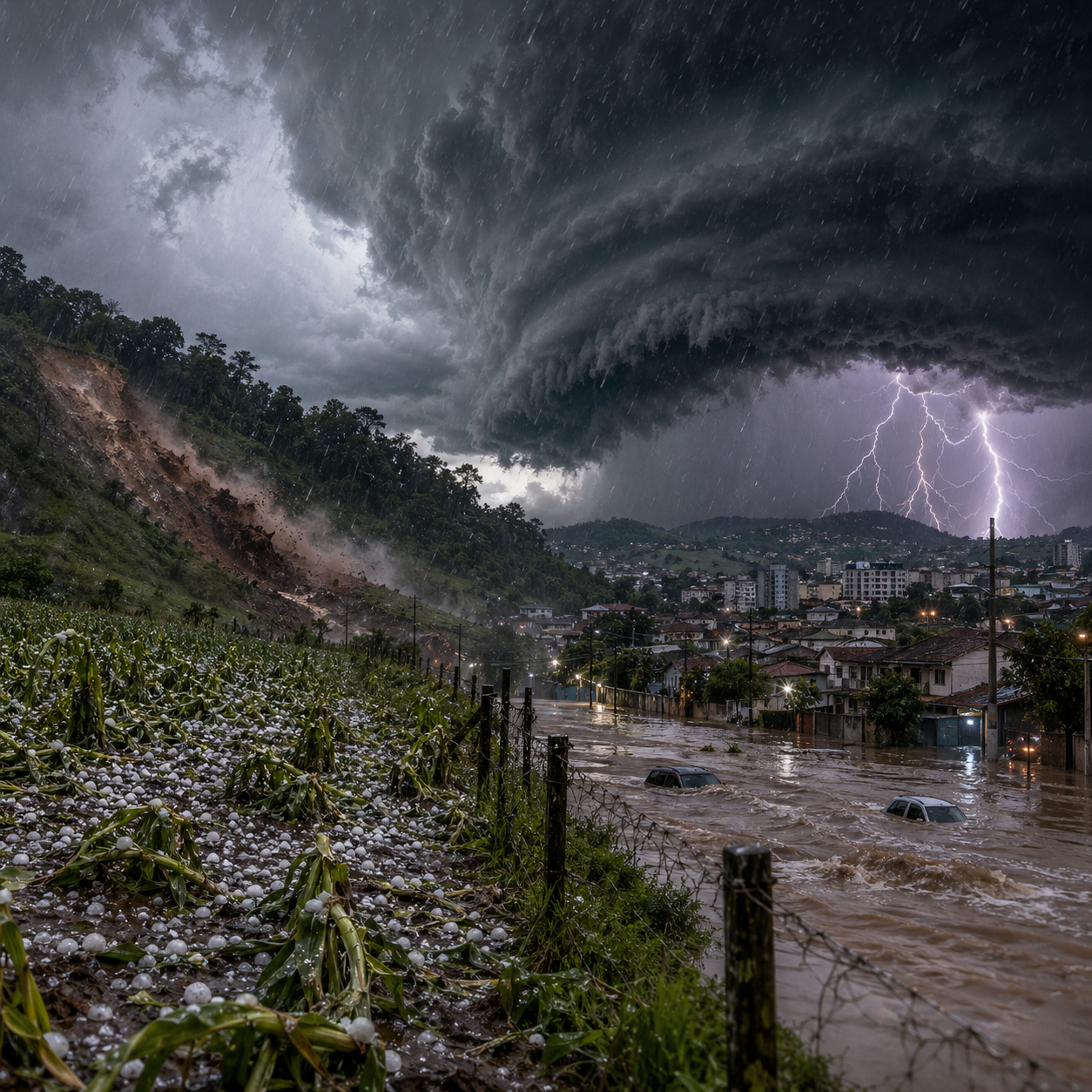

El Niño 2026 may increase rain, hail, and storms in Southern Brazil, increasing the risk of floods, landslides, and agricultural losses.
According to Epagri/Ciram and the State Secretariat for Protection and Civil Defense of Santa Catarina, in a joint weather note published on April 15, 2026, there is an 80% probability of El Niño formation between July and August, with a tendency to persist throughout spring and summer. The update is based on data from the NOAA Climate Prediction Center, the meteorological agency of the United States, and represents the most recent assessment available on the phenomenon.
The scenario is supported by the accelerated warming of the Equatorial Pacific waters observed in recent months. There is still uncertainty regarding the final intensity of the event, with about a 25% chance of a very strong El Niño, but the expected impacts for Southern Brazil follow a well-known pattern: increased rainfall, greater frequency of cold fronts, severe storms with strong winds and hail, as well as a high risk of flash floods, inundations, and landslides.
Understand what El Niño is and how Pacific warming alters the global climate
The El Niño is a climatic phenomenon characterized by the anomalous warming of the waters of the Equatorial Pacific Ocean. This warming alters global atmospheric circulation.
-
Real Estate Agent Buys Marvel Movie Subway Car for $5,000 and Converts It into Themed Airbnb
-
Real Estate Agent Buys Marvel Movie Subway Car for $5,000 and Converts It into Themed Airbnb
-
Former Roma and Fiorentina Player Filipe Gomes Returns to Brazil to Found Empório do Galeto, Aiming for $10 Million Revenue by 2026
-
Canada Builds 6.2-Hectare Containment Box to Trap 615,000 Cubic Meters of Toxic Sediment in Lake Ontario


With the increase in sea surface temperature, the trade winds weaken, allowing warm waters to move towards the Central and Eastern Pacific. This process modifies convection, rainfall, and temperature patterns in various regions of the planet.
Difference of El Niño impacts between South, North, and Northeast Brazil explains climatic extremes
In Brazil, El Niño causes distinct effects among the regions. In the North and Northeast, it tends to reduce rainfall due to changes in atmospheric patterns at altitude. In the South, the opposite effect occurs: an increase in the frequency of cold fronts, greater moisture influx, and persistence of weather systems.

The result is a scenario of above-average rainfall, especially during spring and summer, when the region already experiences higher precipitation volumes. Historical events show the recurrence of severe impacts associated with El Niño.
The episodes of 1982/1983, 1997/1998, 2015/2016, and 2023/2024 recorded floods, landslides, and significant losses in agriculture and infrastructure.
In 2023, municipalities in Paraná recorded rainfall volumes in a single day exceeding the monthly average. In Dois Vizinhos, for example, there were 296 mm in 24 hours, while the historical average for October is 243 mm. Agricultural losses in the state were estimated at around R$ 2.5 billion.
Hail formation is directly linked to convective storms intensified by El Niño
Hail is the result of intense convective storms that develop in clouds with great vertical extent.
For its formation, three main conditions are necessary: warm and humid air at the surface, cold air at altitude, and strong updrafts.
El Niño favors this environment by increasing humidity and atmospheric instability, creating ideal conditions for storms with hail.
Paraná concentrates the highest frequency of hail in Brazil due to a combination of climatic and geographical factors
Paraná has the highest historical frequency of hail occurrence in Brazil. This condition results from a combination of factors such as subtropical latitude, plateau relief, and strategic position concerning cold fronts coming from the south. During El Niño events, the frequency and intensity of these occurrences tend to increase.
Santa Catarina has developed the Spring Operation as a strategy for preparing for extreme weather events.
The program involves preventive actions in the 295 municipalities of the state, including river cleaning, reinforcement of drainage systems, slope stabilization, and training of response teams.
In 2026, the operation includes the II El Niño Workshop, bringing together experts to update strategies and define action protocols.
Meteorological monitoring in Paraná uses advanced network to predict storms and issue alerts
Paraná has Simepar, an environmental monitoring system that operates one of the most advanced networks in the country.
The structure includes automatic rain gauges, monitoring cameras, and short-term forecasting models, used for issuing alerts by Civil Defense. This system allows for the anticipation of extreme events, such as storms, strong winds, and hail.
If confirmed, the phenomenon is expected to intensify throughout the second half of 2026.
The peak is expected between spring and the beginning of summer, a naturally rainier period in Southern Brazil. The combination of factors increases the risk of extreme events concentrated in short periods, enhancing flooding and landslides.
Agricultural sector faces high risk with excess rain during planting and harvesting
El Niño creates specific challenges for agribusiness. Above-average rainfall can benefit initial planting but harm the harvest, especially for crops like wheat, barley, soybeans, and corn.
The concentration of precipitation in short periods increases the risk of productive losses. An additional factor for 2026 is the warming of the Atlantic Ocean.

Higher temperatures increase evaporation and the amount of water vapor in the atmosphere, providing more energy for storms. This scenario can amplify the traditional effects of El Niño.
Now we want to know: is Southern Brazil prepared to face a new cycle of extreme events in 2026?
The projected scenario indicates an increase in the frequency and intensity of extreme climatic events.
In your view, are the current monitoring and prevention systems sufficient to reduce impacts, or is the risk likely to grow in the coming years?








