






 Portuguese
  Spanish


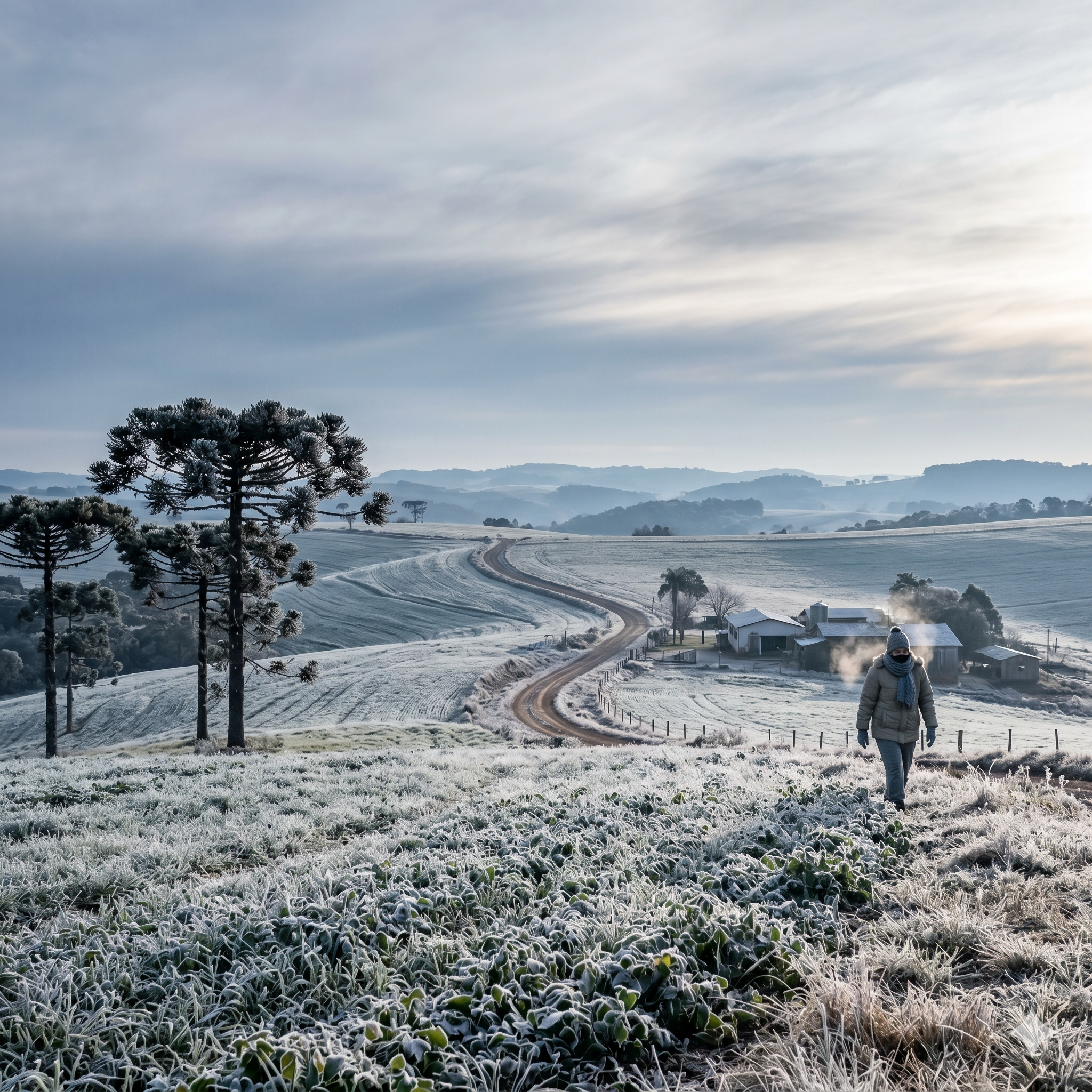

Polar air mass advances over Paraná with intense cold, icy wind, and risk of frost, marking the strongest episode of 2026 so far.
By the end of April 2026, the advance of a cold air mass of polar origin places Paraná on the path of an abrupt weather change, with a sharp drop in temperatures, lower wind chill due to the wind, and risk of frost in the state’s higher areas. According to Climatempo, in an analysis signed by meteorologist Gustavo Verardo, this is the most intense cold air mass of 2026 so far in Southern Brazil, entering through Rio Grande do Sul on Sunday night, the 26th, with stronger effects between Monday, the 27th, and Tuesday, the 28th.
The change also appears in the projections from MetSul Meteorologia, published on April 22, 2026, which indicate a cold air incursion associated with an extratropical cyclone in the South Atlantic, a system capable of pushing cold air from higher latitudes towards Southern Brazil. For Paraná, the alert focuses mainly on the South of the state, where early Tuesday, the 28th, may register temperatures below 10 °C and lows around 5 °C or lower in some localities, while Simepar already pointed out, in April, the possibility of frost in higher regions, such as Centro-Sul, Palmas, General Carneiro, and Guarapuava.
What is striking is not just the cold itself, but the speed with which it arrives and how it completely alters the thermal dynamics in just a few days.
-
Real Estate Agent Buys Marvel Movie Subway Car for $5,000 and Converts It into Themed Airbnb
-
Real Estate Agent Buys Marvel Movie Subway Car for $5,000 and Converts It into Themed Airbnb
-
Former Roma and Fiorentina Player Filipe Gomes Returns to Brazil to Found Empório do Galeto, Aiming for $10 Million Revenue by 2026
-
Canada Builds 6.2-Hectare Containment Box to Trap 615,000 Cubic Meters of Toxic Sediment in Lake Ontario


Cold dawns and rapid temperature drop change the state’s climate pattern
With the arrival of polar air, Paraná is expected to register significantly colder dawns, with temperatures below 10 °C in several regions. In higher altitude areas, especially in the central-south of the state, values may drop even further, approaching levels typical of the coldest periods of the year.
This type of drop does not occur gradually. After the passage of instabilities that can cause rain and increased cloudiness, the sky tends to clear, allowing for a rapid loss of heat during the night. This process favors intense surface cooling, creating ideal conditions for lower minimums.


The abrupt change transforms the environment in a few hours, causing relatively mild days to be followed by dawns with an intense cold sensation.
Wind associated with the cyclone amplifies thermal sensation and intensifies discomfort
Another determining factor in this episode is the wind. The presence of the extratropical cyclone in the ocean generates an atmospheric circulation that favors the entry of cold air accompanied by gusts, especially in the first moments of the weather change.
Even when thermometers indicate single-digit temperatures, the wind chill can be even lower due to constant wind. This happens because moving air accelerates the body’s heat loss, intensifying the perception of cold.
In practice, thermal discomfort tends to be more intense than the numbers suggest, especially during the night and in the early morning hours.
Frost can affect elevated areas and expose rural vulnerability
With the stabilization of the cold air mass and the reduction of winds during the early morning, a new factor of attention arises: the possibility of frost. This phenomenon occurs when the air near the ground cools enough to freeze the moisture present on the surface, forming a thin layer of ice on plants and objects.
In Paraná, the most susceptible regions are those with higher altitudes, where cooling is more intense. This scenario is usually observed in the central-south of the state and in areas near the border with Santa Catarina.
The formation of frost represents a direct risk to agriculture, especially for crops sensitive to low temperatures, which can suffer damage within a few hours of exposure.
Sequence of events reveals typical pattern of more intense cold in Southern Brazil
The episode follows a classic dynamic of the strongest cold events in the Southern region. Initially, the passage of a low-pressure system causes instability and rain. Subsequently, the advance of the polar air mass rapidly drops temperatures. Finally, with the entry of drier air and clear skies, the most intense cooling occurs during the early morning.

This sequence of events creates the ideal conditions for the combination of cold, wind, and frost, especially during transition periods like autumn.
The repetition of this pattern over the years shows how the interaction between atmospheric systems can produce more severe cold episodes even outside of winter.
Thermal contrast highlights the transition from autumn to a colder pattern
Before the arrival of the polar mass, the state still presented typical characteristics of a milder autumn, with moderate temperatures during the day. The entry of cold air completely alters this scenario, creating a striking contrast between the previous days and the new climatic pattern.
This type of transition highlights the climate variability in Southern Brazil, where abrupt changes can occur in short intervals of time.
The result is a sensation of climatic rupture, where the environment rapidly shifts from a comfortable pattern to a scenario of more rigorous cold.
Impacts go beyond temperature and affect urban routine and infrastructure
The arrival of intense cold not only affects thermal perception but also the routine of cities. The drop in temperature increases the demand for heating in homes, alters daily habits, and can impact sectors such as transportation and services.

In regions less prepared for more intense cold episodes, the impact tends to be more noticeable, especially in areas where the infrastructure is not adapted for lower temperatures.
The cold ceases to be merely a meteorological phenomenon and begins to directly influence the functioning of cities.
Given this scenario, is Paraná prepared for increasingly intense cold episodes outside of winter?
The entry of the polar air mass at the end of April reinforces the idea that more intense events can occur outside the traditional winter period, changing how the climate is perceived throughout the year.
With cold mornings, persistent wind, and the risk of frost, the state faces an episode that combines different impact factors in a short period.
The question that arises is direct: Is Paraná prepared to deal with more intense and frequent cold episodes during transition periods, when the population and infrastructure are not yet fully adapted to this type of condition?








