





 Portuguese
  English
  Spanish
  6 min of reading
  0 comments


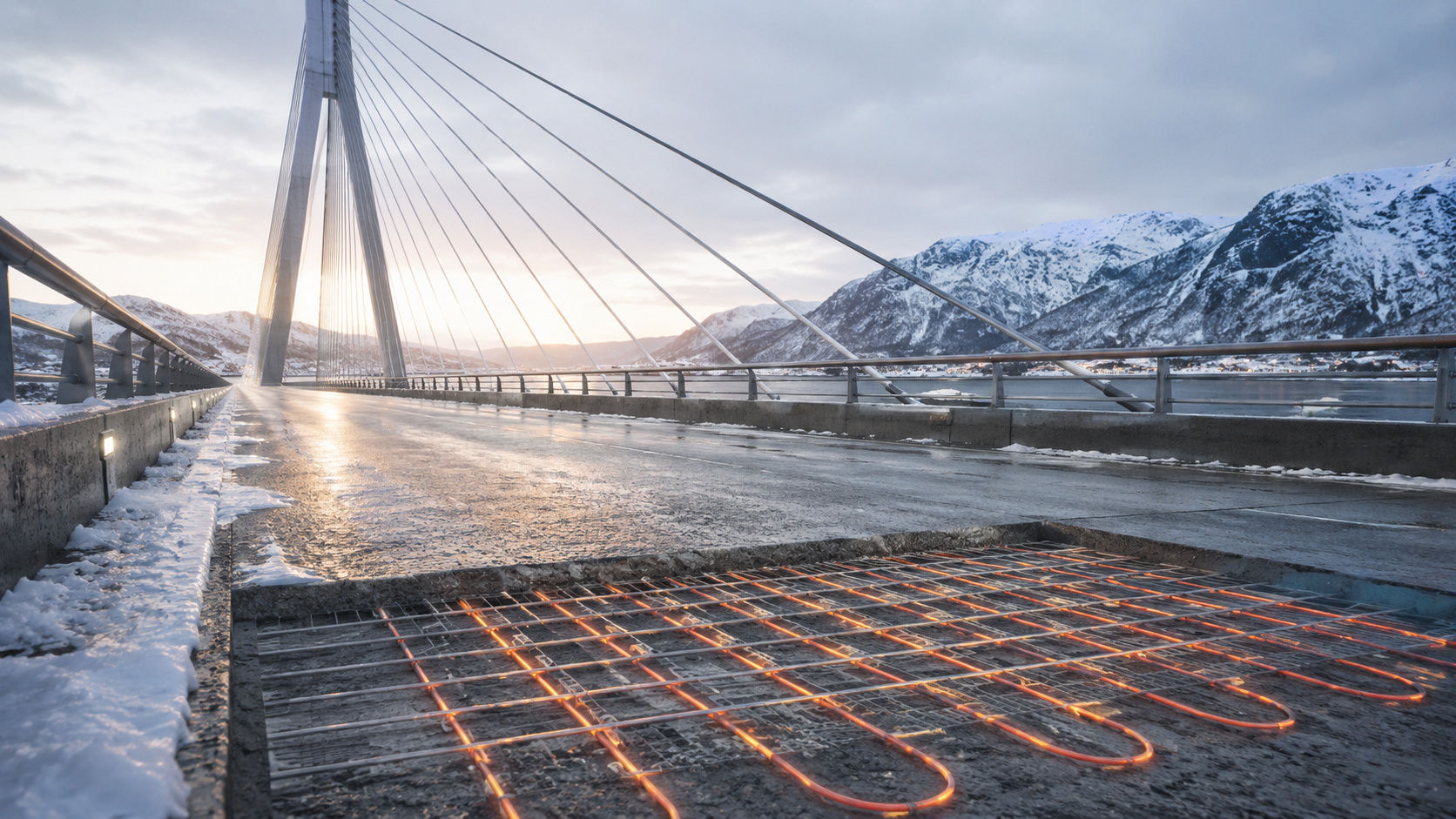
Electrically conductive concrete has already been tested on a real bridge and can heat pavements, melt ice, and reduce risks on highways and airports.
When snow and ice hit a highway, the traditional response usually relies on salt, machines, and emergency crews. But researchers in the United States have been developing an alternative that changes the logic of the problem: instead of removing the ice after it appears, transform the structure itself into a heated surface. According to the Nebraska Department of Transportation and the Federal Aviation Administration, the so-called electrically conductive concrete has already been studied on bridges and airport pavements as a de-icing and anti-icing solution.
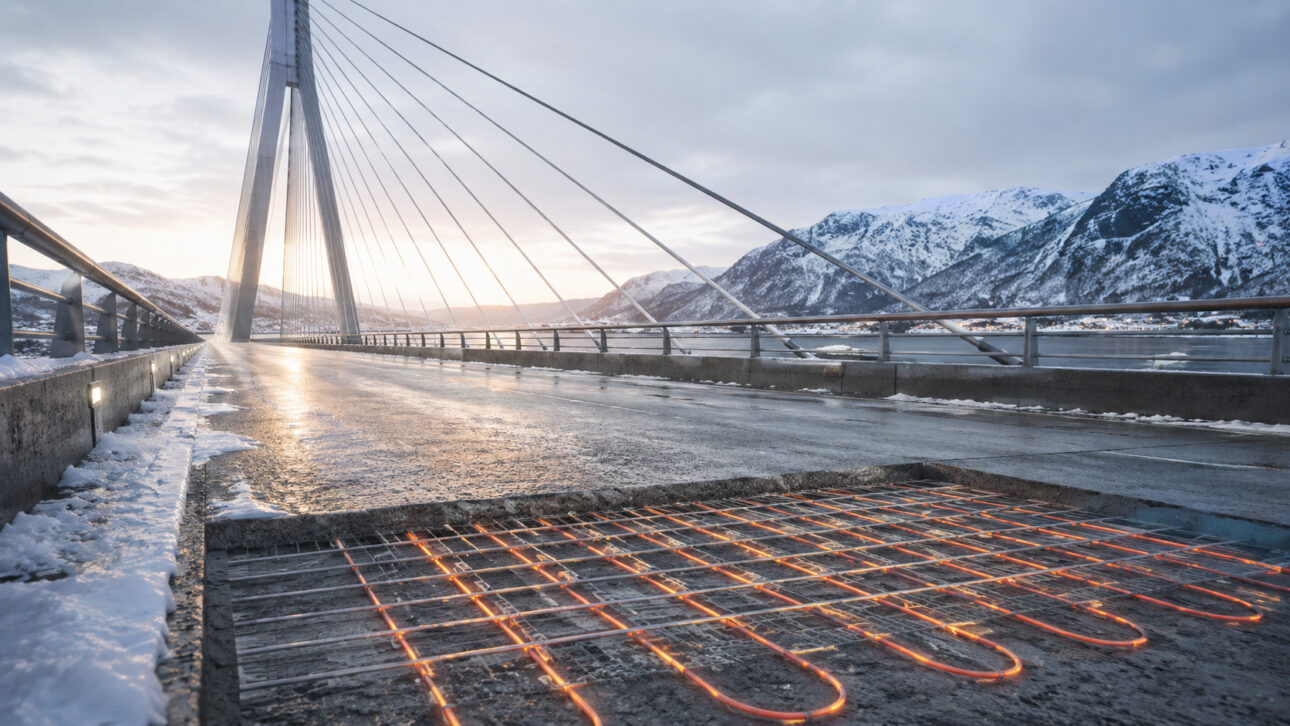
The proposal is simple in concept and sophisticated in engineering. The concrete receives conductive materials in its composition and, when connected to a power source, starts to generate heat by the Joule effect. In practice, this allows bridges, airport runways, and other critical surfaces to function as a large embedded heating system, reducing ice formation and increasing operational safety in winter.
Electrically conductive concrete ceases to be just a structure and becomes a heating system
According to the Nebraska Department of Transportation, conductive concrete is produced with the addition of components capable of allowing the passage of electric current without losing the necessary strength for structural use. When this current passes through the material, the electrical resistance converts part of the energy into heat, warming the pavement surface.
-
City in RS completes lifting of 8 beams of the new Arno Inácio Utzig Bridge with an operation that mobilized 4 cranes and 4 trucks, marking a decisive advancement in the construction and now paving the way for abutments and passageway.

-
Engineer builds house with over 100,000 old newspapers and impresses with its durability; known as Paper House, the property has walls with 215 layers of varnished newspaper and furniture where it is still possible to read headlines from more than a century ago.
-
A couple swapped Rio Grande do Sul for a styrofoam house facing the sea in Santa Catarina and went viral by revealing why they opted for EPS walls reinforced with steel and concrete to live near the beach.

-
Labor shortage halts construction in Canada: the country rushes to build houses, bridges, and billion-dollar projects while mass retirements turn carpenters, electricians, welders, plumbers, and machine operators into highly sought-after professionals by companies.






This means that, externally, the structure may look like a common concrete slab. The difference lies in the internal composition and the electrical power system, designed to activate heating at times when there is a risk of ice or snow. Instead of relying solely on chemical agents or subsequent cleaning, the technology acts preventively on the surface.
This type of solution is especially relevant in areas where freezing occurs faster than on the rest of the road. It is precisely for this reason that the first applications focused on bridges and airport pavements, two areas where ice poses a high risk and requires a quick response.
Bridges freeze before the road and became the initial target of technology
Bridges tend to freeze before the rest of the roadway because cold air circulates both above and below the structure, accelerating the surface’s heat loss. According to the Nebraska Department of Transportation, it was precisely to address this type of risk that research on conductive concrete advanced as a solution for deicing and anti-icing on bridge decks.

The Nebraska technical report documents the development and testing of a specific mixture aimed at bridge overlay, that is, a conductive layer applied over the structural surface to heat the deck and reduce ice formation. The goal was not only to prove the concept in the laboratory but to observe its performance in a real winter environment.
This approach drew attention because it directly addresses one of the most critical points of road safety in the cold. Instead of waiting for the bridge to freeze and then acting, the system can be turned on before or during the weather event, keeping the surface in a safer condition.
Nebraska took heated concrete to a real bridge in Roca
According to the Nebraska Department of Transportation, the technology left the laboratory and was implemented in a demonstration project on the Roca Spur Bridge, south of Lincoln, Nebraska. The site received a layer of conductive concrete equipped with sensors to monitor heating, electrical consumption, and performance during winter storms.
The project was created precisely to verify if the system could keep the bridge surface ice-free under real conditions. The report describes the development of the mixture, the natural field tests, and the implementation of the technology as part of the effort to create practical operation guidelines for the heating system.
This point is central because it shows that heated concrete was not restricted to the experimental environment. There was application in real infrastructure, with technical monitoring and an explicit focus on operational performance under snow and ice.
FAA began studying conductive concrete in airports to reduce ice on critical pavements
According to the Federal Aviation Administration, the technology has also begun to be studied for use in airport pavements, where snow and ice increase costs, operational delays, and safety risks. One of the FAA reports analyzed the feasibility of airfield heated pavements using conductive concrete as a basis for anti-icing systems.
In these studies, the interest was not limited to main runways. The FAA evaluated the potential for use in areas such as taxiways, operational support regions, and other sensitive points where ice accumulation directly affects airport movement. The logic is the same as for bridges: heat the surface before the ice consolidates.
The value of this application lies in the fact that airports spend large amounts on snow, chemicals, interruptions, and team mobilization. A pavement that can actively participate in thermal control can reduce part of this dependency, especially in critical operational areas.
The concrete mix needs to balance electrical conductivity and structural strength
One of the major challenges of heated concrete is that it cannot just conduct electricity. It also needs to continue being engineering concrete, capable of withstanding traffic, load, and environmental exposure for many years. According to the Nebraska Department of Transportation, developing the mix required finding a balance between electrical conductivity and mechanical performance.

To achieve this, the research tested the incorporation of conductive materials into the cementitious matrix. The goal was to create an efficient path for electrical current without compromising the integrity of the structure. This is one of the reasons why the advancement of the technology depends so much on formulation as well as electrical engineering and operational control.
In the FAA’s airport studies, the discussion also appears linked to energy cost, automation of activation, and the need to make the system viable on a large scale.
In other words, the technology has already shown potential, but it still needs to overcome efficiency and implementation barriers to move from strategic uses to broader applications.
Concrete of the future can heat bridges and pavements before ice appears
The advancement of conductive concrete shows how one of the most used materials in engineering history can gain a new function. According to the Nebraska Department of Transportation and the FAA, there is already enough technical basis to demonstrate that the idea works in real situations and has the potential to reduce risks in strategic infrastructure points.
There are still economic and operational challenges before broader adoption, but the principle has already been proven: bridges and pavements can be transformed into heated surfaces, capable of preventing or reducing ice formation with the structural material itself.
If the technology continues to evolve, the concrete of the future will not only serve to support vehicles and aircraft. It could also act as an active thermal protection system, combating snow and ice before they even become a real risk.








Be the first to react!