Portuguese
  Spanish


The Arno Inácio Utzig bridge advanced in Picada Café with the lifting of eight structural beams on May 28 and 29. The operation mobilized cranes, trucks, and specialized teams, paving the way for abutments, passageway, and completion of one of the main stages of the local municipal project.
The construction of the new Arno Inácio Utzig bridge advanced in Picada Café, in Rio Grande do Sul, with the completion of the lifting of the eight beams that form the main supporting structure of the project. The operation used cranes and trucks on May 28 and 29 and marked one of the most important stages of the project.
The work involved specialized teams, four cranes, four support trucks, and logistical planning to position the pieces on the previously installed bases. The information was published by Expansão on June 1, 2026, showing that the project now moves on to the preparation of the abutments and the passageway.
Lifting of the beams marks decisive progress in the project
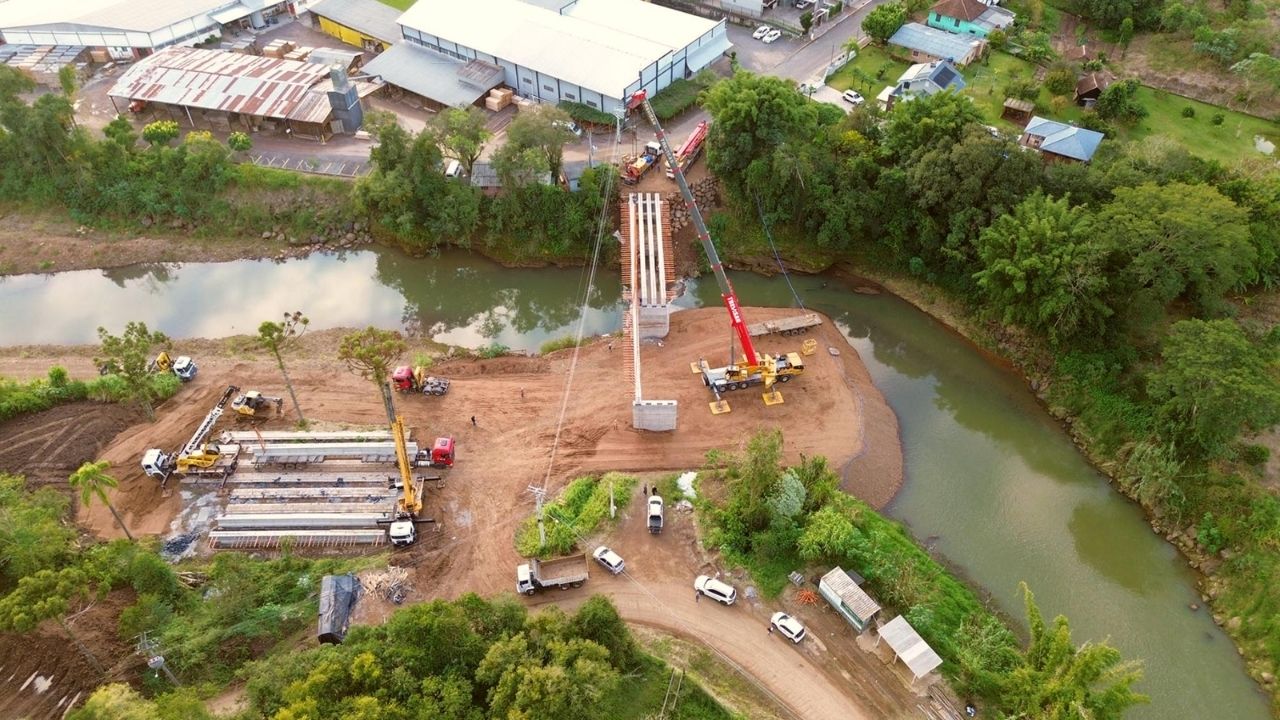
The installation of the eight beams consolidated a fundamental stage of the new Arno Inácio Utzig bridge. These pieces form the support base of the structure and allow the next services to advance over a set already positioned on the previously prepared supports.
-
Brazil’s Largest Port to Accommodate Bigger Ships by October as Ibama Approves Non-Explosive Removal of Hidden Rocks and Sediments

-
Mexico Develops 3D-Printed Concrete from Corn Waste, Cutting Emissions by 70% and Reducing Construction Waste by 90%
-
Traditional Mortar to Decline by 2026: ACIII-E Solution for Large Porcelain Tiles Offers Better Adhesion and Reduces Risk of Loose Pieces in Floors and Facades

-
72-Year-Old Man Spends Six Years Building a Rotating House for His Wife, Completing a Full Turn in 22 Seconds


In practice, the lifting changes the phase of the project. Previously, the focus was on preparing the bases and planning to transport and erect the structures. Now, with the beams installed, the construction approaches the necessary stages to transform the structure into an effective passageway.
Operation required four cranes and four trucks
To facilitate the work, four cranes and four support trucks were used. The beams were initially prepared on land adjacent to the construction site, which reduced the distance between the organization point of the pieces and the final installation location.
After this preparation, the structures were transported to the closest point of the bridge and lifted with precision. The movement of large equipment caught the attention of the local community, especially due to the size of the operation in a municipal project.
Technical planning was essential to position the pieces
Lifting the beams is not a simple step. Each piece needs to be moved, elevated, and fitted into the correct spot, respecting the supports already prepared and the safety conditions of the work front. Any error could compromise the construction pace.
Therefore, the operation was conducted over a day and a half. The execution time shows that it was not just about lifting concrete, but about coordinating machines, teams, and logistics in a precise sequence. This type of step usually involves high technical complexity within the schedule.
Arno Inácio Utzig Bridge enters a new phase
With the eight beams already installed, the new Arno Inácio Utzig Bridge moves on to the next services. Among them is the preparation of the abutments, which are fundamental areas to connect the structure to the access roads and ensure a safe transition between the road and the passage.
The construction of the passageway is also planned. This step is necessary for the structure to cease being just a set of supports and beams and start functioning as a crossing suitable for community use after completion.
Abutments and passageway will be the next focuses
The preparation of the abutments is a determining phase because it involves fitting the bridge into the existing road system. Without this connection, the main structure may be ready, but it still does not fulfill its circulation function.
The passageway, in turn, will shape the section used by vehicles and other users. At this moment, the construction begins to take on an appearance closer to the final delivery, moving from the heavy structural assembly phase to the functional finishing phase.
Community follows the visible stage of construction
The movement of cranes, trucks, and beams made the construction more noticeable to residents of Picada Café. In many public constructions, part of the progress occurs in less visible stages, such as foundations, base preparation, and preliminary services.
In this case, the hoisting of the beams offered a clear image of the progress. The new bridge ceased to be just an ongoing intervention and began to show its main structure erected, which naturally increases the community’s expectation for completion.
Construction approaches the final phase of execution
The completion of the hoisting does not mean that the passage is ready for immediate use. Important stages still remain before delivery, especially at the ends and on the track. Even so, the installation of the beams represents a milestone because it supports the advancement of the next fronts.
The central point is that the construction has overcome one of the most complex phases of the build. With the main structure positioned, the work now focuses on completing the elements that will allow the crossing to function.
Picada Café gains prominence with infrastructure advancement
The new bridge Arno Inácio Utzig is part of an important project for Picada Café. Although the announcement does not detail specific traffic impacts, the advancement of the structure indicates an intervention aimed at improving the passage in the area and fulfilling a municipal infrastructure demand.
In smaller cities, projects of this type tend to have a significant impact on the local routine. A crossing under construction alters commutes, requires planning, and generates expectation because it directly affects the mobility of residents, workers, and those traveling through the region.
Now, attention turns to the next stages until the structure’s completion. Do you think municipal projects like this should have more publicity during each phase, so the population can better follow the deadlines and progress? Leave your opinion in the comments.