





 Portuguese
  English
  Spanish
  5 min of reading
  0 comments


Hospital in Louisville uses ice as a cold battery, reduces air conditioning effort, saves energy, and keeps operating rooms cooled with 27 tanks
A hospital in the United States freezes 280,000 liters of water overnight to use the ice the next day as support for the air conditioning.
The system operates at Norton Audubon Hospital in Louisville, Kentucky, and uses 27 ice tanks to help cool operating rooms and areas occupied by patients. The information was published by AP News, an international news agency.
The logic is simple: the hospital produces ice when energy costs less and uses this stored cold when the building most needs cooling. It is not a common electric battery. It is a way to store cold to ease consumption during the day.
-
Mr. Gerardo built replicas of airplanes with his own hands in Porto Velho, caught the attention of Embraer, and turned the Casa Avião into a tourist attraction for aviation enthusiasts.

-
A bricklayer was clearing debris from a destroyed house in Syria to rebuild the property when he found a 1,500-year-old underground tomb with a cross, burial chambers, and stone graves hidden beneath the floor.

-
Russia paints trucks with zebra stripes to confuse Ukrainian drones powered by artificial intelligence, surprising experts by using a technique created in 1917; learn about zebra camouflage.

-
A robotic hand uses touch and vision to pick ripe fruits with nearly 100% accuracy. Researchers have built a flexible robotic claw that detects the ripeness point and gently picks fruits.






Hospital freezes water while the city sleeps and uses the ice when the heat is most intense
Every night, about 74,000 gallons of water are frozen inside the Norton Audubon Hospital. This volume is equivalent to approximately 280,000 liters, a sufficient amount to supply the tanks that help cool the building.
Previously, the hospital relied on the conventional air conditioning system, similar to what exists in many buildings in the United States. Now, the 27 ice tanks support a network of pipes with cold water.
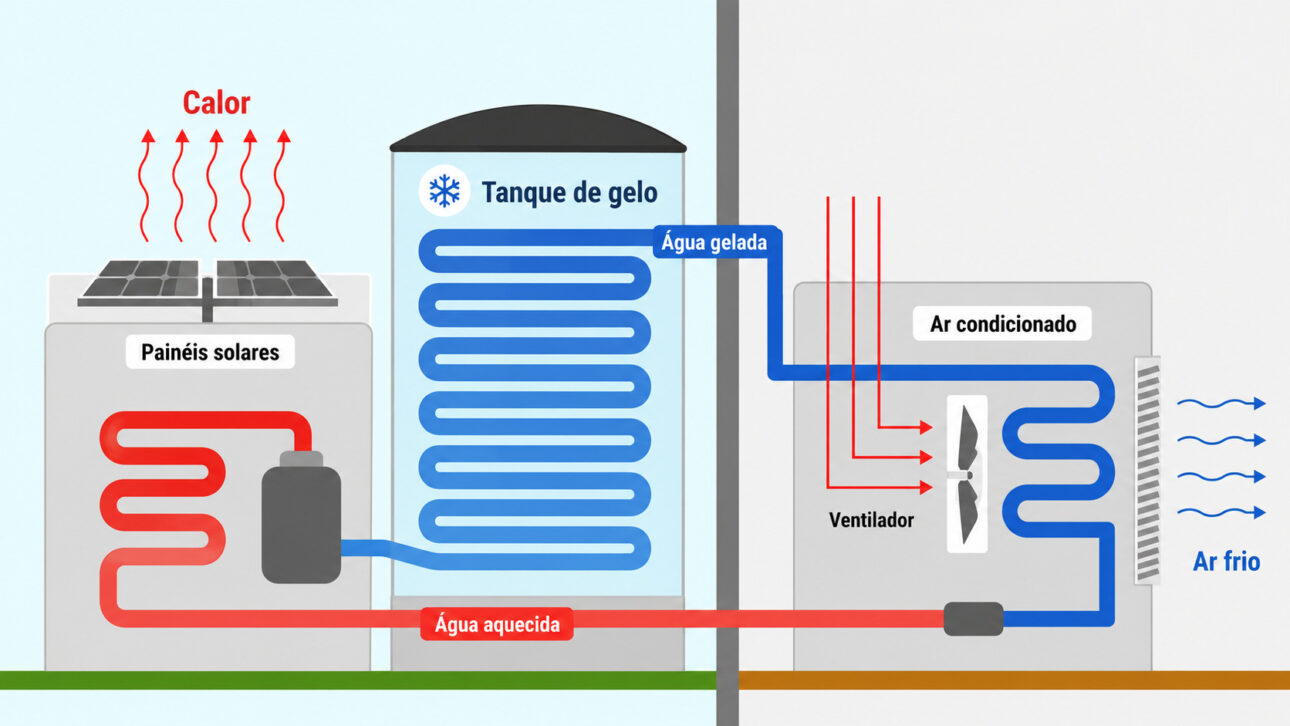
This network helps maintain operating rooms at a safe temperature and also contributes to patient comfort. In a hospital, cold air is not just comfort. It is part of the daily operation of sensitive areas.
The noteworthy point is the chosen timing. The water turns into ice overnight, when grid energy is usually cheaper. Then, the ice works during the day, when the demand for air conditioning tends to rise.
The ice does not store electricity, it stores cold to help the air conditioning
The so-called ice battery may seem like a regular battery, but its operation is different. It does not store electricity in wires or plates. It stores cold in the form of ice.
During the night, the water is frozen. The next day, this ice gradually melts and cools the water that circulates through pipes inside the building.
This cold water absorbs part of the heat from the environments. Then, the cooled air is carried through ventilation outlets, helping the building to maintain an adequate temperature.
It’s like filling a water tank outside peak hours to use later. The difference is that, in this case, the stored resource is not water for faucets, but cold to cool the hospital.
System was installed in 2018 and reduced US$ 278,000 in energy in the first year
The ice system at Norton Audubon Hospital was installed in 2018. In the first year of operation, energy costs were US$ 278,000 lower.
The hospital also estimates that the system and other energy-saving measures have saved almost US$ 4 million since 2016. AP News, a news agency with international coverage, provided the numbers and key details of the operation.
The savings appear because part of the cooling is prepared before peak consumption hours. As a result, the building relies less on energy when the air conditioning usually demands more from the grid.
This type of solution does not eliminate the entire traditional system. It works alongside common air conditioning equipment and helps reduce the burden of consumption during the most expensive hours.
Surgical rooms receive cold from a network of pipes with chilled water
Inside the hospital, the ice is not exposed in the rooms. It operates behind the scenes, inside tanks connected to a cold water network.
When the ice melts, it cools the water that circulates through the pipes. This water helps remove heat from the environments and supports the system that delivers cold air to different parts of the building.
The use in surgical rooms is noteworthy because these locations require constant temperature control. It is not an environment where cooling can fail or be treated as a detail.
Therefore, the idea of storing cold gains importance. The hospital can alleviate part of the energy demand without abandoning the cooling structure that was already part of the building.
Technology also appears as an option for schools, public buildings, and data centers
The ice battery is not a solution limited to hospitals. Manufacturers of this type of system target schools, commercial buildings, public buildings, and data centers.
Data centers are places full of technology equipment that need to stay cool to function without overheating. Therefore, the cooling expense can be an important part of the energy bill.
Trane Technologies, a company that manufactures heating and cooling equipment, is linked to the system used by Norton Audubon Hospital. Nostromo Energy also works with ice batteries and seeks clients with a high demand for cooling.
To an outsider, the idea may seem too simple. But in large buildings, storing cold in ice can reduce the effort of air conditioning and relieve pressure on the power grid.
Why the ice battery draws attention outside the United States
The case of Norton Audubon Hospital draws attention because it turns something common into part of an energy strategy. Frozen water, tanks, and off-peak hours become a tool to save energy.
The solution also helps to understand a bigger problem. The hotter it gets, the more people turn on air conditioning. When many buildings do this at the same time, the power grid needs to support a larger load.
Instead of waiting for the consumption peak to arrive, the hospital anticipates part of the work during the early morning. The ice produced at night helps at the time when the building needs cooling the most.
The experience does not mean that any house or business can replicate the same structure. The case involves 27 tanks, a network of pipes, and a large hospital. Even so, the logic behind the system is easy to understand.
Ice became energy infrastructure inside an American hospital
Norton Audubon Hospital shows that energy savings do not always depend on a technology that is difficult to explain. In this case, 280,000 liters of frozen water help reduce the effort of air conditioning the next day.
The system uses ice as a cold reserve, improves energy use throughout the day, and helps keep hospital environments cool. In a building that needs to operate with patients and surgical rooms, this turns a simple idea into real infrastructure.
Do you think hospitals, shopping malls, and public buildings in Brazil could use ice to reduce energy costs without losing comfort? Comment and share this idea with those who like practical solutions for energy and infrastructure.






Be the first to react!