






 Portuguese
  Spanish


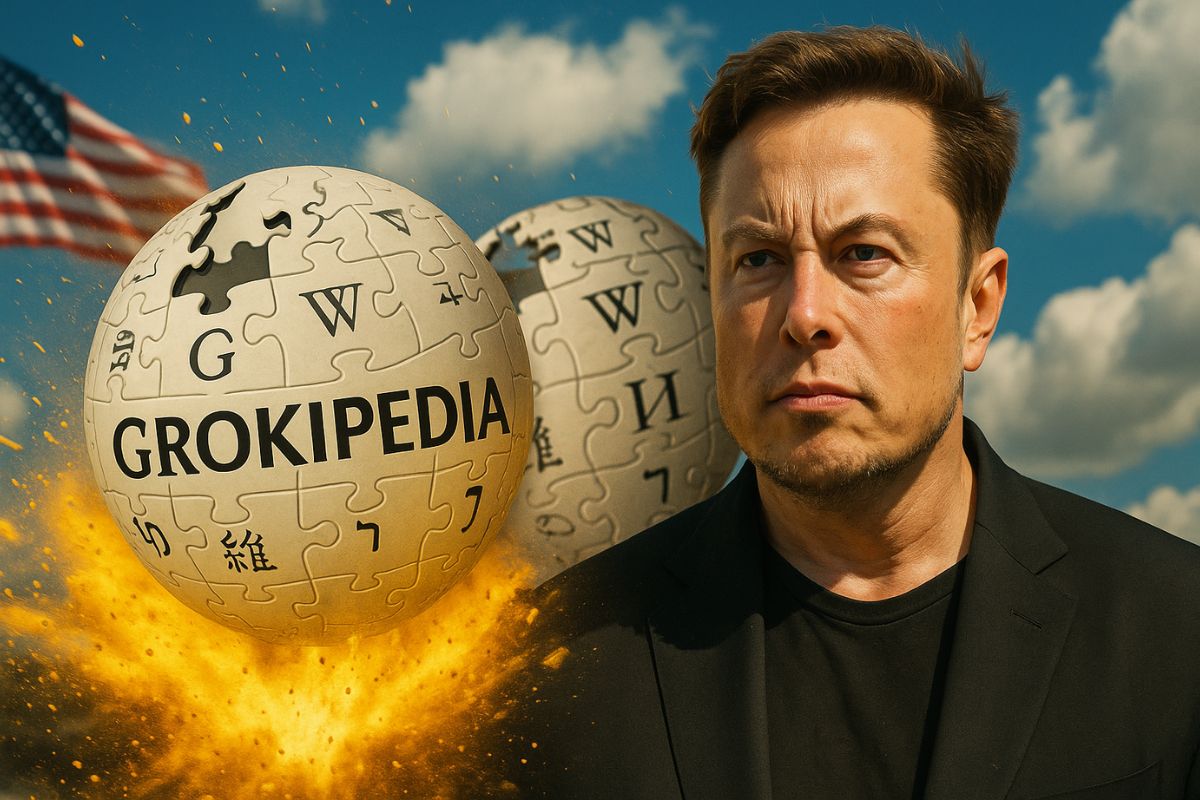


The Platform Created by xAI Aims to Compete with Wikipedia by Using Artificial Intelligence to Generate Content and Promises to Be “Ten Times More Truthful,” According to Elon Musk.
Businessman Elon Musk launched Grokipedia, a new digital encyclopedia developed by his artificial intelligence company, xAI, with the stated goal of competing directly with Wikipedia. The proposal is to create a platform for free knowledge that, according to Musk, will offer “all the truth and nothing but the truth.”
The initial version, called Grokipedia 0.1, was launched with around 885 thousand articles, a significant number, but still far from the over 7 million English pages of Wikipedia. The billionaire claims that version 1.0, already in development, will be “ten times better” than the current one and “more accurate than the competitor.” The project reinforces Musk’s discourse on the need for tools free from “advertisement” and “political bias.”
What Is Grokipedia and How Does It Work
Grokipedia is powered by generative artificial intelligence, the same foundation that supports the Grok chatbot, also created by xAI.
-
Most of the world’s wigs and hair extensions are made from Indian human hair and assembled in a single Chinese city, the global wig capital, where 300,000 people rely on this billion-dollar industry.

-
Despite declining smoking rates in the U.S., Zippo’s windproof lighter factory sees record sales in over 180 countries, remaining the largest employer in its region for decades.
-
Brazilian Driver Accidentally Becomes Millionaire for 7 Hours, Returns $25 Million and Now Seeks $2.5 Million Reward in Court

-
McDonald’s Ice Cream Machines Often Break Due to a Single U.S. Manufacturer, Error Codes, and a Lucrative Repair Model


The system automatically produces texts and is fed by public sources, structured databases, and content selected by the technical team itself.
According to Musk, the goal is to combine automation with transparency, allowing users to consult information based on verifiable criteria.
“The purpose of Grok and Grokipedia is the truth, all the truth, and nothing but the truth. We will never be perfect, but we will strive to achieve it,” stated the executive on his social media platform X.
The launch was originally scheduled for September but was delayed to eliminate what Musk called ‘advertising residues’ in the generated texts.
The central idea is to build a knowledge base supervised by AI, but with minimal human review, which has sparked debate about the reliability and editorial control of information.
Musk’s Critique of Wikipedia and Ideological Bias
Musk is a long-time critic of Wikipedia, claiming that the project exhibits political bias to the left. In 2024, he even publicly called on the public to stop donating to the encyclopedia, stating that it was “controlled by activists” and could not be used as a “definitive source of truth.”
This dispute reflects the entrepreneur’s view on the monopoly of online information, which he considers concentrated in a few platforms with strong editorial power.
By launching Grokipedia, Musk aims to offer an automated and “less biased” alternative, although experts point out that the use of AI may introduce new types of distortions, especially if the training sources are not disclosed transparently.
What Differentiates Grokipedia from Wikipedia
The main difference between the two platforms lies in the origin of the content. While Wikipedia is collaborative, with texts reviewed by thousands of volunteers and governed by the principle of “neutral point of view,” Grokipedia uses machine learning to compile and write articles automatically.
Each text is produced by the Grok system, which seeks to cross-reference data and generate contextual responses. One of the initial articles from Grokipedia about Musk himself describes him as someone who “has promoted debates on technological progress, demographic decline, and institutional biases, often through the X network.”
This type of self-reference and automated curation raises questions about editorial independence and self-criticism, themes that are expected to mark the upcoming debates about the future of the new encyclopedia.
The Potential Impact on the Digital Ecosystem
With Grokipedia, xAI enters the segment of automated knowledge production, challenging collaborative models established for over two decades.
The movement also reinforces Musk’s strategy to centralize his digital ecosystem around the X platform, which already integrates Grok as a conversational AI tool.
The initiative comes at a time when the credibility of online sources is a global topic. The promise of “ten times more truth” sounds ambitious, but it will depend on the quality of data and the transparency of algorithms.
Analysts assert that Grokipedia’s challenge will be to prove that an AI-controlled system can be more neutral than an open community of human editors.
The creation of Grokipedia by Elon Musk opens a new dispute over how information is constructed and validated in the era of artificial intelligence. The project combines technology, ideology, and ambition, promising to change the way the public accesses knowledge online.
Do you believe that an encyclopedia managed by AI can be more impartial than Wikipedia?





“ferramentas livres de ‘viés político'”
Aham kkkkkkkk.
Goebbels estaria orgulhoso.