






 Portuguese
  Spanish
  5 min of reading
  2 comments


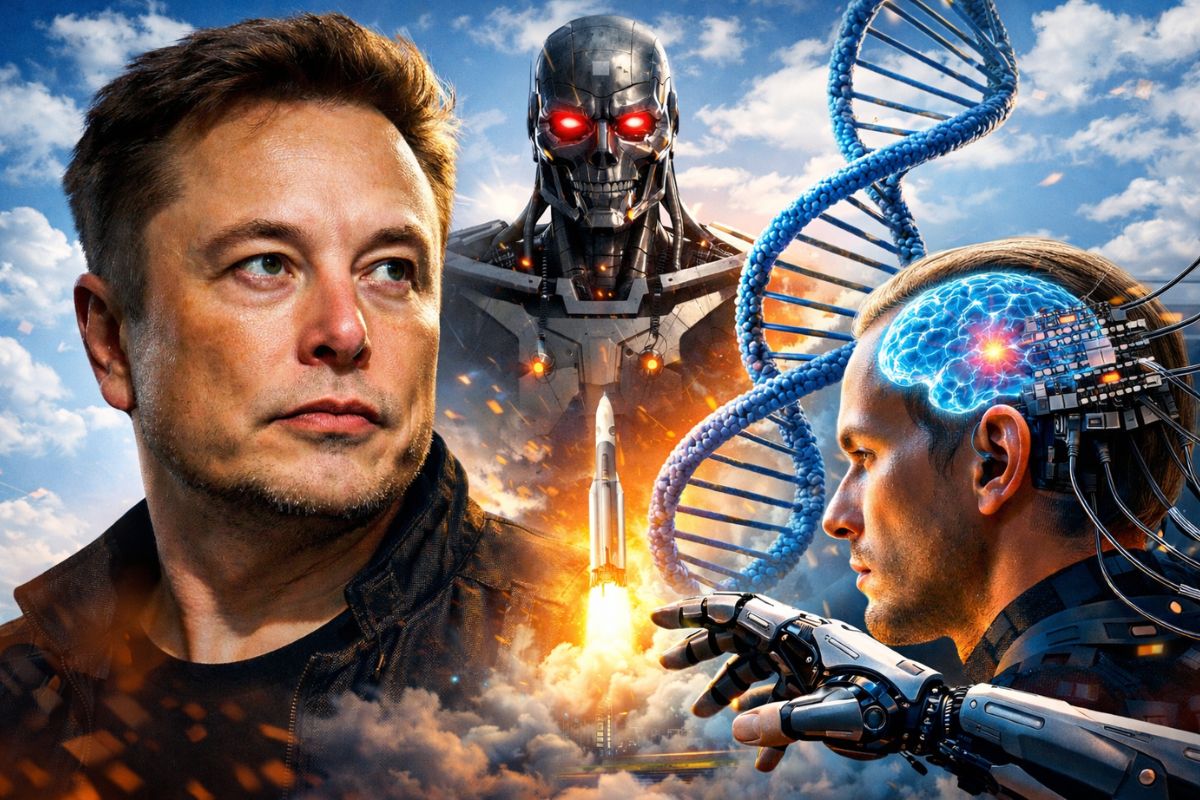


In A Frank Conversation About The Future, Elon Musk Places Artificial Intelligence As The Central Risk To Humanity, Advocates Advances In Genetics To Combat Serious Diseases And Predicts A High-Speed Direct Connection Between Brain And Machines As The Next Leap For Our Species
When asked to respond to which problems he would choose to work on if he were 22 years old today, Elon Musk did not mention career, fame, or money. Instead, he focused on issues that he believes will truly define the future of humanity. For Elon Musk, artificial intelligence is likely the single most important and urgent factor that can transform, for better or worse, the collective destiny of our species.
Alongside AI, Elon Musk highlights two other fields as crucial: genetics, especially in combating devastating diseases like dementia and Alzheimer’s, and the development of a high-bandwidth interface between the human brain and the digital world.
The combination of artificial intelligence, advanced genetics, and a direct connection between brain and machines, according to Elon Musk, will reshape what it means to be human in the coming decades.
-
Brazilian mechanic invented a lamp made from a PET bottle during the 2001 blackout, the idea turned into an NGO present in 30 countries and has already illuminated 40,000 people in 200 communities without electricity in Brazil.

-
The first trillionaire in history, Elon Musk, opens his wallet and pays the equivalent of R$ 306 billion, or US$ 60 billion, for the artificial intelligence programming startup Cursor, in yet another AI investment made through SpaceX, his rocket company.
-
The future of computers may change sooner than expected: Amazon bets on commercial quantum computing within seven years, while qubits, the Ocelot chip, AI, and scientific simulations take center stage in the new race among big techs.

-
What does a Covid-19 vaccine have to do with heart attack and stroke? A study with over 1 million veterans reveals an unexpected link between immunization, the heart, and seniors over 75 years old.



Elon Musk And Artificial Intelligence As Central Risk
Right at the beginning of his response, Elon Musk makes it clear that not everyone needs to “change the world” to be doing something useful.
For him, if a person creates something that adds value, even if it’s a simple game or an improvement in photo sharing, that is already positive.
The turning point comes when the topic shifts to what can truly affect the future of humanity.
It is at this moment that Elon Musk does not hesitate to place artificial intelligence at the top of the list. He states that AI is “probably the single most important item in the short term” when it comes to impact on humanity, and insists that the way this technology is developed must lead to a future that, if seen in a “crystal ball,” would be a scenario we would like to inhabit.
In Elon Musk’s view, the risk is not just in the power of the technology but in the possibility that it can “go wrong” if not carefully managed.
That is why he emphasizes that it is “very important that the advent of AI happens in a good way”, resulting in a positive outcome and not a global-scale problem.
This concern places artificial intelligence less as a simple tool and more as a civilizational turning point.
Genetics As The Second Great Frontier

After artificial intelligence, Elon Musk points to genetics as another central axis of transformation.
It is not just about enhancing physical performance or creating “super humans,” but about tackling diseases that today destroy the quality of life and autonomy of millions of people.
He explicitly mentions the potential to solve genetic diseases and even prevent conditions like dementia and Alzheimer’s through genetic reprogramming. In Elon Musk’s view, if humanity can use genetics to attack these conditions, it would be “wonderful.”
Genetics appears here as the second great frontier, almost a complementary pillar to artificial intelligence, one focused on information and decision-making, the other on the very biological code that defines us.
For Elon Musk, working with genetics today is placing oneself on the front lines of a silent revolution, where leaving behind neurodegenerative or hereditary diseases ceases to be science fiction and becomes a real medical horizon.
It is a direct invitation to young scientists, engineers, and entrepreneurs who want to work on something with profound and lasting impact.
The Direct Connection Between Brain And Machines
The third major point raised by Elon Musk is the need to drastically increase the bandwidth between the human brain and the digital world.
Today, he reminds us, we already have a “tertiary digital version” of ourselves, in the form of cell phones, computers, emails, applications, and everything we store online.
According to Elon Musk, the problem is not the lack of computing power, but the bottleneck of the interface between the cortex and this “digital self”. Keyboard, screen, and touchscreen inputs are slow and limited compared to the speed at which we think.
That is why he considers it “very important” to resolve this bandwidth limitation, creating a high-speed interface between the brain and digital systems.
This vision points to a future where the boundary between human and machine becomes more diffuse.
In Elon Musk’s view, by increasing the bandwidth between brain and machine, we enhance our ability to think, create, and interact with information, effectively making us “super humans” from a cognitive standpoint, but always dependent on a well-designed and safe integration with the digital environment.
Not Everyone Needs To Change The World, But Some Will
Despite speaking about major themes, artificial intelligence, genetics, and brain-machine connection, Elon Musk is keen to relativize the idea that it is only worthwhile to work on something “transformative.”
He acknowledges that many projects that “do not change the world” still hold high value by improving the lives of many people in small doses.
Nevertheless, when responding to what he would do if he were 22 years old today, Elon Musk is clear in choosing areas where each advance can change the course of humanity.
Those who choose to work with artificial intelligence, genetics, or brain-machine interfaces, in Elon Musk’s view, are directly affecting the fabric of the future, from health to thinking, from aging to our relationship with machines.
What Elon Musk’s Message Says To Those Starting Now
The underlying message is simple and direct: if you want to work on something with deep impact, looking at artificial intelligence, genetics, and brain-machine connection makes sense.
If you prefer to engage in something more localized, but still useful, that is also perfectly fine, as long as what you do holds real value for other people.
Elon Musk puts responsibility and possibility in the same sentence. On one hand, he warns of the risk of artificial intelligence “going wrong” if developed carelessly.
On the other hand, he opens the way for those who want to position themselves on the front lines of these transformations, whether by creating technologies or helping to ensure that they truly result in a “future we would like to see.”
And you, after hearing what Elon Musk considers the biggest challenges of humanity, which of these fronts would you be most willing to work on: artificial intelligence, genetics, or a direct connection between brain and machines?




A Lei de Murphy afirma que ” se alguma coisa pode dar errado, vai dar errado”. IA ainda não despertou e, quando despertar, o mundo deixará de ser como o conhecemos.
Muito sábia sua resposta, e concordo plenamente com vc