Portuguese
  Spanish


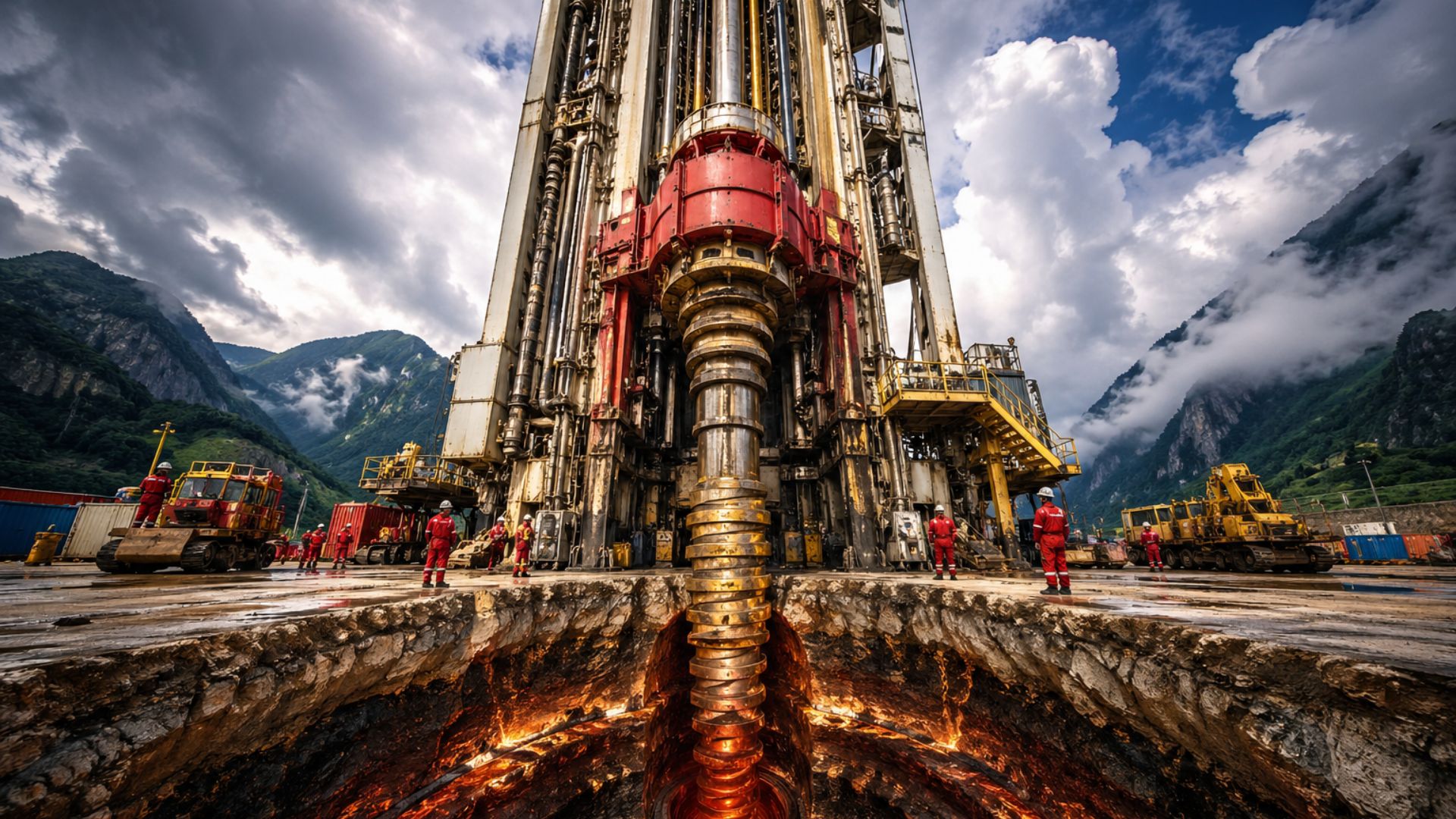


China’s unprecedented underground operation advances beyond 10,000 meters, revealing extreme conditions of temperature, pressure, and deep geology, opening new scientific and energy perspectives in one of the most complex drilling regions in the Asian country.
China has surpassed the 10,000-meter depth mark with the Shendi Chuanke 1 scientific well, drilled in the Sichuan Basin, in an operation that traversed 23 geological formations and reached rocks of the Sinian Formation, estimated to be around 540 million years old.
Located in Jiange County, Sichuan Province, the project became the first scientific well in the basin to reach this level, as reported by Global Times, citing data from China Media Group and China National Petroleum Corporation.
As drilling progressed, engineers began operating in a little-known zone of local geology, where available information was limited and required greater technical caution in the planning and execution of each stage.
-
WD-40’s Secret Formula: How a $620 Million Business Thrives Without a Patent

-
Lonely? This Chinese humanoid robot with soft skin and AI offers 24/7 conversation and stress detection.

-
Advanced Crash Test Dummies with Fake Bones and Organs Can Cost Up to $1 Million, Mostly Produced by U.S. Firm Humanetics
-
In a Los Angeles workshop in 1935, a man invented the peel-off label, laying the foundation for the world’s largest label manufacturer, now generating $8.8 billion and embedding chips in clothing.


Below 7,000 meters, for example, the layers were treated as a territory with virtually no direct data, a condition that increased the level of complexity and required constant adaptations in the methods used during the operation.
Deep Drilling in Sichuan Basin Challenges Technical Limits
Initiated in July 2023, the project advanced continuously, surpassing 10,000 meters by October 2025, consolidating a significant milestone within Chinese initiatives aimed at deep exploration.
During this journey, the well traversed successive geological formations until reaching the Sinian Formation, considered strategic for studies on the deep structure of the Earth’s crust and long-term geological evolution.
Scientific Well Expands Knowledge of Earth’s Interior
Although related to the energy sector, Shendi Chuanke 1 was also conceived as a scientific initiative aimed at developing proprietary technologies and collecting data in still underexplored underground regions.
With the retrieval of rock cores from great depths, researchers gained direct access to materials that were previously analyzed only through simulations and theoretical models.
These samples allow for a more precise understanding of the behavior of ancient rocks subjected to extreme conditions, including intense heat, high pressure, and long periods of preservation within the Earth’s crust.
Temperatures Above 200°C and Extreme Pressure Challenge Equipment
According to Global Times, conditions recorded at the bottom of the well exceeded 200°C, while formation pressure reached levels above 130 megapascals, a scenario that poses significant challenges for any operation of this type.
At these depths, equipment such as drill bits, pipes, and sensors operate under constant wear, requiring continuous monitoring and technical adjustments to prevent structural failures throughout the process.
Furthermore, extreme heat directly affects material performance, while high pressure increases the risk of instability, requiring strict control over fluid circulation and the response of the systems involved.
Samples Indicate Potential for Oil and Gas at Great Depths
Among the most relevant results is the recovery of samples from below 9,500 meters, which revealed geological characteristics compatible with the presence of well-developed reservoirs.
According to the report, the cores indicated the existence of pores, cavities, and fractures, elements considered fundamental for the accumulation of oil and gas in underground formations.
This finding contradicts previous assessments that indicated low storage capacity in such deep layers of the Sichuan Basin, mainly due to extreme temperature and pressure conditions.
Traditionally, strata below 8,000 meters were considered unfavorable for hydrocarbon accumulation, which makes this new evidence relevant for re-evaluating the region’s potential.
Although it does not represent immediate exploration, the result broadens scientific and energy interest by indicating that these areas may preserve suitable structures for resource storage.
China Advances in the Race for Ultra-Deep Drilling
In the national scenario, the Shendi Chuanke 1 becomes the second well to exceed 10,000 meters, trailing only the Shenditake 1, located in the Tarim Basin, Xinjiang.
While the Tarim project consolidated China’s technical capability in this type of operation, the advance in Sichuan extends this domain to a distinct and more complex geological environment.
This difference is relevant because it involves specific challenges related to the basin’s structure, requiring technical solutions adapted to the local conditions encountered during drilling.
In parallel, the initiative reinforces CNPC’s role in developing technologies for deep exploration, integrating scientific and strategic objectives into a single operation.
The 10,000-meter mark, in this context, ceases to be merely a symbolic number and comes to represent the ability to operate in conditions where geological predictability is reduced and technical risks are amplified.
Direct access to deep layers changes geological research
By reaching these depths, the project allowed direct access to layers that remained inaccessible for decades, opening new possibilities for studies on the composition and behavior of the subsurface.
Unlike projection-based approaches, the analysis of real fragments allows for greater precision in interpreting the geological structures present in these extreme regions.
Thus, the data obtained can contribute to the revision of existing models for the Sichuan Basin and to the improvement of techniques used in future drilling operations.
In addition to expanding scientific knowledge, the operation also provides relevant information for the development of more resistant and efficient equipment, capable of withstanding increasingly severe conditions.
In this scenario, Shendi Chuanke 1 demonstrates how ultra-deep drilling has come to integrate different areas, bringing together research, technology, and energy strategy in a single underground operational front.