Portuguese
  Spanish


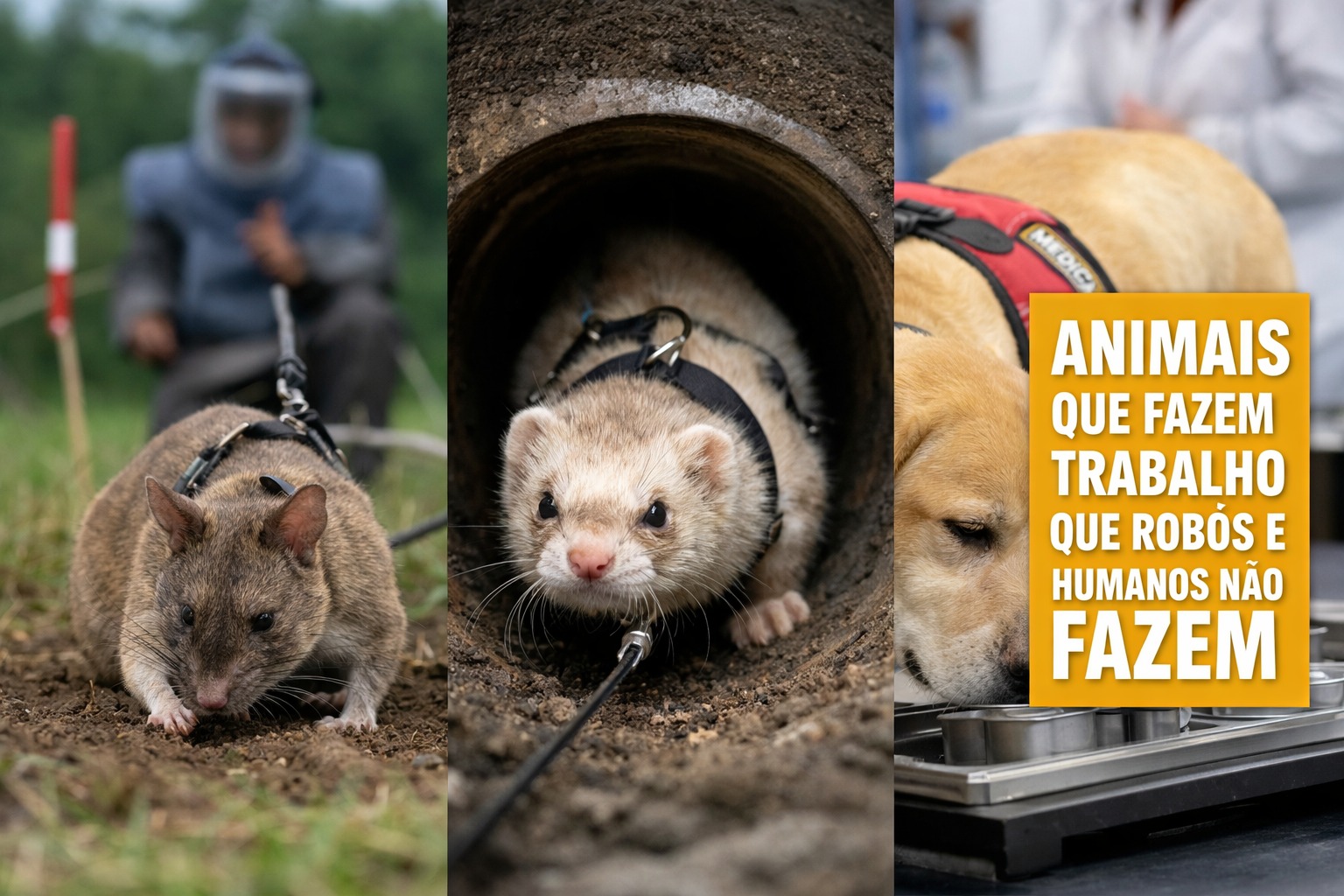

Rats, Ferrets and Dogs Reveal How Instinct Combined with Training Transforms Animals into Indispensable Professionals for Safety, Health, Science and Rescue
In different corners of the planet, trained animals are taking on tasks that would be time-consuming, dangerous, or even impossible for humans. Far from being just companions, they have become silent professionals, capable of saving lives, speeding up projects, and providing comfort in critical moments.
Rats, ferrets, and dogs, each in their own way, show that animal intelligence, when respected and well-directed, can yield extraordinary results.
Rats That Confront Minefields
“They can scour an area the size of a tennis court in about 20 minutes, while humans with metal detectors would take up to four days,” says Dr. Cynthia Fast, who trains these animals at the NGO APOPO.
-
She spent 73 years breathing inside an iron lung, survived the aftereffects of polio, and became the last woman in the United States dependent on the equipment before dying at 78 years old.

-
Brazilian students created a $1 filter using pine bark, cotton, and 3D-printed parts to clean cassava wastewater, reduce the toxicity of a hazardous waste, and transform contaminated water into biofertilizer.

-
Astronaut from Artemis II steps down after mission to the Moon and decision surprises after a record of 406,771 km, a historic 10-day journey, and an unprecedented achievement for Canada.

-
A fossil kept for years in a small museum in Montreal concealed 450-million-year-old soft tissue, a discovery that has only happened once before in history.


The organization is dedicated to the detection and removal of landmines and other explosive remnants of war, using innovative methods such as training African giant rats (Cricetomys gambianus).
Every year, landmines kill or injure thousands of people worldwide. In this scenario, the work of these rodents represents more than technical efficiency; it’s a direct response to a persistent humanitarian problem.
Who Are the HeroRATs
The rats used by APOPO are known as “HeroRATs” and are about the size of a small cat.
They receive this name because of their large cheek pouches, similar to those of a squirrel or hamster, where they like to store food.
Currently, they are working in Angola, Azerbaijan, and Cambodia, and previously operated in Mozambique.
So far, they have cleared 120 million square meters of old minefields, an area larger than the city of Paris or about 17,000 soccer fields.
Additionally, they are long-lived, intelligent, and highly trainable. Large enough to cover vast areas, yet small enough to walk over pressure-sensitive mines without triggering them.
One impressive detail: APOPO has never lost a rat in a minefield.
How They Detect Explosives
When the rats smell vapors from explosive substances like TNT, they scratch the surface of the ground.
This simple gesture is the signal for handlers to mark the location. Then, a human returns with tools and technology to safely remove the mine.
According to Fast, in more than 25 years, their rats have never failed to find a single mine. Another advantage is that they ignore metal scraps, making them more efficient than metal detectors in areas filled with debris.
Even so, initial acceptance is not always easy. In some communities, there was skepticism about the reliability of the animals.
Gaining the Trust of People
“At first, there was much more skepticism, and when we tried to hold land handover ceremonies with the communities, they even refused to step on the land because they did not trust the rats,” says Fast.
One strategy was to organize football matches on previously mined land. Seeing the professionals themselves playing there, people began to trust the work of the HeroRATs.
Today, in places like Cambodia, residents ask when a rat can be taken near their rice paddies, fearing that there may still be hidden mines.
Well Beyond Landmines
The HeroRATs are also being tested in search and rescue missions, locating people buried under rubble after natural disasters.
In an age of automation and robotics, these animals, along with ferrets and dogs, remain indispensable for tasks that machines still cannot perform.
Ferrets, Hunters and Engineers
In a field in northern Derbyshire, England, a professional named Emily prepares to work.
If she trembles, it is not from cold or fear, but her body warming up. Emily is a light golden ferret, agile and flexible. Her human colleague is James McKay, director of the National Ferret Training School.
James manages an elite team of over 40 Mustela putorius furo. For him, the abilities of these animals are innate. Training serves only to channel them.
Ferrets were domesticated about 2,500 years ago to hunt animals that humans could not reach.
The Roman Legion used them to flush rabbits out of burrows, and over the centuries, they have also helped protect barns and crops from rodents.
From Hunting to Problem Solving
In the 1980s, James realized that his ferrets could do much more.
On a farm with drainage problems, he suggested placing a ferret at one end of the drain and marking how far it went, repeating the process on the other side. This way, they found out where the blockage was.
Today, James is sought after to find pipes, drains, and blockages, as well as to assist in the installation of high-speed fiber optic cables.
A thin wire is attached to the ferret’s collar, allowing it to move like a furry needle through spaces inaccessible to humans.
Communication and Well-Being
Each ferret carries a transmitter, and James never loses contact with his “engineers.” He ensures that the animals are happy with the work.
“I wouldn’t do this if I thought there was any cruelty or real risk involved. When I put my ferret in front of a hole, all it wants to do is go in and see what’s on the other side.”
The Ferret That Helped Particle Physics
One of the most famous ferrets in history was Felicia. In 1971, during the construction of the National Accelerator Laboratory, later renamed Fermilab in honor of Enrico Fermi, a problem arose: long, narrow vacuum tubes needed to be perfectly clean.
An engineer suggested using a ferret to traverse the tubes and drag a wire, allowing the passage of a cleaning swab. Felicia took on the task and assisted scientists researching particle physics.
Dogs That Snoop Out Diseases
You may have already heard about dogs that detect cancer. But they can also identify epilepsy, malaria, Parkinson’s, and COVID-19.
Dr. Claire Guest, co-founder and scientific director of Medical Detection Dogs in Milton Keynes, England, has been involved in this field since its inception.
“Dogs have taught us things we didn’t imagine before. It was completely revolutionary to think that cancer had a smell. Now we know that diseases do, indeed, have a smell,” says Guest.
An Extraordinary Olfactory System
Dogs have around 300 million sensory receptors, while humans have 5 million. If a person can detect a teaspoon of sugar in a cup of tea, a dog can detect it in two Olympic-sized swimming pools filled with water.
They continuously inspire air while exhaling through other parts of their nose, preventing the mixing of old and new air.
This sophisticated system allows them to detect subtle scents and follow trails for hours, making them excellent at what they do.
Motivation and Emotional Bonding
Besides smell, motivation is essential. According to Guest, dogs do not work solely for rewards, but because they want to please their owners.
Studies show that humans release oxytocin when petting their dogs, and dogs also release this hormone, creating a reciprocal bond.
The center trains biodetection dogs and medical assistance dogs. The latter live with a single human and alert them to emergencies.
When a Dog Changes a Life
Lauren suffers from postural orthostatic tachycardia syndrome and a functional neurological disorder that causes non-epileptic seizures. Her dog Mabel alerts her when a crisis is imminent.
“She puts her head on my lap and, if I try to get up, she doesn’t move, indicating that I need to stay seated because I’m going to faint.”
Lauren recalls being diagnosed at 16, when she was studying, dancing, and leading an active lifestyle. Suddenly, she became dependent on others for basic tasks.
Having Mabel changed everything. She began to venture out alone and regain some autonomy.
If she could choose between a robot and Mabel, Lauren wouldn’t hesitate.
“I would always choose Mabel. There is also this emotional connection. Imagine the worst day of your life, but having someone by your side, making you feel better. I would never trade her for a robot.”
Around the world, these animals show that technology and nature are not opposites. As machines advance, rats, ferrets, and dogs continue to play essential roles, carrying with them a unique combination of instinct, training, and bond with humans, transforming lives in profound and silent ways.
With information from BBC.