Portuguese
  Spanish





Two Almost Identical Terms Confuse Even Professionals Due to Their Similar Spelling and Pronunciation, But Carry Totally Distinct Meanings That Can Alter the Meaning of Entire Phrases.
Even native Portuguese speakers can get confused with certain words in the language, especially when they have similar spelling and pronunciation.
This is the case with “discrição” and “descrição,” two terms frequently confused by those who write or speak, even though their meanings are completely distinct.
Both words are part of a group known as paronyms, which gathers similar words in form but with different meanings.
-
Forgotten Map Leads Diver to Shipwreck with Gold, Rare Jewels, and Secrets Hidden for Nearly 350 Years

-
Furong: The 2,000-Year-Old Chinese City Built on a 60-Meter Waterfall Becomes a Global Tourist Phenomenon

-
YouTube Inventor Dubbed “Real-Life Tony Stark” Builds Robotic Legs for Father’s Day, Creating a Wheelchair That Conquers Stairs and Rough Terrain
-
Brazilian Scrap Dealer Processes 3,000 Tons of Ferrous Scrap Monthly, Paying $0.09 to $0.70 per Pound, Reveals Why a Hidden Cylinder Costs 1,500 kg Discount





The confusion between them is so common that it appears in various environments, from informal conversations to official documents, causing communication breakdowns and sometimes embarrassments.
In the specific case of “discrição” and “descrição”, the exchange can completely alter the meaning of a sentence.
Understanding the difference between the two terms not only avoids linguistic errors but also demonstrates mastery of the standard Portuguese language.
Meaning of “Discrição” and How to Use It Correctly
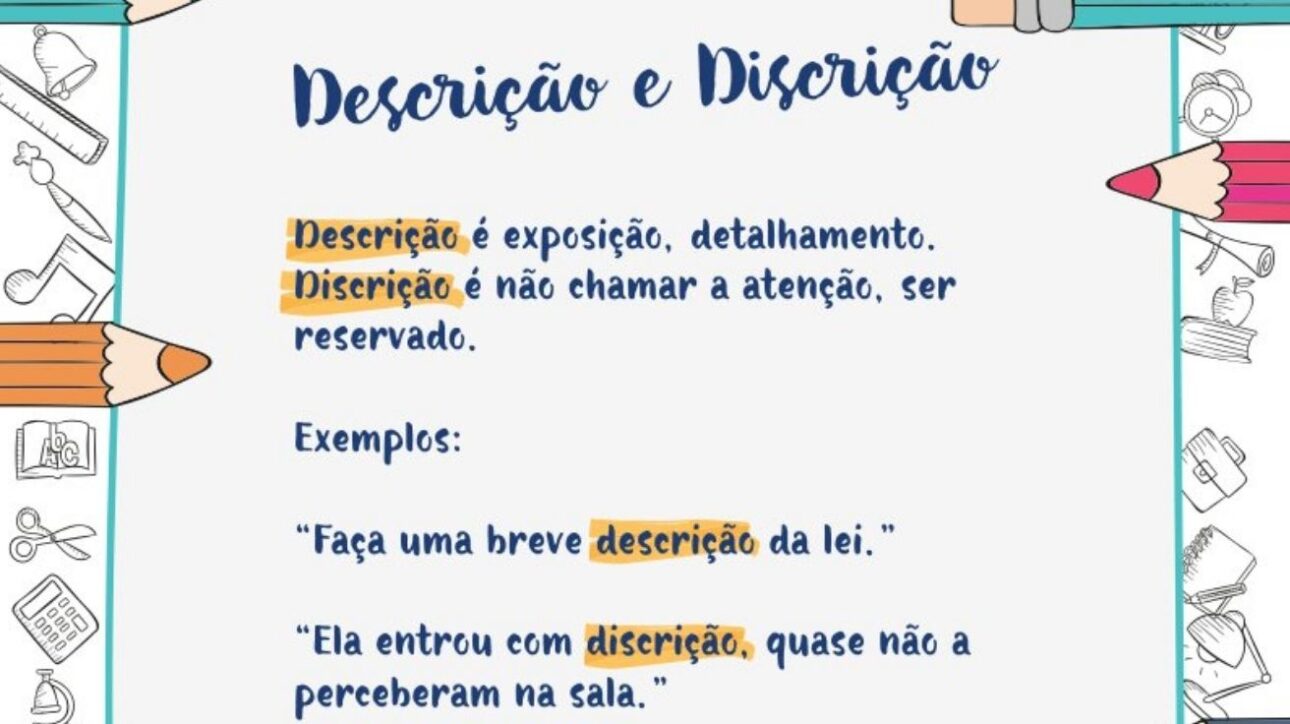
“Discrição” is a feminine noun that expresses the ability to act with reserve, moderation, and prudence.
It is a quality valued in personal and professional contexts, associated with measured behavior and the ability to maintain confidentiality.
Discrete individuals usually avoid flamboyant attitudes and prefer more reserved stances.
Additionally, discrição is often associated with positions of trust, where secrecy and common sense are essential.
Among the main synonyms of “discrição” are caution, sensibility, sobriety, moderation, secrecy, prudence, discernment, and parsimony.
Here are some constructions that illustrate the correct use of the word:
- She handled the situation with great discrição, avoiding embarrassment for everyone involved.
- The professional was praised for his discrição in handling confidential company matters.
- Even at parties, he prefers to maintain discrição and avoid drawing attention.
- Discrição is an essential quality in positions of trust.
- With his usual discrição, he left the meeting without making a fuss.
- The investigator acted with extreme discrição to avoid compromising the operation.
- He dressed elegantly and with discrição, without excess.
- I asked him to handle the matter with discrição to avoid unnecessary comments.
- Her discrição contrasts with her husband’s extroverted behavior.
- In some situations, discrição is worth more than a thousand words.
What Is “Descrição” and When to Use the Word
On the other hand, the term “descrição” is also a feminine noun, but with a completely different meaning.
It refers to the act of reporting, explaining, or detailing characteristics of something, whether a person, object, place, or situation.
Describing is making understandable through words what is perceived with the senses or intellect.
Descrição can be used in various contexts: in literary texts, technical product sheets, legal documents, reports, professional resumes, among others.
The goal is to provide a precise mental image or a clear explanation of what is being described.
Examples of sentences using “descrição” include:
- The descrição of the product on the site helped a lot when buying.
- The author made such a rich descrição of the scenery that it felt like I was there.
- Maria provided a descrição of the suspect to the police.
- The descrição of the position includes salary, benefits, and requirements.
- During the presentation, he provided a descrição of the project clearly and objectively.
- The descrição of the landscape enchanted me, even without seeing it.
- Before buying, I always read the descrição of the ingredients on the label.
- The descrição of the character helped the illustrator create her image.
- In the resume, make sure to provide a good descrição of your professional experiences.
- The accurate descrição of the symptoms was essential for the medical diagnosis.
Why Do “Discrição” and “Descrição” Cause Confusion?
The difficulty in distinguishing between “discrição” and “descrição” is mainly linked to the phonetic similarity between the two.
Both have almost identical sounds when spoken quickly, especially in regions where the pronunciation of “s” and “sc” tends to converge.
Moreover, the use of the terms often appears in formal contexts, increasing the risk of error due to grammatical insecurity.
The incorrect spelling of these words can compromise the clarity of communication, especially in official documents, essays, and professional reports.
Strategies to Avoid Making Mistakes Again
A practical way to avoid confusion between these paronyms is to associate them with well-distinct concepts.
“Discrição” comes from “discreto,” which refers to reserved behavior.
On the other hand, “descrição” derives from “descrever,” meaning to report or detail something.
Remembering these associations can help with appropriate usage.
Portuguese teachers recommend frequent reading and writing practice as effective ways to internalize the correct use of paronymous words.
Additionally, carefully reviewing the text before finalizing a more formal communication is also essential to avoid slips.
Origin and Etymology of “Discrição” and “Descrição”
Both “discrição” and “descrição” originate from Latin but came from different roots.
“Discrição” comes from discretio, which meant discernment or the ability to judge.
On the other hand, “descrição” derives from descriptio, a Latin term that indicated the action of writing or describing something in detail.
The etymological origin reinforces the semantic difference between the two terms, even though the evolution of the language has made their forms quite similar in modern Portuguese.
Impacts of Incorrect Use on Communication
Cases of incorrect use of these words frequently appear in resumes, corporate emails, and academic texts.
The interchange can compromise the interpretation of a message or even generate doubts about the author’s linguistic competency.
In legal and administrative contexts, the imprecision between “discrição” and “descrição” can lead to erroneous interpretations, highlighting the importance of correctly mastering the Portuguese language.
Have you ever confused “discrição” with “descrição” in any everyday situation? Share your experience with these words that deceive even the most fluent in the comments!