






 Portuguese
  Spanish
  4 min of reading
  0 comments


Standing 2 km Tall with 678 Floors, the Rise Tower in Riyadh Promises to Become the Tallest Building in History and a Landmark of Modern Engineering.
The world of engineering and architecture is about to witness an unprecedented feat. In the capital of Saudi Arabia, Riyadh, a project for a megastructure has been unveiled that could redefine the limits of civil construction: the Rise Tower, a skyscraper that will reach 2,000 meters in height (a 2 km tower), equivalent to 10 times the size of Christ the Redeemer. The project is designed by the renowned British studio Foster + Partners, responsible for iconic works such as the Millau Viaduct, Beijing Airport, and the sustainable city of Masdar in the UAE. The proposal is to build a tower with 678 floors, estimated to cost around US$ 5 billion, that will easily surpass the current world record of the Burj Khalifa in Dubai, which stands at 828 meters.
Announced in 2023 and with bidding already planned for 2025, the Rise Tower project will be the jewel of the ambitious urban plan called North Pole, a new district of 300 km² being developed north of Riyadh. It is a mega-operation that will bring together residential, corporate, tourist, and cultural centers, with the tower as the central and symbolic element.
A New Level for Global Engineering
The Rise Tower aims to double the height of the tallest buildings currently under construction, such as the Jeddah Tower, also in Saudi Arabia, which seeks to reach 1 km in height. The Rise, on the other hand, is expected to achieve double that, something never attempted anywhere else in the world.
-
Bolivian Female Construction Workers Form Association to Combat Discrimination and 38% Pay Gap in the Industry

-
Near Amsterdam, residents buy land and discover they must also build streets, manage drainage, handle waste, and grow food on half their plot.
-
Brazil’s WEG to Open New Factory in China by 2027, Expanding Production of Large Rotating Electric Machines and Low to Medium Voltage Motors in Rugao

-
Chinese Shipyard Secures $1 Billion in Orders for Low-Carbon Container Ships Amid Global Fleet Renewal Efforts


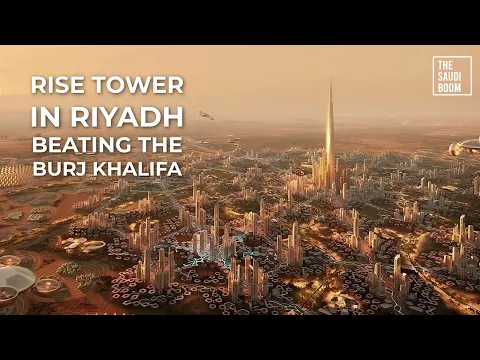

With 2 km in height, the tower will require engineering solutions that have not yet been applied on a large scale, such as multi-stage elevators, advanced anti-twisting systems, and high-strength hybrid materials. The project envisions a structural core in the shape of a triple helix, designed to withstand wind forces and minimize vibrations at extremely high altitudes.
The vertical transportation of future occupants will be done by ultra-fast double-deck elevators, with intermediate stations at various heights, called sky lobbies. The challenge will be to transport thousands of people safely, comfortably, and efficiently across hundreds of floors.
Vertical City in the Desert
The Rise Tower will not just be a building but rather a kind of vertical city. It is expected to house hotels, luxury apartments, shopping centers, offices, recreational areas, auditoriums, and even public observatories. All of this integrated into a larger urban environment, with access to mass transport infrastructure, parks, and cultural centers.
The project aligns with the Saudi government’s strategy to transform Riyadh into one of the leading financial and technological centers in the Middle East by 2030. The tower would serve as a symbol of this transformation — an architectural demonstration of the kingdom’s economic, technological, and political power, which has been diversifying its economy beyond oil.
Although still conceptual, the Rise Tower is already advanced in terms of feasibility study and is under the direct management of the Public Investment Fund (PIF), the same state fund responsible for projects such as NEOM and The Line, other mega-works aimed at positioning Saudi Arabia as a global hub for innovation.
Technical Challenges and Estimated Timeline of the Rise Tower Riyadh
Even with all the resources available, the project faces complex challenges. The construction of a 2 km tall building requires lighter and more resistant materials than those traditionally used. There are thermal issues, atmospheric pressure concerns, fire safety, and, above all, structural stability in a region prone to severe weather variations.
Another significant obstacle will be logistics: to reach this height, the supply of concrete, steel, and structural components will need to be coordinated with precision. Each step of the timeline will depend on the previous one, with zero tolerance for large-scale failures.
The first bids are expected to occur in 2025. If construction starts within that timeframe, it is estimated to take between 10 and 15 years to complete. This means the tower could be completed between 2035 and 2040.
Rise Tower Riyadh: A Project Reflecting Global Ambitions
The Rise Tower is not just an architectural ambition but also a diplomatic and economic tool. By launching a project of this magnitude, Saudi Arabia signals to the world its intention to lead the race for innovation, luxury, and sustainability on an urban scale.
Furthermore, there is a symbolic dimension: the construction of the tallest tower in the world in the midst of the desert reinforces the contrast between tradition and the future. It is a way to show that a country historically linked to oil exploration now also wants to be remembered for cutting-edge engineering, iconic architecture, and the ability to achieve the impossible.
If built according to the original design, the Rise Tower will go down in history as the work that elevated engineering to a new level. Its 2 kilometers in height will represent not only a technical achievement but also a geopolitical, urbanistic, and symbolic milestone.
With the signature of one of the largest architectural firms in the world, virtually limitless resources, and the ambition of a country undergoing a full reinvention, the Riyadh tower has everything to become the new absolute reference in vertical construction. And even though its challenges are enormous, the mere fact that it has come off the drawing board already places the Rise Tower at the center of global attention.





Be the first to react!