Portuguese
  Spanish



Researchers from UFRJ Developed a Plant Capable of Desalinating Water and Generating Renewable Energy with Heat Waste from Solar Energy Panels.
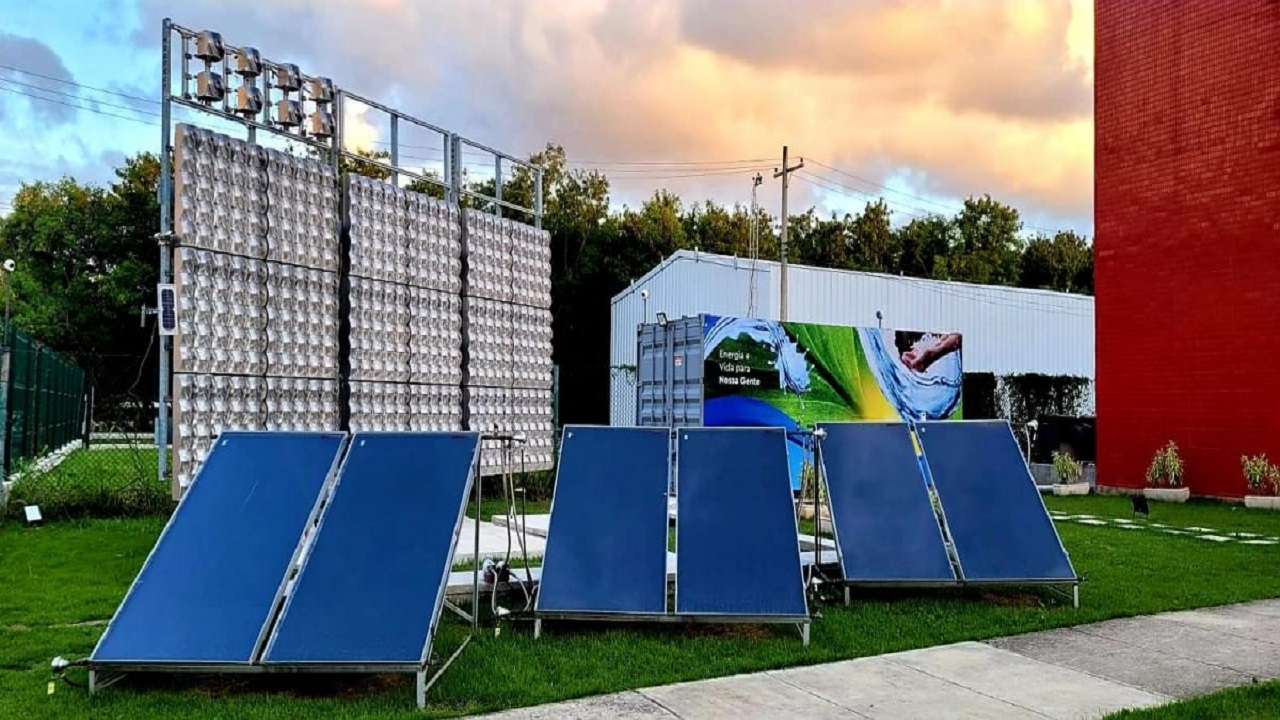
Mechanical, chemical, and mechatronics engineering students from UFRJ developed a system capable of generating renewable energy and distilled water simultaneously. The researchers created a technological demonstrator that recovers heat waste from solar energy panels and reuses it to heat water, which feeds a desalination unit via membrane distillation. The thermal energy emitted can be used in cooling processes for environments.
Plant Can Generate Renewable Energy Decentralized and Independently
The technology, called Sustainable Polycogeneration Island, can help decentralize the production of renewable energy in Brazil and also has the potential to serve locations that are not connected to the national electrical grid, such as communities in the northeastern semi-arid region, oil and gas fields near the coast, islands, and conflict areas, among others.
The name given by the UFRJ students has an explanation: “Island” comes from the opportunity to generate renewable energy in a decentralized, independent manner; “poly” is linked to its multiple possibilities of use; “cogeneration” relates to the inputs being generated together; and “sustainable” because the island is energetically self-sustaining, according to the coordinator of the Laboratory of Nano and Microfluidics and Microsystems – Carolina Palma Naveira-Cotta.
-
Brazil saved US$ 32.4 billion in 2025 by switching from fossil to renewable energy and only ranked behind China and the United States on the IRENA global podium.

-
Fired during apartheid and with a little borrowed money, an electrician started with a borrowed truck and transformed electrical services into a group connected to energy, real estate, and infrastructure in South Africa.

-
Wood has ceased to be just a construction material in Yale research and has become insulation for electrical transformers that face intense heat, aging, and increasing pressure from the renewable energy-powered grid.
-
More than 1,000 residents of a remote island in Kiribati now have clean water and electricity with solar systems operated by the community itself.


UFRJ Demonstrator Can Generate 13 kW
The demonstrator installed at UFRJ occupies an area of 200 m² and features a high-concentration photovoltaic solar panel with a generation capacity of 5 kW of electrical energy and 8 kW of thermal energy. It also provides three sets of solar collectors for complementary water heating.
Naveira-Cotta states that a portion of the renewable energy that would be lost by the solar panels is recovered and used in a secondary process. To recover part of the thermal energy, a system of micro heat exchangers was installed behind the panels of the UFRJ plant.
These devices use microchannels through which a refrigerant fluid passes, capturing some of the heat that would be wasted.
Prototype Came to Life in Early 2020
The UFRJ initiative is positive and highlights its importance for addressing regions with water or electricity scarcity. The prototype began to take shape in early 2020 and was developed during the pandemic, but the idea emerged in 2014.
In the industrial sector, the intensification of processes focuses on reducing energy consumption and the generation of waste from various procedures through the use of new technologies.
According to Cotta, in recent years, several methods have been researched in this line of inquiry, and some demands have emerged.