






 Portuguese
  Spanish


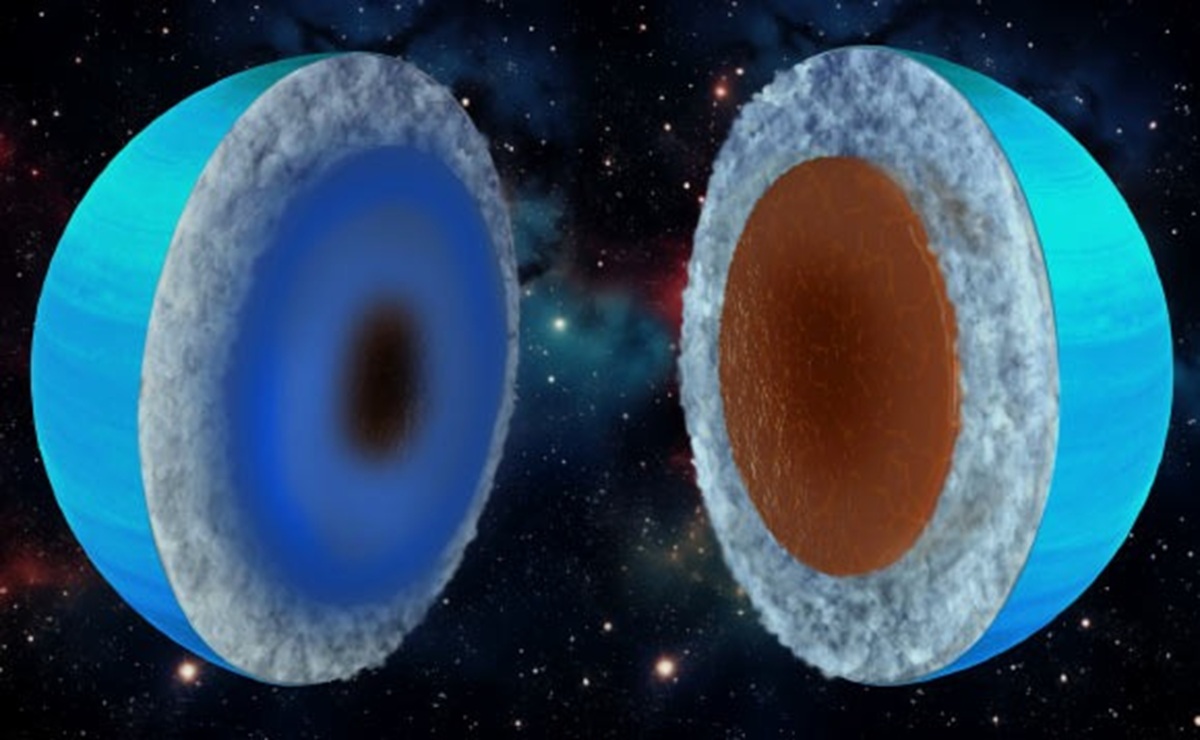

Research from the University of Zurich Uses Agnostic Physical Models to Reassess the Internal Composition of Uranus and Neptune, Highlighting Water or Rock-Rich Scenarios and New Explanations for Complex Magnetic Fields
A new study from the University of Zurich indicates that Uranus and Neptune may not be predominantly icy, applying agnostic physical models that suggest internal compositions rich in water or rock, with direct implications for magnetic fields and future scientific missions.
Researchers from the University of Zurich claim that classifying Uranus and Neptune as ice giants may be overly simplistic, as both planets are still poorly understood from a structural and compositional perspective.
“The classification of ice giants is too simplistic, as Uranus and Neptune are still not well understood,” said Luca Morf, a PhD student at the University of Zurich, commenting on the limitations of traditional models.
-
James Webb Telescope Uncovers Unexpected Clues on Mysterious Moon, Potentially Redefining Planetary Origins

-
$1.5 Billion Sleipnir Vessel Transforms Ocean into Floating Construction Site with 12 Hybrid Engines and Capacity to Lift 20,000 Tons

-
23 Years After Tragedy, Brazil’s Alcântara Space Center to Launch New Suborbital Rocket in 2026 with South Korean SEBIT Project Targeting Near-Space Tests
-
Entrepreneur Turns Neighbor’s Coffee Grounds Waste into Eco-Friendly Pellets, Earning Up to $40,000 Monthly in Brazil


According to Morf, models based exclusively on physics contained excessive assumptions, while empirical approaches presented simplifications that hindered a realistic understanding of the interiors of these distant planets.
“We combined both approaches to obtain interior models that are agnostic or unbiased and, at the same time, physically consistent,” Morf explained, describing the methodology adopted in the study.
The researchers began their work with random density profiles for the planetary interior, avoiding prior assumptions about the specific composition of Uranus and Neptune.
From these profiles, the team calculated gravitational fields consistent with available observational data and then inferred possible internal compositions consistent with those results.
The process was repeated multiple times until achieving the best possible match between the numerical models and observational data, allowing for the evaluation of multiple plausible internal scenarios.
With the new agnostic and fully physical model, scientists identified that the internal composition of the giants of the Solar System may go beyond ice, including significant proportions of water or rocky material.
“This is something we suggested for the first time nearly 15 years ago, and now we have the numerical framework to demonstrate it,” said Professor Ravit Helled from the University of Zurich.
“The new range of internal composition shows that both planets may be rich in water or rich in rocks,” Helled added, highlighting the expanded understanding of these planetary bodies.
Magnetic Fields and Internal Layers
The study also offers new interpretations for the unusual magnetic fields of Uranus and Neptune, which differ significantly from the dipolar field observed on Earth.
While the Earth presents well-defined North and South magnetic poles, Uranus and Neptune exhibit more complex fields with multiple detected poles.
“Our models have what we call ionic water layers, which generate magnetic dynamos in locations that explain the non-dipolar magnetic fields observed,” Helled said.
According to the results, the magnetic field of Uranus would originate from a greater depth than that of Neptune, indicating relevant structural differences between the two planets.
Despite the advancements, the authors acknowledge uncertainties associated with the behavior of materials under extreme pressures and temperatures in the planetary core, a topic still poorly understood by current physics.
“This may affect our results,” Morf stated, emphasizing that limitations in knowledge about exotic conditions remain a relevant challenge for the field.
Even with these uncertainties, the results challenge decades-old assumptions and guide future research in materials science under extreme planetary conditions.
<p“Both Uranus and Neptune may be rocky giants or ice giants, depending on the model's assumptions,” said Helled.
According to the researcher, current data is insufficient to clearly distinguish the scenarios, reinforcing the need for dedicated missions to both planets.
The study was published this week in the scientific journal Astronomy & Astrophysics, broadening the debate on the true nature of the outer giants of the Solar System.


