






 Portuguese
  Spanish


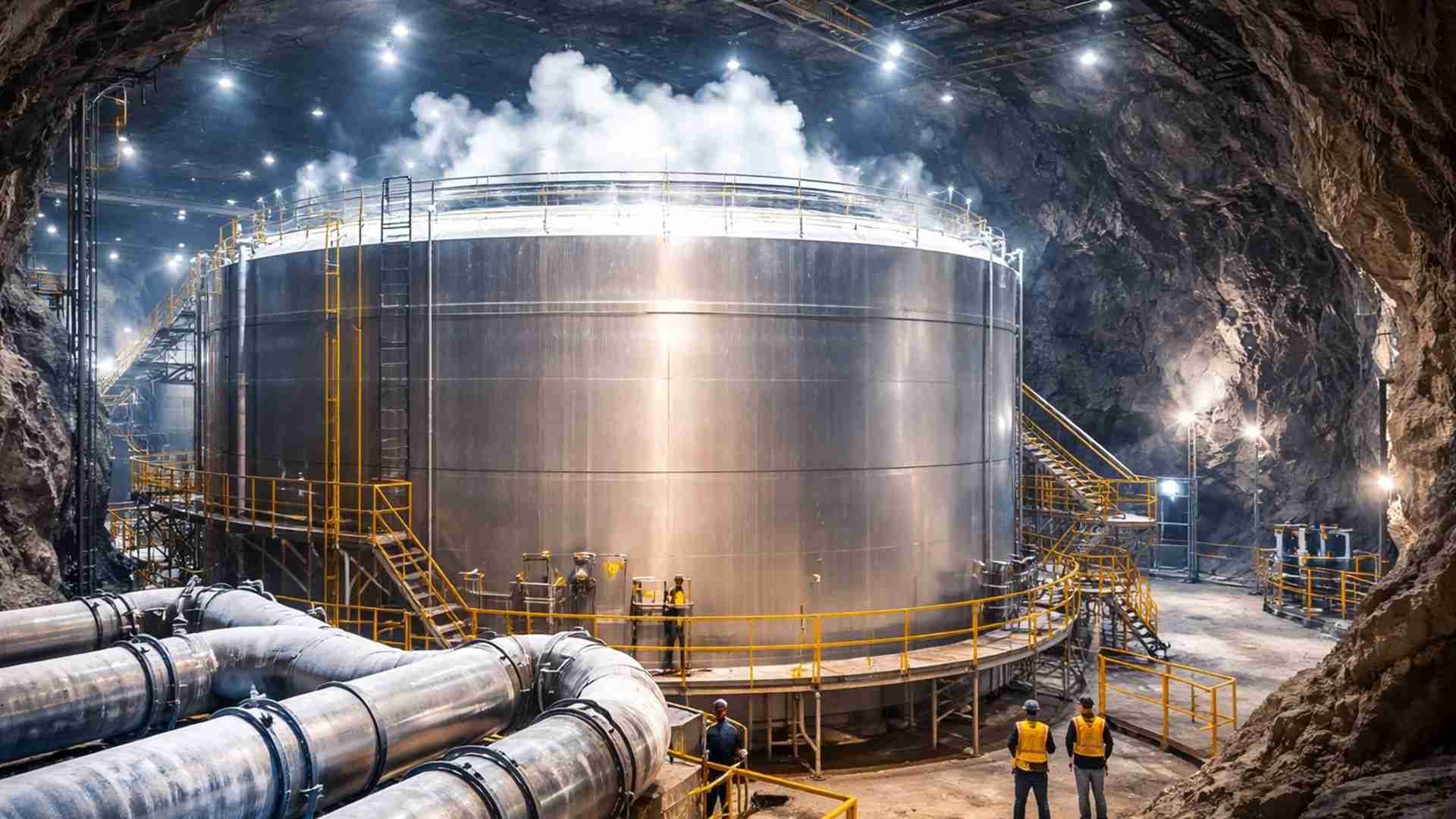


Installed more than 1.5 kilometers deep in an old mine in South Dakota, the Deep Underground Neutrino Experiment requires the cryogenic storage of 15,000 tons of liquid argon at -186 °C, combining extreme engineering, 500,000 cubic feet cryostats, and innovative technology to reduce cosmic radiation interferences and enable precise neutrino measurements.
Scientists in the United States are building underground cryogenic containers to store more than 15,000 tons of liquid argon at -186 °C, enabling the Deep Underground Neutrino Experiment, installed more than 1.5 kilometers deep to reduce cosmic radiation interferences.
Cryogenic Engineering Challenge on an Unprecedented Scale
American researchers are facing a large-scale engineering challenge by developing super-cooled vessels capable of containing more than 15,000 tons of liquid argon. The material must be kept at -186 degrees Celsius to ensure the proper functioning of the scientific detectors.
The effort is part of the Deep Underground Neutrino Experiment, a non-fictional experiment that uses enormous volumes of cryogenic liquid argon to detect rare subatomic particles.
-
ChatGPT Alerts FBI to Prevent Planned Murder of 8-Year-Old in Brazil’s Espírito Santo

-
Scientists Discover 125-Million-Year-Old “Pregnant Fossil” with Preserved Embryos and Microscopic Larvae Inside Mollusk in England

-
17-Year-Old Justin Bernstein Develops Bacteria to Produce Glass on Arctic Ice to Reflect Sunlight, Wins $50,000 U.S. Scholarship

-
The 19-Meter Rocket-Helicopter: A Private Industry Prototype That Challenged Space Race Logic



The detectors will be submerged in these cryogenic baths, positioned underground, in an arrangement that moves in the opposite direction to usual, directing downwards.
Reduction of Cosmic Radiation and Scientific Precision
According to Vincent Basque, a researcher at Fermilab, the underground installation of detectors in South Dakota will allow for a significant reduction in background cosmic radiation. This condition is essential to prevent external signals from overwhelming the experiment’s sensors.
The configuration enables the study, with high precision, of neutrinos sent by the Fermilab beam in Illinois, in addition to the detection of neutrinos coming from astrophysical sources like the Sun or a nearby supernova. The experiment also seeks to identify extremely rare processes associated with these particles.
The project team emphasizes that DUNE is regarded as the most sensitive experiment ever conceived to investigate the origins of the universe based on the properties of neutrinos, described as the first particles emitted after the Big Bang. This sensitivity requires rigorous environmental control and protection against interferences.
Underground Installation and Protection Against Cosmic Rays
To prevent cosmic rays, which constantly traverse space and hit Earth, from masking the weak signals captured by the detectors, the experiment will be operated at the Sanford Underground Research Facility. The complex is located in Lead, South Dakota.
The detectors will be positioned at a depth of over one and a half kilometers, sufficient to absorb most cosmic traffic, according to the project’s official statement. This depth transforms an old mine into a kind of scientific “giant refrigerator” adapted for extreme conditions.
The team is preparing to initially install two multi-kiloton detector modules, using variations of the liquid argon time projection chamber technology, known as LArTPC. International collaborators plan to add two more modules in the coming years.
Giant Cryostats and International Collaboration
Each detector module will be housed in an insulating container called a cryostat, with a volume close to 500,000 cubic feet, approximately equivalent to five Olympic swimming pools. These pieces of equipment are not standardized items and required specific development for the project.
The cryostats were designed by GTT, a company specialized in the transport of liquefied natural gas, and provided with the collaboration of CERN, which participates in DUNE. GTT had already been developing smaller cryostats for CERN experiments since 2007.
According to Lluís Miralles Verge, project leader for the cryostat at CERN, this is the first time such large structures are being produced. The DUNE LArTPCs will be installed in caverns accessible only by a deep shaft, requiring detailed and precise logistical and design planning, a process described as extremely complex.
Layered Structure and Performance Testing
To ensure leak-proof confinement of liquids and vapors, as well as proper insulation and support, the DUNE cryostats are composed of multiple layers. The GTT design utilizes the membrane cryostat concept, in which the inner layer forms a membrane intended to contain the liquid cryogen.
Each layer descends down the shaft in parts and is assembled directly in the detector cavern, starting with the outer structure. Completing the inner parts of a single DUNE cryostat requires assembling more than 5,000 individual pieces, highlighting the complexity of the system.
David Montanari, project manager for cryogenics at DUNE, stated that the prototypes built at CERN were essential.
They demonstrated that detectors, cryostats, and cryogenic systems work together seamlessly, ensuring confidence that the cryostats of the distant detector will perform adequately, even under such harsh conditions.


