Portuguese
  Spanish


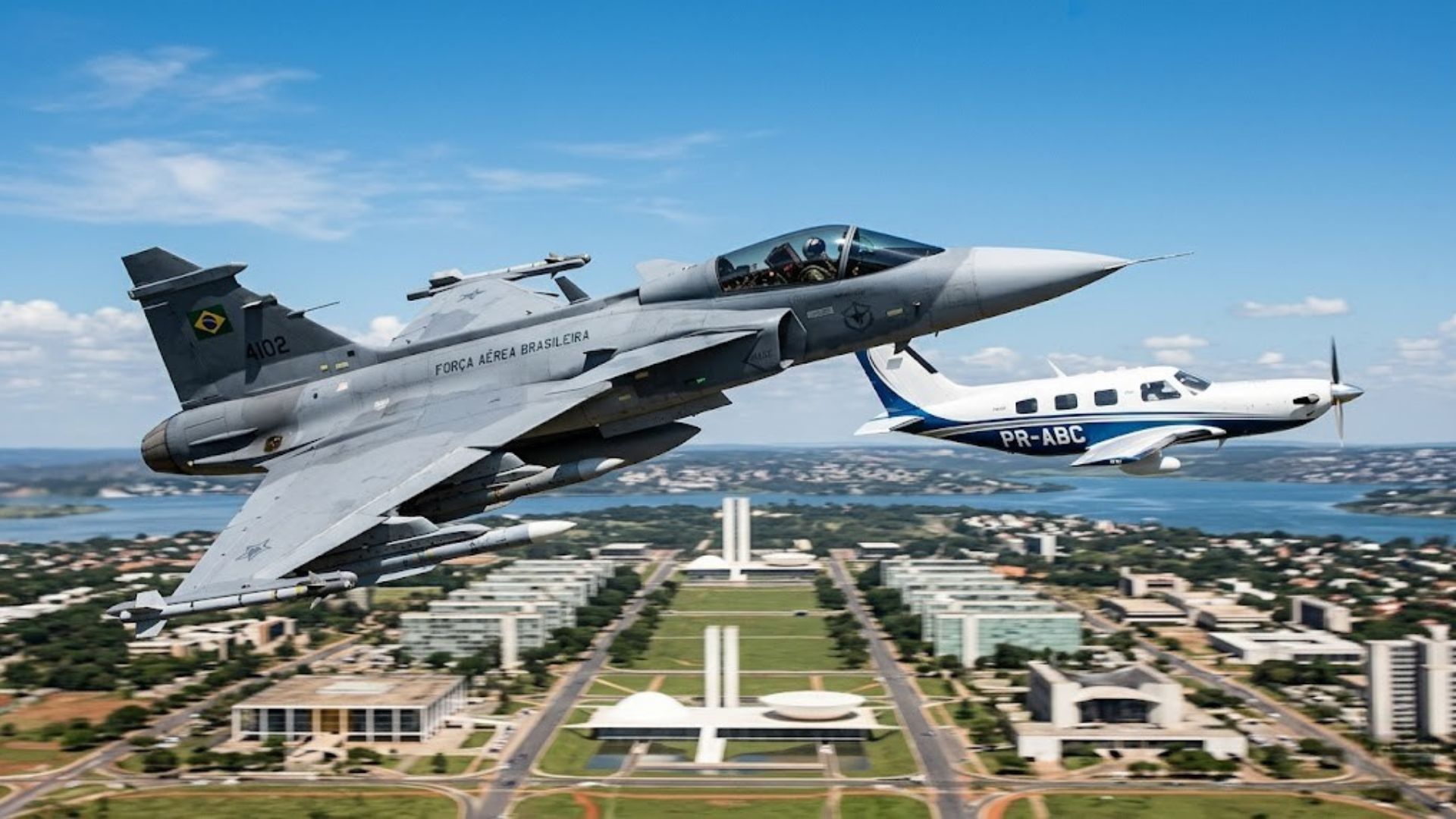

Unprecedented operation with Brazilian supersonic fighter jet marks advance in air defense and consolidates Gripen’s use in real surveillance missions in the country’s airspace, after a sequence of technical certifications and official entry into the alert system.
A Brazilian Air Force F-39E Gripen fighter jet was used for the first time in the interception of a civil aircraft near Brasília this Tuesday (14).
According to the Estadão newspaper, the target of the escort was a Piper M600 turboprop, model PA-46-600TP, which was flying within the Flight Information Region of the federal capital, in a scenario treated as part of the routine surveillance and training of air defense.
The incident gained relevance because it involved precisely the newest vector of FAB’s fighter aviation, currently based in Anápolis, Goiás, in the 1st Air Defense Group, the unit responsible for the model’s readiness in the country.
-
Woman Invented the First Dishwasher Using Hot Water and Pressure in 1886 and Founded a Company to Sell It

-
Self-Taught Innovator Develops Colorful Maritime Rockets for Nighttime Ship Communication, Adopted by the U.S. Navy for Safer Visual Messaging
-
The Secret U.S. Underwater Network That Tracked Soviet Submarines for Decades Now Used for Science

-
7-Year-Old Girl Rejects Lollipop, Questions Sugar’s Impact on Teeth, and Launches Sugar-Free Brand Now in 25,000 U.S. Stores





The Gripen’s entry into this type of mission occurs just weeks after the aircraft officially began to perform Air Defense Alert service from Anápolis Air Base, with a focus on protecting the airspace of the Central Plateau.
Air interception in Brasília with Gripen
According to the information released about the intercepted flight, the Piper M600 was traveling at about 260 knots true airspeed, equivalent to approximately 480 kilometers per hour, at flight level 280, or about 8,500 meters of altitude.
The fighter jet activated for the mission was FAB 4103, identified in reports as the fourth model received in Brazil.

Even though the approach of a fighter jet to a civil aircraft draws attention outside the aviation environment, this type of procedure is part of the normal air defense repertoire.
In operations of this type, the objective can vary between visual identification, tracking, verification of compliance with traffic rules, and training of protocols that need to be executed quickly by controllers, military pilots, and civil crews.
Gripen enters air defense alert in Brazil
In this context, the interception recorded over the Brasília area also serves as a demonstration of the Gripen’s operational maturity within the Brazilian aerospace defense system.
On February 24, 2026, the FAB itself reported that the F-39 had been employed for the first time in Air Defense Alert mission, a milestone defined by the institution as the consolidation of the aircraft in its full operational capacity within the country’s defense system.
The Air Force stated at that time that the mission was coordinated by the Aerospace Operations Command and executed by the 1st GDA, based in Anápolis, a unit that keeps the fighter jet in a state of readiness.
The alert service operates permanently and provides for rapid activation whenever the air defense system detects an aircraft that, for some reason, requires investigation or monitoring.
Certifications and tests of the F-39 Gripen fighter
The use of the Gripen in interceptions did not occur in isolation.
Before that, the model underwent a series of certifications and tests that expanded its use in real and training missions.
The FAB reported that the operational advancement of the F-39 was made possible after stages such as in-flight refueling with the KC-390, the actual launch of the Meteor missile, and the first air-to-air shot with the cannon conducted on national territory.

The actual firing of the Meteor missile was announced by the Air Force in November 2025, during a technical exercise aimed at developing the capability for beyond-visual-range combat.
In that training, the 1st Air Defense Group participated with four F-39E Gripen aircraft, in a campaign considered strategic for the evolution of the fighter’s use in Brazil.
Shortly after, on December 11, 2025, the FAB also announced the first air-to-air shot with the model’s internal 27-millimeter cannon.
The activity was regarded as another step in the validation process of the platform for operational situations, including air defense scenarios in which the aircraft needs to be capable of employing different weapon systems according to the type of mission.
Production of the Gripen in Brazil and partnership with Embraer
This sequence of milestones helps explain why the interception of the turboprop near Brasília came to be seen as symbolic.
It was not just another monitoring flight, but the first time that the new Brazilian fighter appeared, in a recorded manner, in an interception of a civil aircraft, something that reinforces its incorporation into the routine of airspace policing.
The centrality of Brasília in this process is not coincidental.
The Anápolis Air Base, where the Gripen operates, occupies a strategic position for covering the Central Plateau and for prompt reaction to any occurrences in the region’s airspace.
It was from there that the F-39 began to integrate into the alert service, gradually replacing an operational logic previously associated with other FAB fighter aircraft.
In addition to its supersonic performance, the Gripen combines advanced sensors, data integration, and multi-mission capability, characteristics that have made the program one of the main modernization projects of Brazilian combat aviation.
The FAB claims that the model combines air defense, attack, and reconnaissance in a single platform, with a direct impact on response and deterrence capability.
Meanwhile, the program is also advancing on the industrial front.
On March 25, 2026, Embraer, Saab, and FAB officially presented, in Gavião Peixoto, in the interior of São Paulo, the first F-39E produced in Brazil.


The ceremony marked the presentation of the first supersonic fighter manufactured in the country, within a project that involves technology transfer and increasing participation of the national industry.
On that occasion, the companies reported that local production uses a Brazilian and international supply chain and that another 14 fighters from the contract will follow the same manufacturing model.
Saab also reported that, up to that stage, 11 aircraft had already been delivered, although the FAB had recorded, in February, ten units in operation in the 1st GDA, a difference that may arise from the interval between formal delivery and full incorporation into operational routine.
Interception and Air Surveillance Training
In operations like the one recorded this Tuesday, there is a technical component that goes beyond the image of the fighter flying close to a civilian aircraft.
Intercepts serve to train communication, visual positioning, reading the behavior of the accompanied aircraft, and executing standardized procedures, especially in cases of airspace closure, changes in circulation rules, or suspicion of irregularity.
On the other hand, this type of action also serves as a familiarization element for civilian pilots, who need to recognize signals and comply with internationally defined protocols when being accompanied by military aircraft.
The presence of the Gripen in this environment shows that the fighter has moved beyond the phase of progressive incorporation and has begun to perform concrete tasks within the Brazilian aerospace defense system.
The first interception of a civilian aircraft by the F-39 thus fits into a broader moment of consolidation of the program.
After years of development, training, weapon trials, and industrial structuring, the model begins to appear in missions that visibly translate its role within the defense of national airspace.