Portuguese
  Spanish


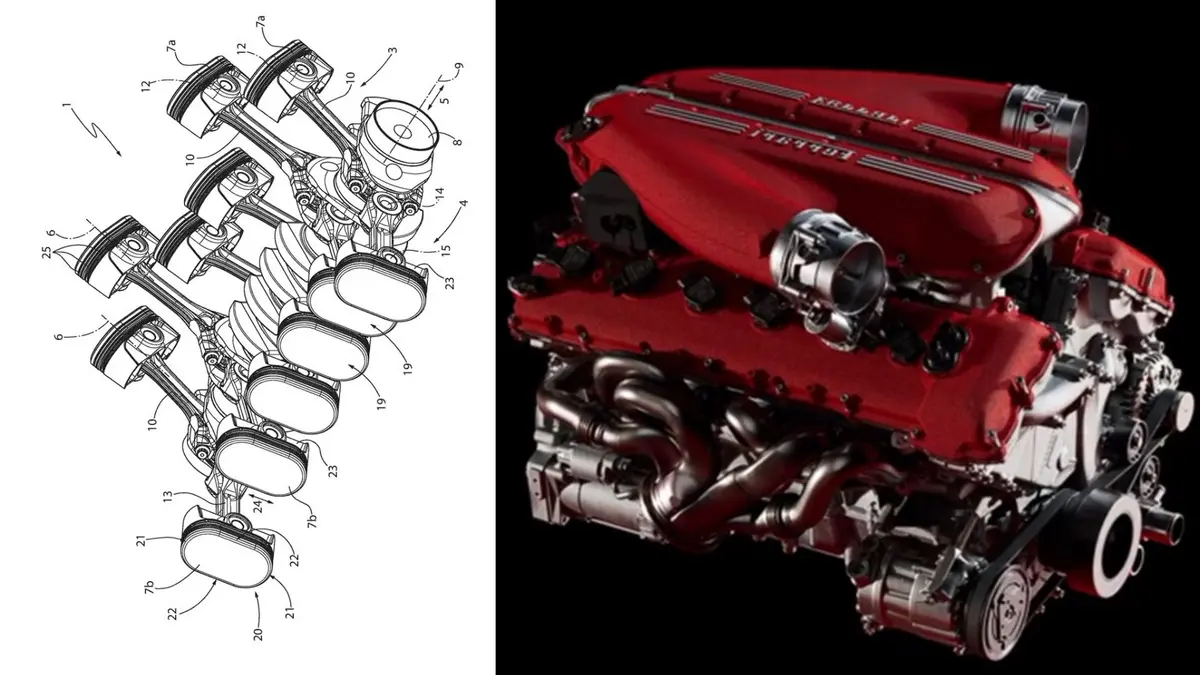


The Technology Promises to Enhance Efficiency, Increase Power, and Redefine High-Performance Standards in Ferrari Supercars, Attracting the Attention of the Automotive Industry.
Ferrari is innovating once again in the design of internal combustion engines. A recent patent filing in Europe reveals that the automaker is developing oval pistons for its V12 engines.
The proposal promises greater efficiency, reduced friction, and better space utilization in the engine.
A Bold Change in the V12
Conventional engines use round pistons that move within the cylinders to generate power.
-
Toyota Corolla Hybrid Achieves 17.5 km/l in City with Self-Charging System and Regenerative Braking, Offering a Spacious and Quiet Ride Without Needing a Plug

-
Land Rover Issues Recall for Airbag Connector Fault Affecting 250,857 Vehicles in the US, Alerting Drivers in Brazil for Official Notice

-
Brazilian Electric Motorcycle Once Promised 180 km Range and Affordable Price, Now Faces Uncertain Future Amid Delays and Manufacturer’s Bankruptcy
-
Chery Stockman 2026 Unveiled: Larger Than Toyota Hilux, Featuring Unique Plug-In Hybrid Diesel Engine, 3.5 Ton Towing Capacity, and 1,000 kg Payload to Challenge Traditional Off-Road Trucks


Ferrari, however, proposes an elongated shape, similar to a pill.
This change allows the cylinders to be closer together, reducing the engine size without compromising performance.
With this approach, Ferrari aims to optimize space, especially in models equipped with mid-mounted engines.
The strategy also opens doors for future hybrid configurations, without losing the sound and performance identity of traditional V12s.
Cutting-Edge Technology and Engineering
The new design from Ferrari is not unprecedented in the industry. Honda has tested oval pistons in competitions, but the current approach differs by focusing on the production of high-power engines for everyday use.
The patent describes a configuration where two pistons share the same connecting rod on the crankshaft, reducing mechanical complexity and minimizing friction.
Additionally, indentations along the pistons help dissipate heat and optimize combustion.
The reduction of internal friction means less energy loss, making the engine more efficient. This could result in greater power per piston stroke without increasing fuel consumption.
For a brand that always seeks extreme performance, this solution is an important step in the evolution of combustion engines.
Impact on the Future of Ferrari Engines
Even with the global trend toward electrification, Ferrari does not intend to abandon internal combustion engines.
The new technology of oval pistons may be a way to meet emission regulations without compromising performance and the sound identity of the engines.
Other brands have already explored unconventional designs, like Mazda with its Wankel rotary engine. However, recent advances in metallurgy, additive manufacturing, and computational simulations make Ferrari’s approach more viable.
With this innovation, the Italian automaker aims to keep its engines relevant in a future where energy efficiency is increasingly prioritized.
Although there is no forecast for mass production, the patent demonstrates Ferrari’s commitment to innovation and the pursuit of new technological solutions.
What to Expect Going Forward
The introduction of oval pistons could mark a new chapter in the history of high-performance engines.
If the project moves forward, it may result in smaller, more efficient, and powerful engines, preserving Ferrari’s sporty essence.
For fans of the brand, this means that the iconic sound of V12 engines may be maintained for longer, now with a lesser environmental impact.
As electrification advances, Ferrari continues to explore ways to extract the most from internal combustion, ensuring that its cars remain exciting and technologically advanced.