Portuguese
  Spanish


Ferrari decided to bring back the iconic lever with a metal grille that hadn’t appeared in a production car since 2012, but hid behind it digital engineering that simulates every detail of the classic manual experience
A few days after surprising the automotive market with the Luce, its first fully electric and five-seater model, Ferrari decided to thrill purists in a completely different way. Last Friday, July 3, 2026, the Italian automaker revealed the 12Cilindri Manuale, a special and limited edition that revives the legendary gear shift metal grille — the famous “gated shifter” — absent from Maranello’s production lines since the end of the 599 GTB Fiorano in 2012.
According to information released by CNN Brazil, however, this is not a traditional mechanical return. In this sense, Ferrari’s novelty lies precisely in the contrast: on the outside, the car seems like a nostalgic revival; on the inside, it hides sophisticated digital technology, capable of combining the physical involvement of a classic transmission with the response speed of a modern dual-clutch gearbox. According to the model’s official page on Ferrari’s own website, the system named “Manuale By-Wire” is born from the combination of wire shift control and wire clutch pedal, promising to return “raw physical intensity” to the heart of the V12 experience.
The “Manuale By-Wire” technology and the partnership with the brand’s nautical sector
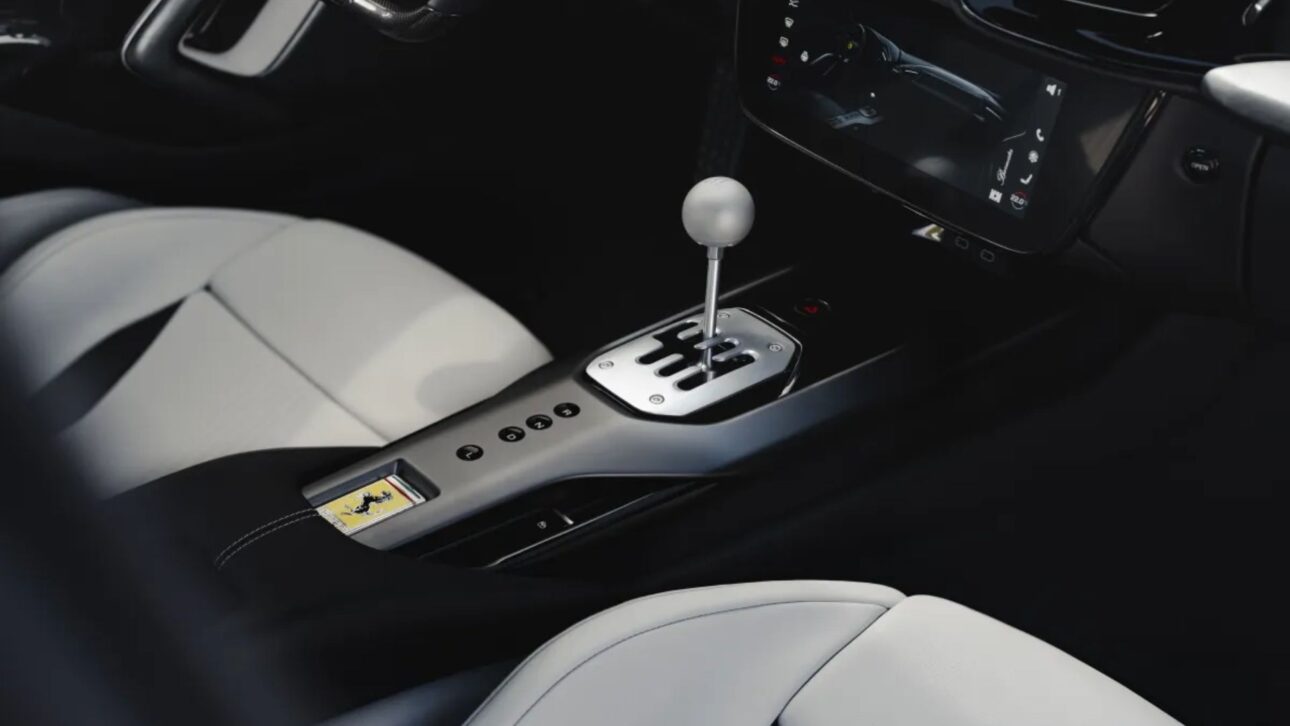
The great differential of the 12Cilindri Manuale is the fact that neither the gear lever nor the clutch pedal have any physical or hydraulic connection with the engine or the 8-speed DCT automatic transmission, positioned at the rear of the vehicle. All operation takes place through what Ferrari has dubbed the Manuale By-Wire concept, which transforms each physical movement of the driver into highly precise digital signals — an approach, incidentally, quite similar to that adopted by Koenigsegg in its 850 CC model.
-
Discover the 2021 Fiat Cronos 1.3: Affordable Maintenance, Reliable Mechanics, and Fuel Efficiency of Up to 15.6 km/l

-
Cummins Unveils Hydrogen-Powered X15H Engine with Over 800 km Range and 15-Minute Refueling, Challenging Electric Truck Dominance

-
Chevrolet Onix 2026 Priced at R$ 86,790 with Discounts, Underpricing Citroën C3; Features 1.0 Engine, 6 Airbags, 8″ MyLink, Wi-Fi, and OnStar

-
Fiat Mobi Price Nears $18,000 in Brazil: Entry-Level Hatch with 1.0 Firefly Engine, Manual Transmission, and Stability Control Sees $400 Increase.


To ensure the sensation didn’t feel artificial, Ferrari’s development department joined forces with Hypersail, the team responsible for the brand’s nautical projects and already mastering advanced wire control technologies. From this partnership, an internal mechanical module of the highest precision was born, machined from solid blocks of high-strength steel, weighing approximately 3.5 kg. Additionally, engineers inserted actuators and eccentric bearings capable of replicating the weight, synchronization resistance, perfect fit, and even the characteristic metallic click sound of the old steel rods hitting the aluminum guides with millimeter precision. Unlike older models — where oil temperature and even the assembler’s “mood” interfered with gear resistance — the new digital system ensures impeccable consistency without sacrificing the analog soul that sports car enthusiasts so value.
Even the engine can “stall”: the realistic clutch simulation

Another highlight is the third pedal installed on the floor, a true showpiece within the brand’s simulation proposal. Ferrari configured the clutch pedal with a resistance of 15 kg — exactly the same load required by the old 599 GTB Fiorano. Through an analog mechanism composed of a pre-load spring, cam, and roller, the pedal faithfully reproduces the physiological curve of a real mechanical clutch.
Meanwhile, angle sensors monitor the driver’s foot position in real-time, and the software logic has been calibrated so that the entire operation is practically imperceptible. Still, there is a deliberately human catch: if the driver mistimes the coupling between the accelerator and the clutch when starting from a standstill or downshifting, the car will jerk — or even “stall,” stalling the V12 engine, just as it would in a traditional manual vehicle. According to Ferrari itself, more elaborate maneuvers, such as the classic heel-and-toe, are fully supported and even encouraged by the electronic system.
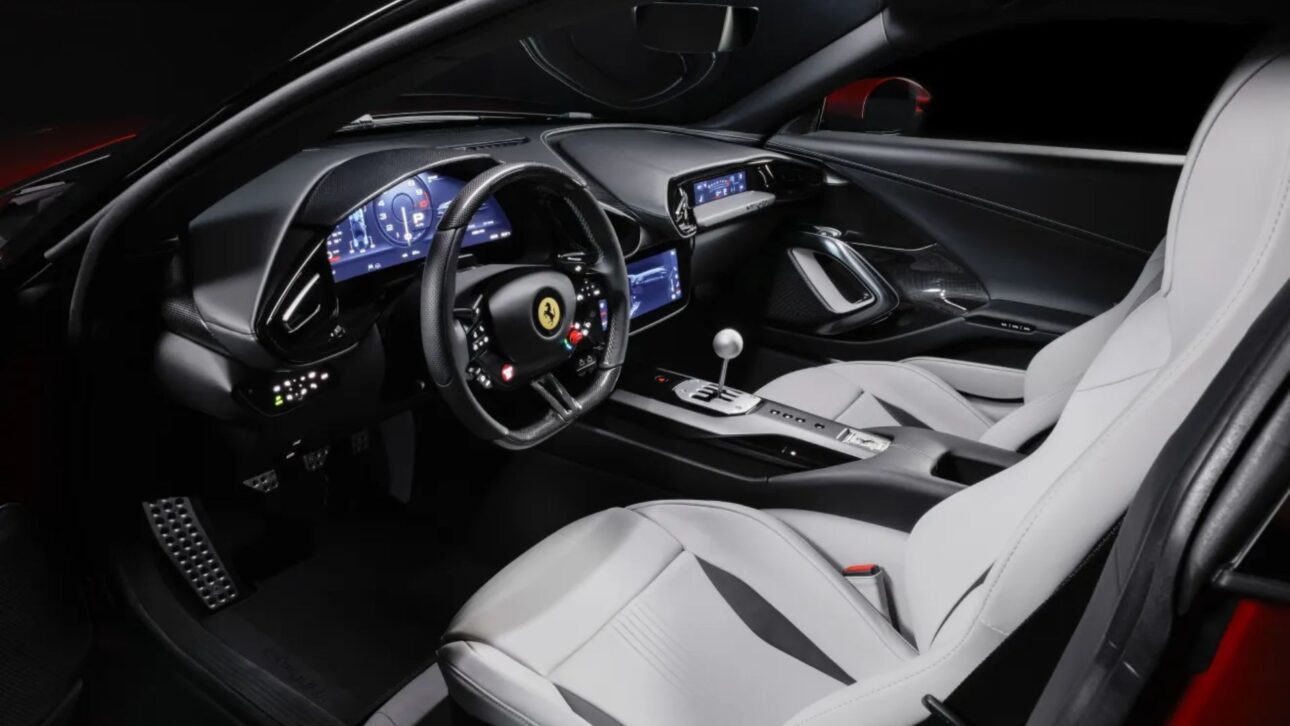
On the other hand, the driver retains total freedom of choice between two worlds. By pressing the clutch pedal at speeds below 100 km/h, the vehicle automatically enters manual mode: the driver operates the “H” pattern of the grille, using the first six gears of the DCT transmission, as well as reverse, accessed by pushing the lever down. In this mode, even the paddles behind the steering wheel have been completely removed, precisely to preserve the ritual of gestures, and the gear numbers on top of the aluminum knob light up in amber.
In automatic mode, activated by pressing the “D” button on the console — positioned just below the lever — the numbers on the handle change to white, and the car manages the 8 gears of the dual-clutch gearbox entirely automatically, ensuring more comfort in traffic jams or on long-distance trips, when the 7th and 8th gears come into play to improve efficiency. Even in this mode, the driver can still use the lever to pre-select a gear, with the 12.3-inch digital panel graphically displaying how the tachometer will react once the change is made.
Intact Heart: V12 Engine and Supercar Performance
Under the reverse-opening hood, Ferrari chose to keep the naturally aspirated 6.5L V12 engine completely untouched, with a 65° angle and dry sump, capable of delivering an impressive 830 hp at 9,250 rpm and 678 Nm of torque at 7,250 rpm, with a maximum rotation of up to 9,500 rpm. The exhaust sound was also preserved exactly as we know it in the base 12Cilindri — after all, for Ferrari, tampering with the car’s heart was never on the agenda.
Thanks to the efficiency of the by-wire system, the brand guarantees that a skilled driver can extract practically the same performance numbers as the conventional automated version. The model accelerates from 0 to 100 km/h in 2.9 seconds, surpasses the 200 km/h mark in less than 7.9 seconds, and reaches a top speed of over 340 km/h. All this with an almost negligible weight cost: the Manuale version weighs only 5 kg more than the conventional 12Cilindri, which already leaves the factory with a dry weight of 1,565 kg.
Tailor Made Exclusivity and a Hidden Tribute in the Production Number
The production of the 12Cilindri Manuale will be strictly limited to 1,499 units worldwide — and this number was not chosen by chance. It is a direct tribute to the displacement, in cubic centimeters (1,499 cm³), of the very first twelve-cylinder engine ever built by Ferrari, back in 1947.
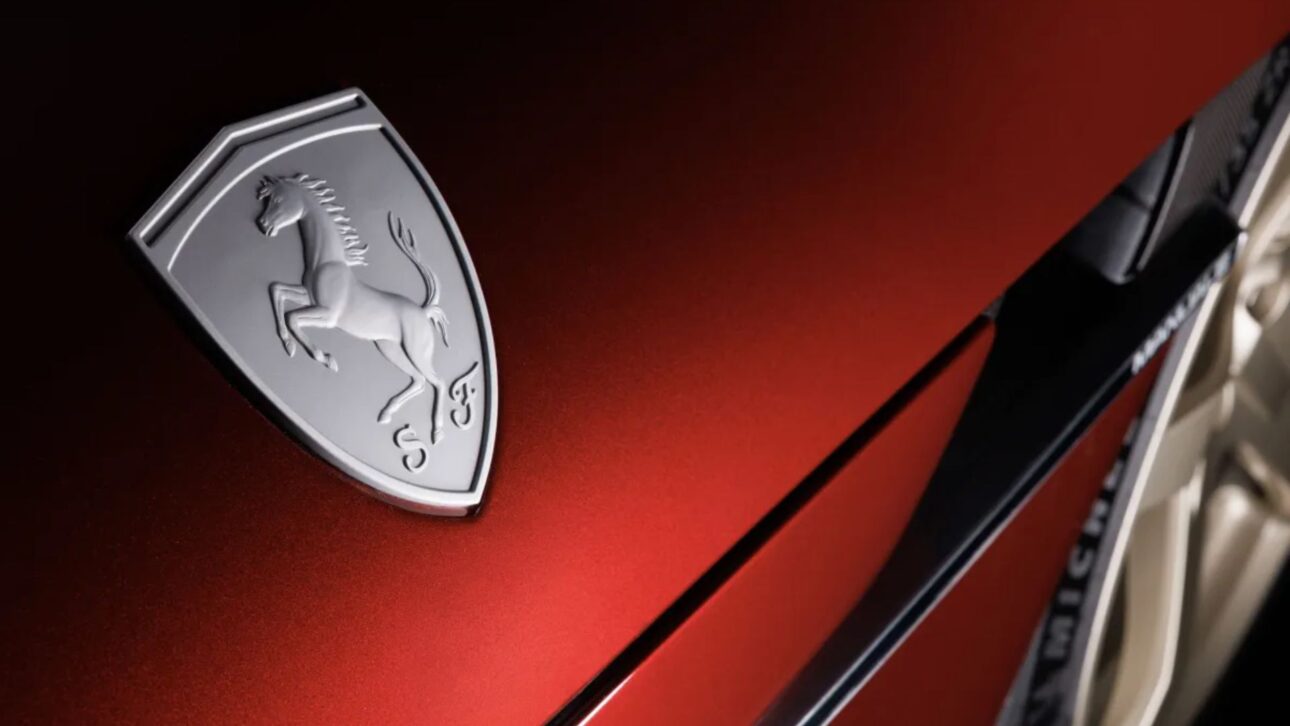
All units will undergo the brand’s well-known Tailor Made customization program, ensuring that no example leaves identical to another. The design, signed by the Ferrari Design Studio under the leadership of Flavio Manzoni, features exclusive details: the front splitter and active rear wings receive a pinstripe-style paint in homage to the classic 365 GTB4 “Daytona”; the traditional Scudetto on the front fenders gains relief minted like valuable coins, with the special series logo laser-engraved on the sides; and the central console has been redesigned, gaining an anodized aluminum frame in the shape of a tuning fork around the grille, in addition to seats — available in Comfort or Racing versions — upholstered in leather and CorsaTex, with six vertical grooves directly alluding to the six gears of the manual mode. The buyer can also choose from 25 historical colors from the brand’s palette, highlighting the Rosso Rubino of the launch car, as well as shades like Argento Nürburgring, Verde Zeltweg, and Viola Hong Kong.
All this “retro-technological” engineering refinement, however, comes at a price: Ferrari has set the suggested price of the 12Cilindri Manuale at 590,000 euros — approximately R$ 3.6 million at the current direct exchange rate —, a premium of 190,000 euros over the standard 12Cilindri value. As part of the standard convenience package for VIP clients, the model also includes the Genuine Maintenance program, which guarantees 7 years of free scheduled maintenance, performed every 20,000 km or once a year, always with original parts and diagnostics connected directly to the headquarters in Maranello.
Complete technical specifications of the Ferrari 12Cilindri Manuale
Engine and transmission
- Engine: 65° V12, naturally aspirated, dry sump (6,496 cm³)
- Maximum power: 830 hp at 9,250 rpm
- Maximum torque: 678 Nm (69.1 kgfm) at 7,250 rpm
- Maximum rotation: 9,500 rpm
- Compression ratio: 13.5:1
- Transmission: F1 dual-clutch with 8 gears, operable via Manuale By-Wire electronic system (6 gears in manual mode)
Performance and consumption
- 0 to 100 km/h: 2.9 seconds
- 0 to 200 km/h: less than 7.9 seconds
- Maximum speed: over 340 km/h
- Braking from 100 to 0 km/h: 31.4 meters
- Braking from 200 to 0 km/h: 122.0 meters
- Combined consumption: 15.5 liters/100 km (approximately 6.45 km/l)
- CO₂ emissions: 353 g/km
Electronic controls SSC 8.0 (Side Slip Control) System, Traction Control (TC), Electronic Differential (eDiff), Magnetic Dampers (SCM), Rear Axle Steering (PCV 3.0), Dynamic Enhancer (FDE 2.0), Electric Steering (EPS), ABS-Evo integrated with Manettino, and 6D Chassis Sensor.