Portuguese
  Spanish


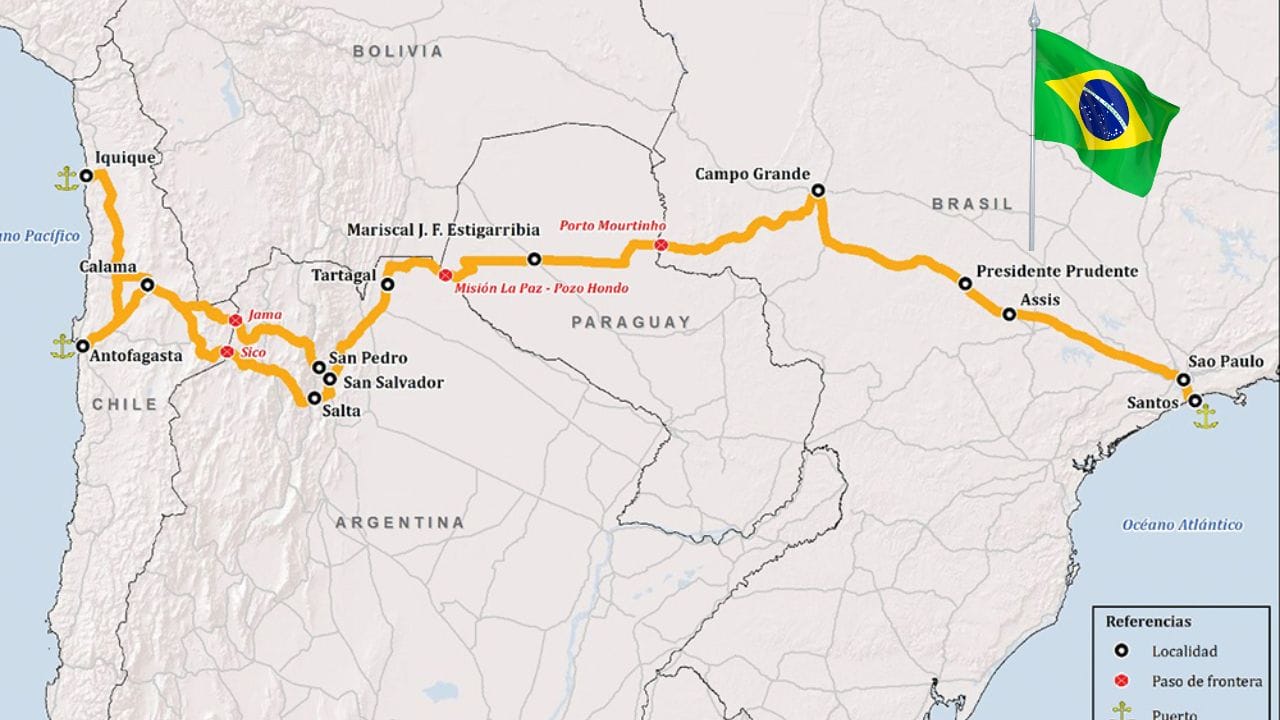


The Railway, Extending Through Several South American Countries – Including Brazil, Bolivia, Paraguay, Argentina, and Chile – Will Use Existing Rail Networks, Integrating Them Into a Network That Crosses the Continent. This Project, Comparable to the Bioceanic Road Route, Promises to Significantly Shorten Trade Distances Between South America and Asia, Reducing Costs and Transportation Time.
The Bioceanic Railway, an ambitious project for continental integration, promises to revolutionize transportation and trade in South America. Planned to extend from the Brazilian Atlantic coast to the Chilean port of Antofagasta on the Pacific, the railway aims to offer a more efficient and economical route to the Asian market, strengthening the competitiveness of South American products.
The need for the railway arose from the realization that the current route, which requires transporting goods from the interior of the continent to the Atlantic coast, followed by a long maritime journey to Asia, is both costly and time-consuming. The bioceanic railway promises to shorten this route by thousands of kilometers.
Route and Technical Specifications


The proposed route begins at the Brazilian ports of Santos, Paranaguá, and São Francisco do Sul, passing through the International Hub of Três Lagoas, and crossing Brazil to Corumbá, on the border with Bolivia. From there, it goes to Santa Cruz de la Sierra, interconnecting with other branches of the rail network that lead to the Chilean ports of Antofagasta and Iquique.
-
The Port of Itaqui closes the best first semester in history with over 17 million tons and takes off as the locomotive of the Northern Arc.

-
Brazil’s North-South Railway to Auction Two Grain Terminals in Central Tocantins

-
AI-powered traffic cameras in São Paulo now issue fines for cellphone use and seatbelt violations around the clock

-
Brazil’s First Freight Railway Built from Scratch, EF-118 Connecting Espírito Santo to Rio de Janeiro, Goes to Auction in October Attracting Chinese Giant in Multi-Billion Dollar Bid for Southeast Rail Network


The project faces significant challenges, including the need to revitalize existing railway sections in Brazil, such as the West Network. Currently, the speed and cargo capacity of these sections are well below ideal, requiring substantial investments and improvements in infrastructure.
Comparative Costs and Benefits
Compared to the Bioceanic Road Route, the railway offers a more economical and efficient alternative for cargo transportation. While the road route would cost around 83 million dollars, the railway requires an investment of approximately 30 million dollars.
The reduction in costs and time for transporting goods to Asia could significantly increase the competitiveness of South American products in global markets. And of course, the bioceanic railway can boost regional economic development, opening new opportunities for trade and investment.
The Bioceanic Railway is a large-scale project that can transform the economic and commercial landscape of South America. By providing a direct connection between the Atlantic and Pacific oceans, it represents not only an innovation in terms of transportation infrastructure but also an opportunity for South American countries to strengthen their position in global trade. The realization of this project will depend on international collaboration, substantial investments, and overcoming technical and logistical challenges.