






 Portuguese
  Spanish


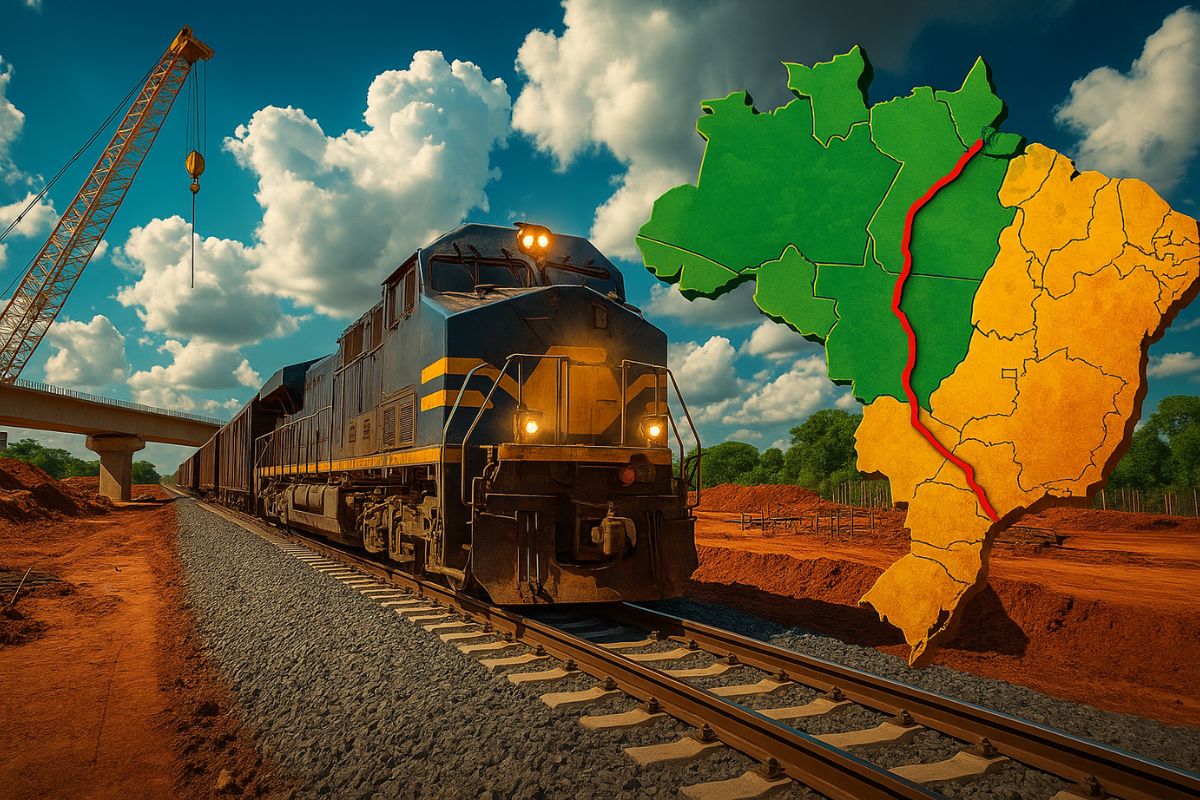

The North-South Railroad was born to integrate Brazil from end to end and reduce the logistical cost of the country. Initiated in 1987, during José Sarney’s government, the project spanned five federal administrations, two recessions, and a pandemic, alternating between phases of progress and stagnation. The formal delivery of the final stretch, connecting the axes to the ports of Itaqui (MA) and Santos (SP), occurred in June 2023.
Today, the railroad totals 2,257 km in operation, within a total plan of 4,155 km that will cross 12 states (including Pará, Maranhão, Tocantins, Goiás, Minas Gerais, and São Paulo). The accumulated cost exceeds R$ 11 billion, with concessions and decisive private investments for the completion of the network and the expansion of terminals.
What Is the North-South Railroad and Why Does It Matter
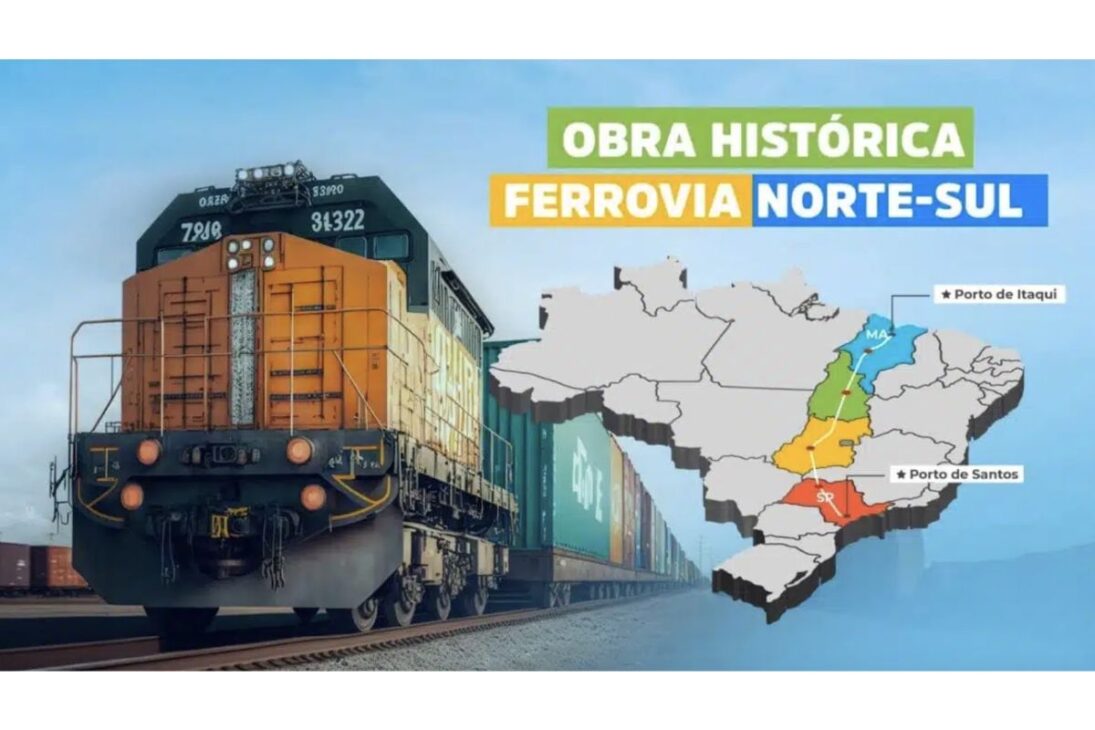
Considered the backbone of the railway system, the NSR was designed to connect producing areas in the Center-North to the major ports, reducing dependency on road transport.
-
Giant 3,600-ton Crane Breaks Two World Records by Installing World’s Largest Single-Piece Forged and Welded Hydrogenation Reactor, Weighing 3,037 Tons, in Chinese Petrochemical Plant in Just Six Days

-
$80 Million Bridge in Brazil Cuts Travel Time from 30 Minutes to 1 Minute, but Audit Reveals Major Flaws
-
Man Builds Stone Bed with Granite Rocks and Hand-Sawn Cedar Beams, Home Extension Garners Over 437,000 Views on Bonus Bolts Channel

-
Brazilian Researcher Develops Color-Changing Roof Tile to Reduce Air Conditioning Use by Up to 15%




The main goal is to decrease freight costs and increase competitiveness, especially for grains (soybeans, corn), minerals, and industrial products.
In practice, the route creates logistics corridors that connect agricultural and industrial hubs to rail terminals and inland ports.
By shortening economic distances and standardizing flows, the NSR tends to alleviate harvest bottlenecks, mitigate freight seasonality, and attract new investments in storage and cargo processing.
Timeline: 1987–2023
The initial layout envisioned about 1,550 km between Açailândia (MA) and Anápolis (GO). Between 2003 and 2016, the project gained momentum but also accumulated allegations of deviations and project changes that extended deadlines and costs.
In 2019, the southern stretch (Porto Nacional/TO–Estrela d’Oeste/SP, 1,537 km) was sub-conceded to Rumo Logística for R$ 2.719 billion in grant.
Rumo announced approximately R$ 4 billion to complete construction and build strategic terminals.
In 2023, the final delivery consolidated operational connections with Itaqui (MA) and Santos (SP), linking producing areas to the two main maritime exits of the country. Outcome: the NSR transitioned from a promise to a effective flow axis.
Extension, Operation, and Governance
The total project plans for 4,155 km, crossing 12 states across four macro-regions.
In operation, there are 2,257 km, with the network divided between VLI Logística (northern stretch) and Rumo Logística (central and southern stretch).
This division by concessions requires coordination of windows, passage agreements, and standardization of procedures to maintain regularity and predictability of trains.
Financially, the NSR combines historic public investments (via Valec) with recent private capex for completing construction, yards, signaling, rolling stock, and multimodal terminals.
In this shared governance, the railroad seeks to gain scale, operational safety, and long-term predictability for shippers.
Logistical Integration: Where Are the Gains and Bottlenecks
The gains appear when the railroad connects with transhipment terminals, warehouses, and good access highways.
In these cases, shippers report significant cost reductions, with a direct impact on freight price formation and export competitiveness.
The consistency of full trains in the port-to-inland direction also supports more stable tariffs.
The bottlenecks arise when there are shortages of yards, urban access, expansion licenses, or when there are interferences in the right-of-way (irregular crossings, invasions).
Without end-to-end integration, the benefits of the railway are lost: trucks cover long stretches, the cycle of cars slows down, and total cost rises again.
The key is well-tied multimodality.
Economic and Sectoral Impact
For the agribusiness, the NSR enables shorter and more predictable routes to the ports, improving export logistics and encouraging investments in crushing, corn ethanol, and storage near the railroad.
Industries of cement, steelmaking, paper, and cellulose also benefit from heavy load and lower freight variability throughout the year.
Regionally, the rail induces new service hubs (workshops, maintenance, logistics operators), expands skilled jobs, and improves local revenue.
With lower emissions per ton transported, the rail mode also adds a positive environmental effect compared to the predominant road matrix.
Costs, Concessions, and Key Numbers
The total cost of the NSR exceeds R$ 11 billion over nearly four decades, combining public investment (initial phases) and recent private contributions.
In 2019, Rumo won the sub-concession of the southern stretch for R$ 2.719 billion and invested approximately R$ 4 billion in completing works and terminals.
The northern stretch is under the operation of VLI, focusing on maintenance, safety, and capacity enhancement.
Sensitive point: the dilution of capex requires a constant volume of cargo and medium and long-term contracts.
Without firm demand, the cost per rail ton rises, disincentivizing the modal shift and reopening space for trucks on intermediate stretches.
Immediate Challenges and Next Steps
The immediate challenge is to consolidate operational continuity between concessions, eliminate access bottlenecks, and accelerate private terminals at agricultural and industrial junctions.
Process standardization, prioritization of crossings, and signaling technology help to increase the useful window without sacrificing safety.
On the horizon, the goal is to reach the projected 4,155 km, expand connections with other networks, and stabilize North and Southeast corridors with harvest predictability and take-or-pay contracts.
When the railroad “closes the cycle” with port, yard, and road access, the effect is cumulative: more cargo, lower unit cost, and greater external competitiveness.


