Portuguese
  Spanish


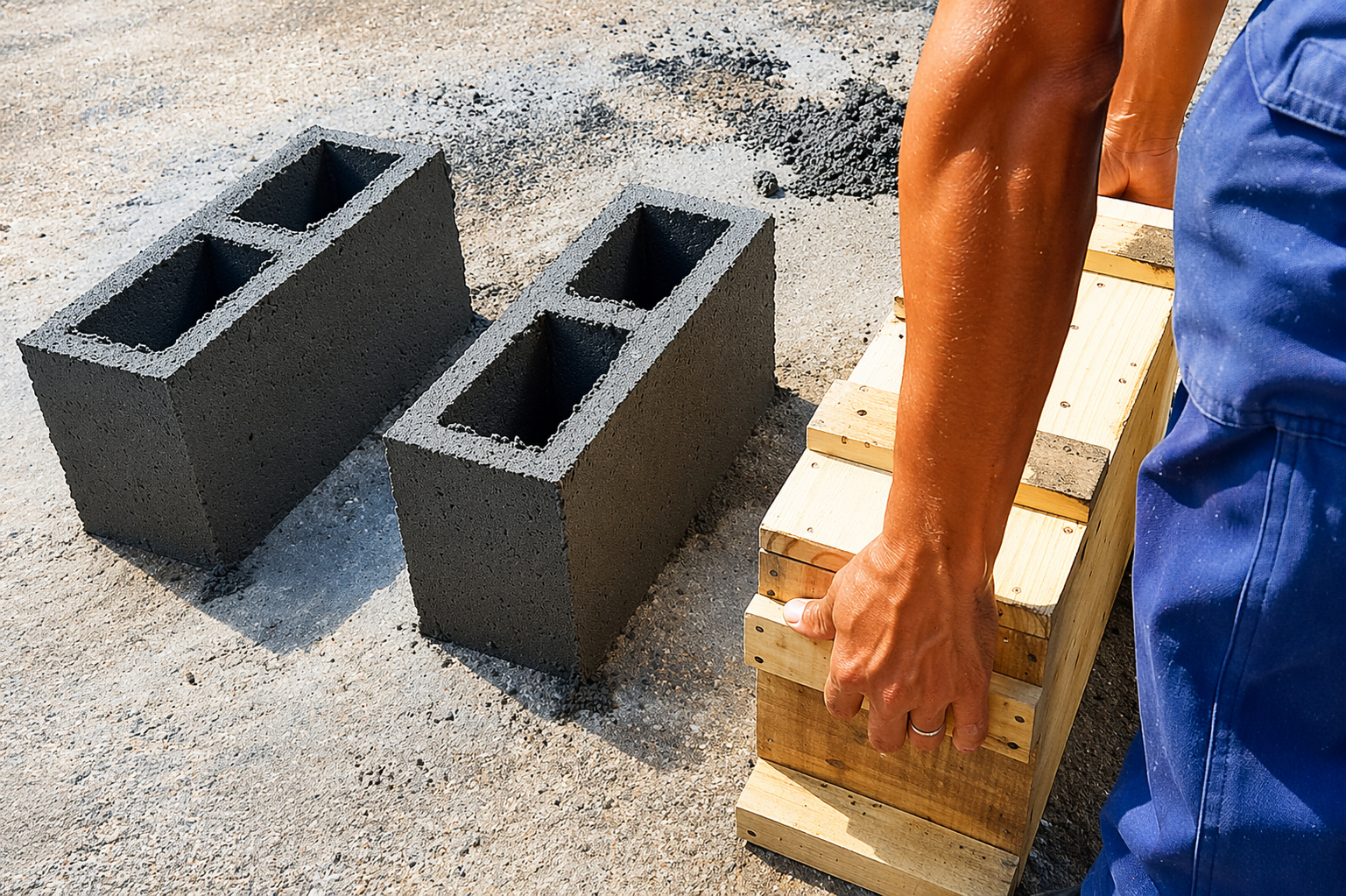

Concrete block production on-site stands out for reducing costs and maintaining good strength with a simple technique
The production of concrete blocks on-site has drawn attention for combining cost-effective construction and practicality. The technique uses accessible materials and a simple wooden mold, allowing for the manufacture of strong pieces without relying on industrial equipment.
This manufacturing model shows the potential to significantly reduce expenses. With a balanced mix and a well-executed process, the result is a firm block, with good finish and suitable for structural use, even when made manually.
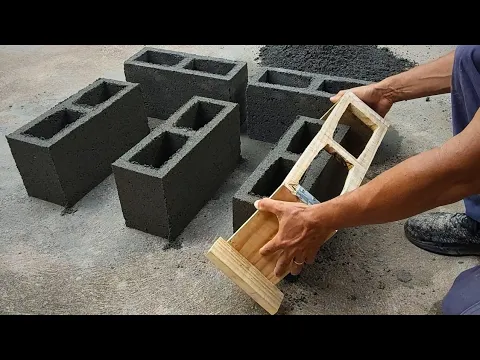

Recycled wooden mold allows for simple and efficient production
The basis of the process lies in the use of a mold constructed from repurposed wood. This detail reduces costs and also facilitates handling during production.
-
A Brazilian street cleaner built a machine to recycle PET bottles in the hinterlands of Paraíba, transforming the trash he swept from the streets into threads, brooms, and equipment sold even outside Brazil, and began earning about R$ 7,500 per month with his own invention.

-
In a city where every piece of land is worth gold, he began buying plots in the 1960s and built a real estate empire with over a thousand properties.

-
An artist sank over 500 life-sized human statues at the bottom of the Caribbean Sea, and what seemed like macabre art turned into a living reef covered with corals that attracts divers from all over the world.

-
A fossil kept for years in a small museum in Montreal concealed 450-million-year-old soft tissue, a discovery that has only happened once before in history.


The structure features a removable module and a side hinge, allowing the mold to be opened easily. This system directly contributes to a simpler demolding process without damaging the block.
The side and bottom openings are about 25 mm, a measurement that defines the thickness of the walls. The internal cores have a slightly tapered shape, which helps to remove the block without compromising its integrity.
Standardized measurements ensure the strength of the structural block
The produced block follows common dimensions in civil construction, with 14 cm in width, 19 cm in height, and 39 cm in length. This standard favors fitting and use in structures.
The piece has total voids, which requires precision in the positioning of the cores. Unlike sealing blocks, this model is designed to support loads, reinforcing the importance of the correct shape.
The walls have a thickness between 25 mm and up to 35 mm, depending on the finish. Even while still curing, the block can weigh between 14 and 15 kg, indicating good density and strength.
Simple mix with the correct proportion ensures the quality of the mix
The composition of the mass follows a direct and easy-to-reproduce proportion. The base uses two parts of sand, two parts of stone powder, and one part of cement, a combination that offers strength to the block.
In practice, 10 L of sand, 10 L of stone powder, and 5 L of cement were used, equivalent to about 6 kg of cement. This mixture results in a consistent and homogeneous base.
Water is added gradually until the ideal point is reached, known as the crumb point. At this stage, the mass remains loose but retains its shape under pressure. The consumption was close to 2.5 L of water, considering the moisture of the sand.
The information was released by a specialized construction channel, Oficina Maker, which presented the complete step-by-step of the technique.
Layer compaction improves the structure of the block
The filling of the mold occurs in stages, contributing to a more resistant result. Initially, about 30 percent of the mold is filled, followed by light taps to compact the mass.
This process is repeated in layers until the mold is complete. Compaction can be reinforced with a piece of wood, ensuring better distribution of the material.
This method reduces the presence of internal voids and increases the final quality of the block, making it more suitable for structural use.
Careful demolding maintains shape and finish of the block
Before removal, gentle taps on the sides help to loosen the material. This care prevents the block from breaking or losing its shape.

The removal of the mold occurs simply, with the opening of the external structure and removal of the internal module. The shape of the blocks facilitates this process.
The result is a block with well-defined edges, a uniform surface, and good strength, even without the use of industrial equipment.
The channel responsible for the content, Oficina Maker, reinforced the efficiency of the technique and the ease of application in daily life.
Production on-site can transform the cost of the work
The manufacturing of structural concrete blocks on the construction site emerges as a viable alternative to reduce expenses. The use of simple and reused materials directly contributes to this result.
In addition to cost savings, the method allows for greater control over production. This includes the consistency of the mass, the pace of manufacturing, and the final quality of the pieces.
The combination of simple techniques and accessible materials shows that the structural block made manually can meet the needs of construction, with good performance and lower cost.
The possibility of producing one’s own material raises an important reflection on costs in civil construction and the utilization of available resources.
In light of this, a question arises: to what extent can simple methods like this replace industrial processes in small works without compromising safety and durability?