Portuguese
  Spanish


Satellite Images Reveal Military Embarrassment with the Vessel That Was the Pride of Kim Jong-un’s Naval Modernization Plan.
The leader of North Korea, Kim Jong-un, witnessed a military embarrassment. The country’s newest destroyer, weighing 5,000 tons, sank during its launch last week. This incident involved the largest warship ever built by Pyongyang. Experts indicate that the sideways launching technique was crucial to the accident.
The Sinking of the New Destroyer Witnessed by Kim Jong-un
Kim Jong-un witnessed the sinking of the country’s newest 5,000-ton destroyer. The incident occurred during the launch last week. The vessel was a source of pride in Kim’s ambitious plan. The goal was to modernize and expand its navy inherited from the Soviet era. After the sinking, Kim classified the incident as a criminal act. Three shipyard officials, including the chief engineer, were arrested. A senior official from the armaments sector was also detained, according to the KCNA agency.
The Risky Technique Behind the Disaster
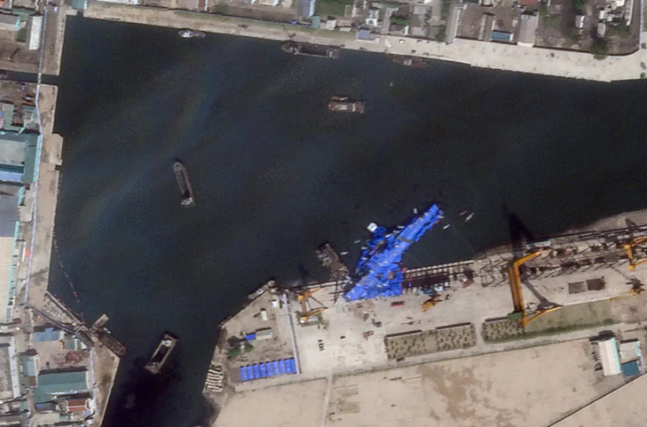
It was the first time analysts observed North Korea using sideways launching for warships. This highlighted the lack of experience. It also demonstrated Kim’s political pressure for quick results. Satellite images captured three days before the accident showed the 143-meter-long vessel. This was the largest ship of its class ever built by Pyongyang. It was positioned on a launching ramp. An observation structure, where Kim was likely located, was about 40 meters away and still under construction.
-
The U.S. Navy Conducts Submarine Tests in Idaho Lake to Detect Underwater Noises Hidden by the Ocean

-
Nuclear Submarine USS Alexandria Retired After 35 Years, Having Completed Over 1 Million Miles in Missions

-
MODEC Introduces New Hull Design for FPSO Gato do Mato to Produce Up to 120,000 Barrels of Oil Per Day in Brazil’s Pre-Salt Region
-
This Massive 12-Meter, 21-Ton Underwater Drone Can Operate Autonomously for Up to Five Days


Make-Do and Lack of Experience with the Largest Ship
The destroyer was assembled in Chongjin. It is a port city on the northeast coast of North Korea. The location is known for manufacturing smaller vessels, such as cargo ships and fishing boats. Analysts from the Center for Strategic and International Studies (CSIS) stated that the shipyard “undeniably” lacked experience. There was a lack of knowledge in constructing and launching large warships. The Chongjin shipyard did not have a dry dock large enough to build a Choe Hyon-class destroyer. It also lacked a sloped ramp to slide the vessel down the stern into the water. The engineers built the largest ship at the dock, under a net cover, and had to launch it sideways.
The Contrast with Success in Nampo and Pressure for Results
The ill-fated ship had a similar size and configuration to the guided destroyer Choe Hyon. This was North Korea’s first and the most powerful surface ship ever built by the country. The Choe Hyon was the highlight of a christening ceremony last month in Nampo. The grand event featured confetti, fireworks, and the presence of Kim and his daughter. A large observation platform was set up near the Choe Hyon, which was already floating. This launch occurred without incident. Engineers used a common technique: they built the Choe Hyon inside a barn, transferred it to a floating dry dock, and placed it in the water by filling the dock. Engineers in Chongjin, with less advanced facilities, must have felt enormous pressure after the success in Nampo.
Consequences and Doubts About the Recovery of the Largest Ship
When done correctly, sideways launching makes the ship slide and briefly dip into the water. A tugboat usually assists. When they tried to push the North Korean destroyer into the water, it lost balance. Satellite images taken two days after the accident showed the largest ship covered with a blue tarp. It was capsized on its right side. The bow was stuck to the ramp while the stern projected over the port. The observation platform had been removed. Launching large ships sideways requires delicate balance, said Choi Il, a retired South Korean Navy captain. The heavy weapons mounted on the destroyer may have made the task even more challenging. North Korea stated that it could restore the ship’s balance and repair it in about ten days. However, Yang Uk, a military affairs specialist, assessed that the damage seems more severe. “The ship looks a bit twisted,” he said. “It does not appear to have been built with the structural integrity required for a warship.
With information from InfoMoney.