






 Portuguese
  Spanish




New Model Prioritizes Families with Per Capita Income of Up to Half the Minimum Wage
The Ministry of Education (MEC) launched Social Fies.
The new modality of the Student Financing Fund was created through Resolution No. 58/2024.
This measure aims to regain the social function of the program.
-
City Hall opens selection process with free registration, salaries up to R$ 3,622.31, and positions for teacher, driver, speech therapist, assistant, and other roles in education in Juazeiro.

-
Work as an Enem exam supervisor and earn R$ 864 per day: Inep opens national selection for Enem, PND, and Enamed 2026 certifiers with applications from June 8 to 28 and strategic roles in exam supervision throughout Brazil.
-
Navy opens competition for the Technical Corps of Naval Ratings with strategic positions in military submarines and nuclear facilities, expanding the technological role of the naval force in 2026 with highly specialized training and impact on Brazilian defense.
-
Attention exam candidates: Maranhão accelerates public competitions in 2026 after the announcement by Governor Carlos Brandão with 3,350 confirmed vacancies, the definition of the organizing committee, and expected notices, expanding opportunities in security, education, and administration with a direct impact on the state economy.




It allows low-income students registered in CadÚnico to finance up to 100% of their educational expenses.
The new policy reserves 50% of the spots for this priority group.
The group includes self-declared black, brown, indigenous, and quilombola candidates.
The selection of beneficiaries occurs automatically during registration, based on the CPF.
The system cross-references the provided data with the CadÚnico records.
This cross-referencing ensures agility, reduces bureaucracy, and eliminates the need for in-person income verification.
Despite this, students must attend the CPSA to validate their information.
If there is any inconsistency, the committee may request additional documentation.
However, the presentation of income proofs is waived, as long as the amount is within the limit of half the minimum wage per capita.
Inclusion and Diversity Are Priorities in the Second Half of 2025
In 2024, Fies reserved specific spots for black, brown, indigenous, quilombola, and people with disabilities.
This was the first time that the program adopted this measure since its inception.
This innovation is part of MEC’s actions to expand equity in higher education.
The candidate must declare their ethnicity or disability status during registration.
In the case of people with disabilities, a medical report with details is required.
The document must indicate the type and degree of the disability, as well as the corresponding CID code.
This requirement applies to all PCD candidates, regardless of the chosen Fies modality.
The measure seeks to ensure greater representation and fairness in the selection process.
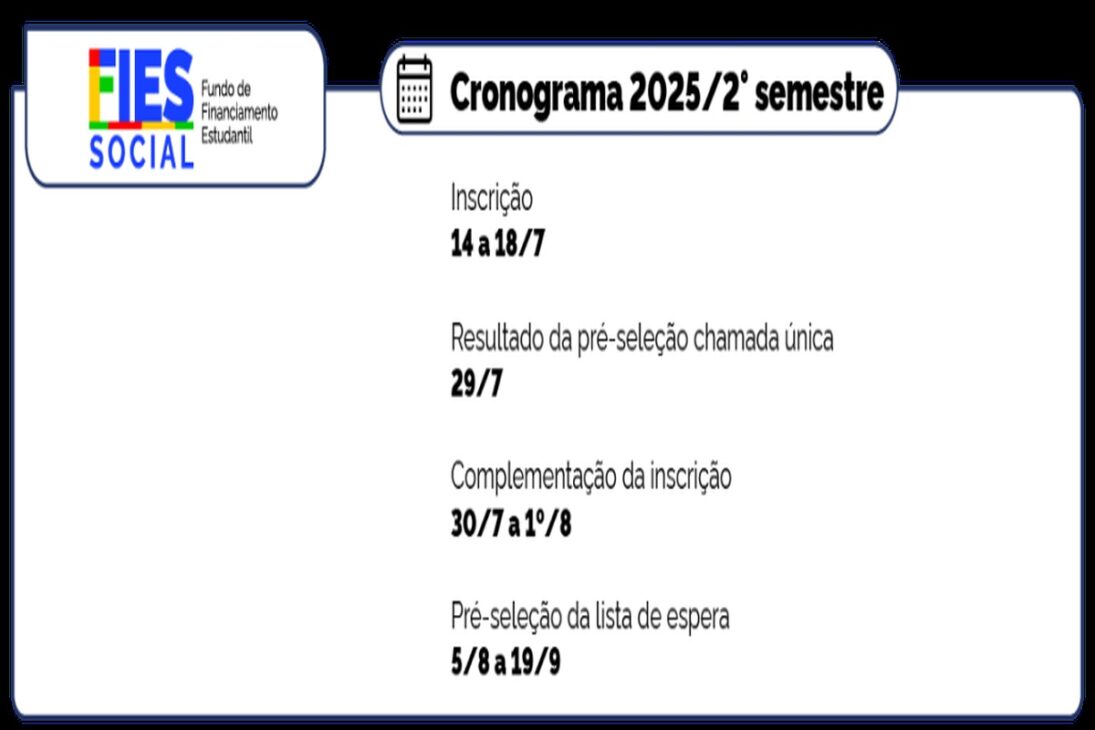
Registrations Open Until July 18 With More Than 74,000 Spots
Registrations for Fies for the second semester of 2025 are open until July 18.
They must be made exclusively on the Unified Portal for Access to Higher Education.
The process is free and entirely online, through login with CPF.
In this edition, 74,500 spots are available in private educational institutions.
These spots are distributed across 18,419 courses and shifts, from 1,215 colleges.
The system automatically identifies eligible students based on their CPF.
Therefore, it is essential to keep the CadÚnico information updated.
Additionally, the candidate must have taken the Enem since 2010.
The minimum required score is 450 points, without a zero on the essay.
The Goal Is to Ensure Social Justice in Access to Higher Education
Social Fies was designed to benefit those who need it most.
It strengthens the state’s role in reducing educational inequalities.
The policy values income and ethnic-racial belonging criteria.
This way, access to higher education across Brazil is expanded.
The proposal seeks to eliminate the financial barriers still present in the country.
These barriers hinder students from enrolling in private institutions.
With full financing, the chance of persistence and completion of the course increases.
The program also encourages a more diverse and representative education.

Adoption of Private Institutions Strengthens the Program’s Capillarity
More than 1,200 colleges, therefore, have joined Social Fies throughout the national territory, which also expands educational coverage on a large scale.
This initiative ensures greater capillarity, as it reaches both peripheral regions and rural areas that previously had limited access to higher education.
Furthermore, students from different states consequently gain more concrete opportunities for student financing with greater equity.
Thus, MEC expects a significant increase in higher education enrollments in 2025, strengthening educational public policy.
In this way, Social Fies consolidates itself as an essential tool for inclusion while promoting social justice.
It also directly contributes to the democratization of education and, thereby, helps combat regional and social inequalities.
With this measure, therefore, the social role of student financing in today’s Brazil is reinforced, especially in the context of expanding access.


