Portuguese
  Spanish


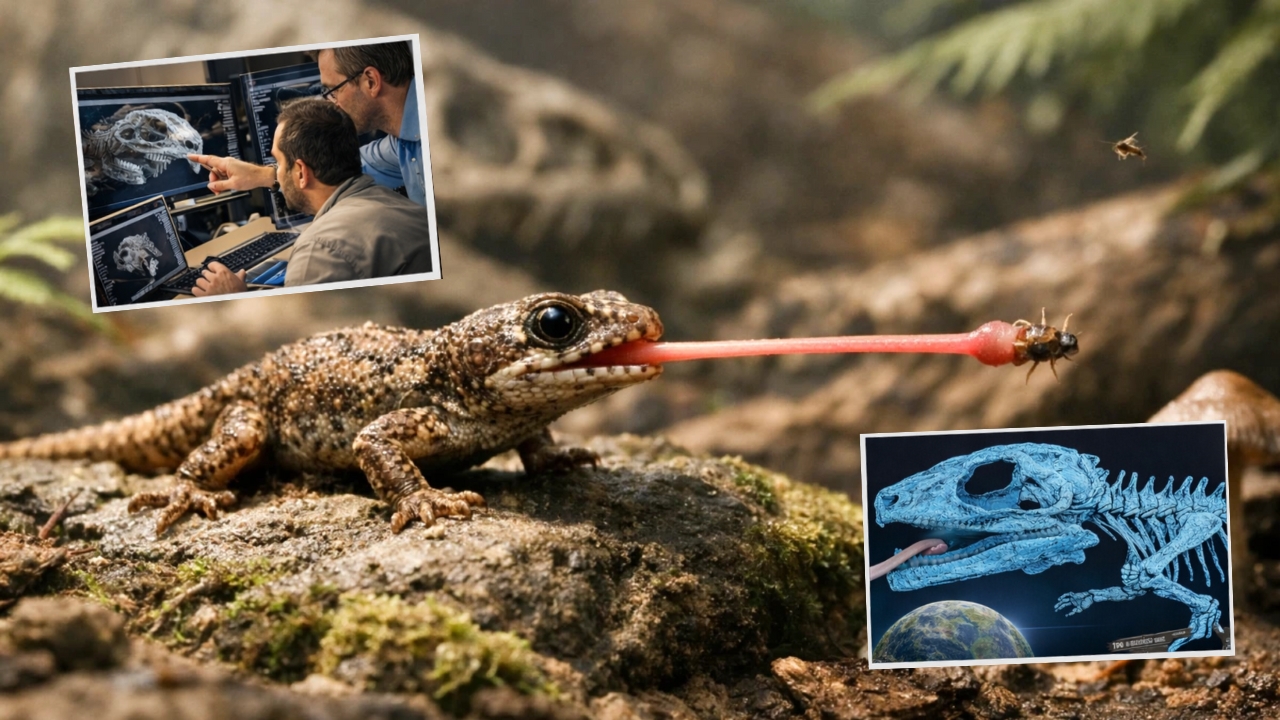


They Identified A New Amphibian Based On 468 Bones And Thousands Of Remains To Define Nabia Civiscientrix, Triggering A Historical Review Of Albanerpetontids And Catching The Attention Of The Scientific Community.
The discovery occurred from fossils 150 million years old, found in Portugal, and the result was surprising because it is not a dinosaur, but a small Jurassic amphibian.
The remains mainly came from the Lourinhã region, in an area known for giants like Lourinhanosaurus and Miragaia. This time, however, the focus was different: an animal less than 5 centimeters long that lived under the feet of the dinosaurs.
The detail that caught the most attention was the level of anatomical reconstruction possible from hundreds of bones and modern techniques, something rare for this type of extinct animal.
-
Iraq floats and sinks under an arm of the Euphrates 10 giant concrete boxes of 46,000 tons and 125 meters each to assemble a 2.4 km submerged tunnel and open a new land route between Asia and Europe.

-
Scientists use more than 20,000 artificial birds and solar speakers to “trick” seabirds, reactivate nesting routes, and revive a colony on an island that seemed abandoned.

-
She spent 73 years breathing inside an iron lung, survived the aftereffects of polio, and became the last woman in the United States dependent on the equipment before dying at 78 years old.
-
Brazilian students created a $1 filter using pine bark, cotton, and 3D-printed parts to clean cassava wastewater, reduce the toxicity of a hazardous waste, and transform contaminated water into biofertilizer.




What Was Discovered In Lourinhã And Why The New Species Became Highlighted
The fossils revealed a new species of Jurassic amphibian in Portugal, named Nabia civiscientrix. The material came from the Lourinhã Formation and includes 468 bones.
In addition, thousands of remains found in the beds of the Guimarota area, in the Alcobaça Formation, also supported the creation of a new genus and a new species, reinforcing the consistency of the finding.
The identification was made by an international team with paleontologists from the Faculty of Sciences and Technology of NOVA University Lisbon (NOVA FCT) and the Lourinhã Museum, in collaboration with specialists from Spanish and British institutions.
How 468 Bones And Rare Pieces Helped Complete The Anatomy Of The Animal
Among the researchers, Miguel Moreno Azanza from the University of Zaragoza explained that some bones were easily recognizable, but the big surprise was finding rare elements, such as the square and ilium bones.
These pieces, which do not easily appear in the fossil record of this group, helped complete the anatomical view of the animal and close gaps that had existed for decades.
The new material was also compared to fossils from the Guimarota site, also Jurassic, which strengthened the review and showed that there was something different from what was previously thought.
Review Of The Material From Guimarota Changes The Classification And Destroys The Celtedens Hypothesis
The main author of the study, Alexandre Guillaume from NOVA FCT and the Lourinhã Museum, pointed out that the analyzed data confirm something important: the material from Guimarota, long recognized as belonging to a species not yet formally defined, did not fit into the genus Celtedens, as was supposed.
The in-depth review led to the definition of the new genus and species Nabia civiscientrix, described as the oldest albanerpetontid identified in the Iberian Peninsula and one of the oldest in the world.
This type of reclassification draws attention because it changes the reading of the past and reorganizes how other fossils can be interpreted.
Less Than 5 Cm, Ballistic Tongue And Dry Skin, The Characteristics That Caught Attention
The amphibian would have been less than 5 centimeters long, a size that contrasts with the large dinosaurs of the same ecosystem.
The animal exhibited unique characteristics, such as a ballistic tongue similar to that of modern chameleons, dry and scaly skin, small claws, and eyelids.
The study also highlights the diversity of small vertebrates that shared the Jurassic ecosystem of Lourinhã, crawling at their feet, with the presence of albanerpetontids.
Microtomography In London And 3D Models Opened The Way For New Research
Some of the best-preserved fossils were analyzed in London through computed microtomography, allowing for the creation of detailed 3D models of the bones.
These models support a complete review of the anatomy of the albanerpetontids and contribute to a new set of morphological data, now available for future investigations.
Alexandre Guillaume explained that for a long time, studies were stuck to a limited set of easily recognizable bones, as complete or articulated specimens were lacking, and many bones were not illustrated and thus not identified.
As a consequence, some species were described based only on a few bones and then could not be compared with more complete specimens, precisely because those pieces were absent or poorly preserved.
Guillaume and co-author Susan Evans, based on the new material and other specimens worldwide, proposed an updated set of morphological data for future analyses, implementing new characteristics and revising the previous ones, one of the main results of the work.
The investigation integrates a Citizen Science project and engaged residents and visitors. The results were published in January in the scientific journal Journal of Systematic Palaeontology.
In the end, the discovery of Nabia civiscientrix in Portugal not only reveals a 150-million-year-old Jurassic amphibian but also changes the understanding of an entire group of extinct lys amphibians, opening a new path to investigate the small, often invisible life that coexisted with the dinosaurs.
And you, what impressed you the most about this discovery, the size of the animal, the ballistic tongue, or the fact that 468 bones changed history? Leave your comment.