






 Portuguese
  Spanish
  3 min of reading
  23 comments


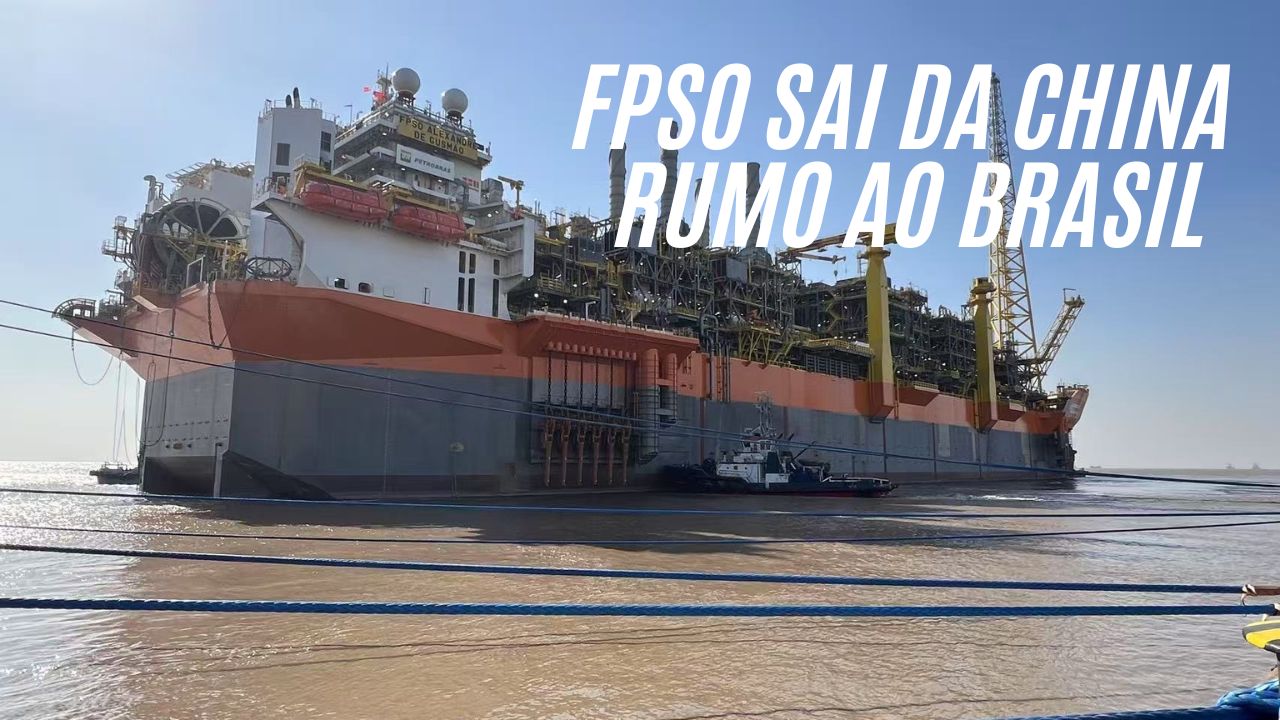


Floating Unit Leaves China for Brazil With Capacity to Produce 180 Thousand Barrels of Oil and Compress 12 Million m³ of Gas Per Day; the FPSO Reinforces Pre-Salt Exploration and Increases Production in the Mero Field by 31%
The FPSO Alexandre Gusmão, a floating production, storage, and transfer unit, has begun its historic journey from China to Brazil. This technological giant, which will be the fifth platform to operate in the Mero field in the pre-salt region of the Santos Basin, is a milestone for offshore exploration in the country.
What Is the FPSO Alexandre Gusmão and Its Importance
The FPSO Alexandre Gusmão impresses not only with its size but also with its operational capacity. With a daily production capacity of 180 thousand barrels of oil and the compression of 12 million cubic meters of gas, this platform represents the pinnacle of offshore engineering. Equipped with HISEP technology patented by Petrobrás, it will be capable of separating oil and gas at the seabed, reinjecting CO₂ into the reservoir, reducing emissions, and increasing efficiency.
The Mero field, located in ultra-deep waters 180 km from the coast of Rio de Janeiro, already has four FPSOs in operation. The arrival of the FPSO Alexandre Gusmão will raise the total capacity of the field to an impressive 770 thousand barrels per day. This means a 31% increase in production, consolidating the Santos Basin as one of the most promising areas in global offshore.
-
Oil production grows in Rio, but reserve replacement raises a warning sign

-
Petrobras is expected to complete the drilling of the Morpho well in the Foz do Amazonas in August 2026, the first well in the Equatorial Margin, an oil frontier that the ANP estimates at more than 30 billion barrels and could redraw the map of Brazil.

-
Oil returns to the center of concerns with tension between the US and Iran

-
IEA reduces forecast for global oil demand in 2026 after impacts of the Middle East crisis


The Journey from China to Brazil
The crossing of the FPSO Alexandre Gusmão from China to Brazil is a noteworthy logistical feat. This movement requires meticulous planning to ensure that the unit arrives in perfect condition and ready to operate. The maritime transport of such large structures symbolizes the level of complexity involved in projects of this magnitude.
The platform is expected to begin operations in 2025. With this, Petrobrás and its partners will take another important step in pre-salt exploration, maintaining the development schedule for the Mero field.
The Mero Field

The Mero field, operated by Petrobrás in partnership with companies like Shell Brasil and TotalEnergies, is one of the largest assets of the pre-salt. Currently producing with four FPSOs, the field exemplifies how exploration in ultra-deep waters can be efficient and profitable.
The distinguishing feature of the FPSO Alexandre Gusmão is the use of HISEP, an innovation that separates oil and gas directly on the seabed, reinjecting CO₂ into the reservoir. This not only enhances production efficiency but also minimizes environmental impacts, making operations more sustainable.
The Economic and Environmental Impact
With the FPSO Alexandre Gusmão, Brazil reinforces its position as one of the world’s largest oil producers. The increase in production not only strengthens the national economy but also attracts new investments to the sector.
The reinjection of CO₂ and the use of advanced technologies demonstrate Petrobrás and its partners’ commitment to sustainability. In times of global attention to climate change, initiatives like these are essential to balance production and environmental preservation.
The FPSO Alexandre Gusmão represents much more than impressive numbers; it symbolizes the future of offshore exploration in Brazil. Combining cutting-edge technology, energy efficiency, and environmental commitment, this unit reinforces the country’s strategic role in the oil and gas sector.




Se não for mais um daqueles contratos mal assombrados, que a Petrobrás é obrigada assinar por esse governo irresponsável. Que venham os lucros para empresa e para o Brasil. Porém se for diferente do que esta aí nessa reportagem, teremos prejuízos bilionários maís pra frente.
Fiquei impressionado com a notícia uma coisa muito grandiosa .
Mas hoje em dia o mundo funciona assim precisa das parcerias se fosse os Estados Unidos também estaria encomendando a plataforma na China e tudo é duas mãos compra e vende é o mundo de hoje. Mas o governo brasileiro poderia ter uma reserva percentual de tecnologia e fabricação nacional.
Quanto a intermidiacao fazer o PT?
Outra Daysi??