Portuguese
  Spanish


In the Kubuqi Desert, China advances with a solar corridor that combines renewable energy, sand containment, and environmental recovery in one of the most emblematic arid areas in the north of the country.
China is building in the Kubuqi Desert, in the Inner Mongolia Autonomous Region, a corridor of solar panels planned to reach 400 kilometers in length, about 5 kilometers in width, and 100 gigawatts of installed capacity by 2030.
Known as the “Great Solar Wall”, the project combines energy generation, desertification control, and recovery of degraded areas in the north of the country, according to information from NASA.
The work has not yet been completed.
-
New Study Finds Brief Stress Episodes Can Alter Blood and Increase Risk of Clot Formation

-
Ukraine Escalates War Efforts with Plan to Deploy 25,000 Ground Drones, Test Phantom MK-1 Humanoid Robot, Use Armed Mini-Tanks, and Expand Automated Attacks up to 15 km from Frontline

-
New Superfiber Developed by Imperial College Researchers and Approved by the EU Promises to Increase Satiety and Help Prevent Weight Gain
-
Harvard Researchers Develop Biological Clock to Estimate Life Expectancy, Potentially Transforming Human Aging Studies


According to Chinese authorities cited by NASA, about 5.4 gigawatts had been installed by December 2024.
Images from the Landsat 8 and Landsat 9 satellites show the expansion of solar plants between 2017 and 2024 in a strip of dunes south of the Yellow River, between the cities of Baotou and Bayannur.
Kubuqi was once called the “sea of death” because of its aridity, strong winds, and low vegetation cover.
With the implementation of the plants, part of this landscape began to receive photovoltaic panels, ecological management areas, and structures aimed at generating electricity for urban and industrial centers.
The goal of 100 gigawatts places the venture among the largest solar projects planned in the world, according to the size reported by Chinese agencies and companies.
The city of Ordos states that the “Solar Wall” should cross areas administered by the municipality, from Juungar Banner to Hanggin Banner, passing through Dalad Banner, with integration between photovoltaic energy and sand containment measures.
Local planning foresees the recovery of about 3 million mu, approximately equivalent to 200,000 hectares of sandy lands, through projects associated with solar energy and ecological restoration actions.
The structure also includes energy bases, substations, transmission cables, and initiatives related to storage, equipment manufacturing, and agriculture under panels.
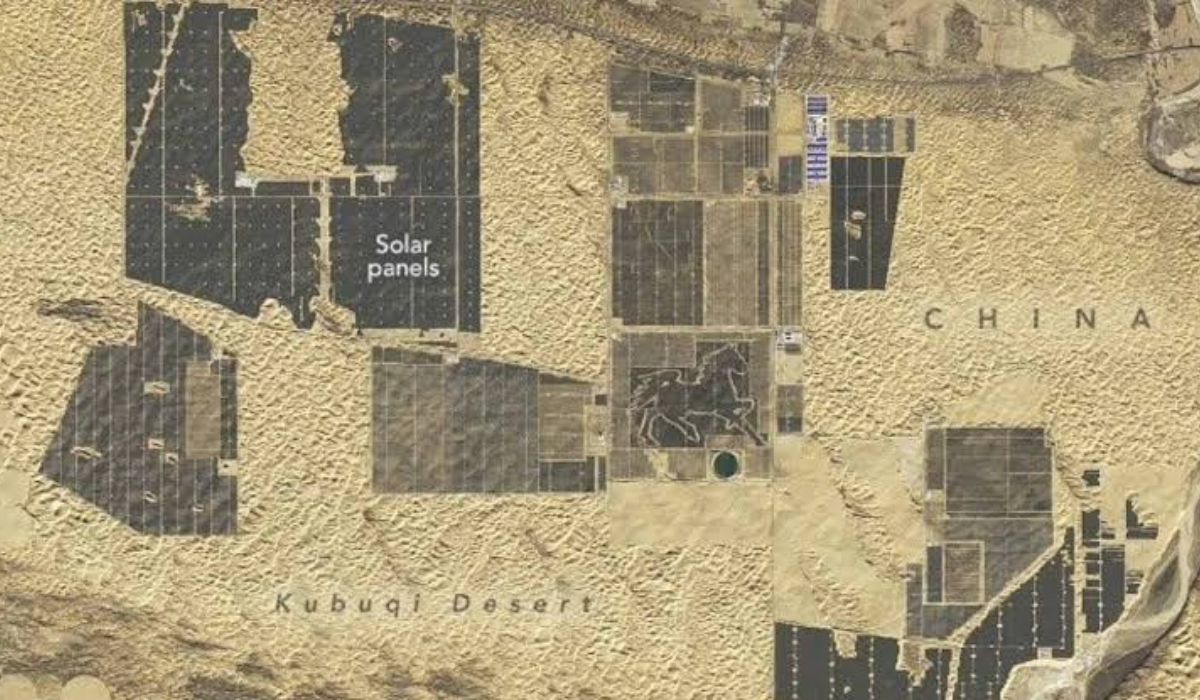
Junma Plant and the Solar Record in the Kubuqi Desert
Within this corridor lies the Junma plant, a name associated with “good horse” in Chinese.
The installation gained prominence for forming, when viewed from above, the image of a horse in motion.
The Guinness World Records recognized the project as the largest image made with solar panels, composed of 196,320 modules, in Dalate Banner, Ordos, on July 9, 2019.
The record specifically refers to the image formed by the Junma plant, and not the entire Great Solar Wall.
According to Guinness, the figure occupies 1,398,421 square meters and has an average daily generation capacity of 500,000 kilowatt-hours.
NASA reports that this installation was completed in 2019 and is part of the solar expansion in Kubuqi.
The choice of the horse was associated by record organizers with the cultural connection of the animal to the region.
In the context of Inner Mongolia, this reference appears as part of the visual identity of the plant, without altering the main function of the enterprise, which is energy generation and land use in arid areas.
Solar Energy Against Desertification in Inner Mongolia
One of the project’s features is the use of panels as part of a desertification control strategy.
In addition to generating electricity, the structures reduce the direct incidence of the sun on part of the soil, help decrease evaporation, and can reduce wind speed in areas near the installations.
According to the state agency Xinhua, local researchers state that the shade from the panels, reduced evaporation, and lower wind speeds favor plant growth under the structures.
The report also states that species used for sand fixation are being cultivated in project areas in Kubuqi.
The China Three Gorges Corporation reports that its solar and wind base in Kubuqi is expected to provide about 40 terawatt-hours of electricity per year to the Beijing, Tianjin, and Hebei region when completed.
The company also claims that the project aims to improve the local ecology and boost industrial chains related to photovoltaic generation, energy storage, and digitalization.


In a report published in September 2025, Xinhua reported that the base located in the central section of the “great photovoltaic wall” plans for 8 gigawatts of solar energy, 4 gigawatts of wind energy, and 4 gigawatts of coal support.
According to Na Guiting, vice president of Inner Mongolia Three Gorges Mengneng Energy Co., Ltd., the first two phases, of 1 gigawatt each, had already been connected to the grid.
The same survey reported that the two phases transformed more than 63 thousand mu, about 4.2 thousand hectares, into areas occupied by solar panels.
The estimate released by the company is that, when completed, the project will deliver approximately 40 billion kilowatt-hours per year to the Beijing, Tianjin, and Hebei region, with more than 50% coming from clean sources.
Energy transmission to Beijing, Tianjin, and Hebei
Solar generation in a remote area requires infrastructure to bring electricity to consumer centers.
In the case of Kubuqi, the energy is planned to supply the Beijing, Tianjin, and Hebei region, one of China’s main population and industrial hubs.
Transmission remains a technical challenge for such projects.
Large renewable bases installed in northern and western China are far from the largest consumer markets, requiring long-distance lines, substations, and integration with high-voltage networks.
In Ordos, local authorities state that the expansion of the “Solar Wall” is occurring alongside reinforcements in the electrical grid and energy distribution infrastructure.
This model is part of a broader national policy.
Reuters reported in September 2025 that China began incorporating solar projects into combating desertification in arid regions of the north and west of the country.
The strategy described by the agency uses the shadow of the panels to protect resilient seeds and shrubs, while barriers reduce wind speed and limit sand displacement.
According to Reuters, China plans to install 253 gigawatts of solar energy between 2025 and 2030 in projects aimed at rehabilitating about 7 thousand square kilometers.
The agency also recorded that desertified lands represented 26.8% of Chinese territory, compared to 27.2% a decade earlier.

Chinese Program to Combat Desert Expansion
The fight against desertification in China predates the current photovoltaic expansion.
The country launched, in 1978, the Three-North Shelter Forest Program, internationally known as the “Great Green Wall,” with a planned duration until 2050.
The initiative aims to contain the expansion of deserts, reduce sandstorms, and expand vegetative barriers in the north, northeast, and northwest of the country.
In Kubuqi, solar energy was incorporated into this agenda as a tool for combined use.
The electricity generated by the panels meets the demand for renewable sources and supply security, while the physical structures help to alter local conditions of wind, shade, humidity, and soil fixation.
Researchers and public agencies, however, treat this process as gradual and dependent on constant management.
In an interview with Reuters about desert containment projects in China, Wang Xiaoling, director of the Baijitan nature reserve, stated that the goal is not to completely eliminate deserts, but to reduce the damage associated with the advance of sand.
The so-called “Great Solar Wall” thus combines electricity generation, land restoration, and territorial planning in an area that was once associated with extreme aridity.
The execution until 2030 should indicate to what extent this model can reduce desertification and, at the same time, increase the supply of renewable energy to large consumer centers.