






 Portuguese
  Spanish


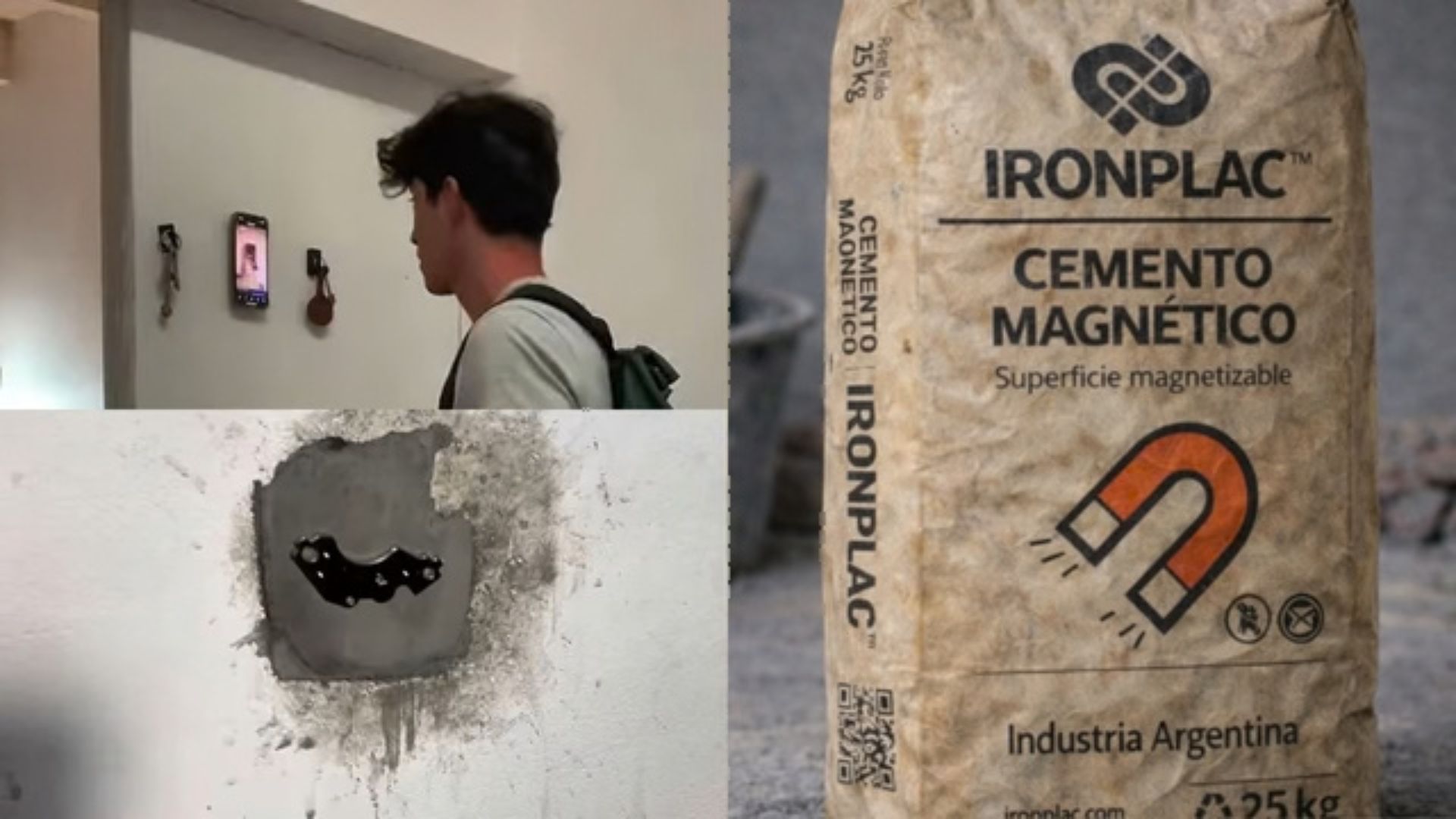


Argentinian Innovation Transforms Ordinary Walls into Surfaces Capable of Supporting Objects with Magnets, Eliminating Drills, Nails, and Dirt During Installation. Coating Called Ironplac Proposes a New Way to Organize Domestic and Professional Environments by Allowing Quick Position Changes Without Damaging Walls.
An Argentine industrial engineering student has developed a magnetizable coating that promises to change the way to hang and reorganize objects on interior walls, eliminating holes, screws, and mess during installation, according to recent reports from Argentine and international media.
Called Ironplac, the material was created by Marco Agustín Secchi, 29 years old, and works as a coating applied over the wall, similar to a fine plaster, that allows the attachment of items using high-power magnets.
The idea, according to Secchi himself in an interview published by the Argentine newspaper La Nación, arose from a direct question about the domestic and professional habit of drilling walls whenever the need to hang a picture or organize tools arises.
-
Eight Artists Secretly Lived in a Hidden 70m² Apartment Inside a Shopping Mall in Brazil for Four Years

-
Artist Lives in Giant Wooden Egg Over a UK River to Observe Tides and Environmental Changes
-
Over 20 Metal Drums Repurposed into School Transport Train Boost Attendance in Australian Aboriginal Community

-
Abandoned Coal Crane at Copenhagen’s Old Port Transformed into Luxury Waterfront Retreat with Spa and Ship Views





In seeking an alternative to nails, anchors, and screws, the student reports having directed the research to combine usual construction solutions with a more flexible everyday use, prioritizing the ability to move everything around without damaging the surface.
How Ironplac and the Magnetizable Wall Work
The Ironplac is presented as a powdered material that, when mixed with water, can be applied as a coating on walls, in a step similar to traditional finishing, and, once dry, begins to react to the force of magnets placed on items.
The effect occurs because the formula includes mineral loads and ferrous components that make the applied layer ferromagnetic, allowing the wall to “hold” items with the help of magnets, without the coating itself needing to generate a magnetic field.
In practical terms described in reports, the user places a small magnet on the object, touches it to the coated area, and achieves attachment with the possibility of quickly repositioning, without the noise of a drill and without creating new holes.
In demonstrations cited by the media, Secchi tested the application with items such as pictures and tools, including larger everyday items, exploring the proposal to transform the wall into a functional organization surface.
Construction Technology Focused on Everyday Use

Although the incorporation of metallic particles in construction materials exists in studies and applications for technical purposes, the focus of Ironplac, as it has been presented, is on an everyday problem: hanging and reorganizing objects quickly, without mess and without permanent marks.
This direction brings the solution closer to common scenarios in homes and offices, where the need for frequent adjustments often clashes with the cost of repairs, the aesthetic limitations of holes, and the restriction of not being able to drill walls in rental properties.
Another highlighted point is the versatility of use, as the same coated area can serve both for decoration and for organizing tools and materials, as long as the object receives a magnet suitable for the weight it will support.
When describing the project’s evolution, Secchi referred to Ironplac as a “construction platform”, indicating the intention to integrate the system with other materials and applications, rather than treating it merely as an isolated product.
Project Still Undergoing Testing and Seeking Investors
Despite the publicity, reports indicate that Ironplac is not yet on sale, and that the initiative remains in the prototyping and testing stage in practical applications, while the inventor seeks investors and partnerships to scale up production.
At this stage, decisive information for the market remains open, such as clear load limits per area, performance over time, behavior on different types of walls, and compatibility with technical requirements and construction standards.
There are also questions about economic viability, as the final cost tends to influence comparisons with known alternatives, such as metal panels, magnetic boards, rails, and adhesion solutions, which vary in price, finish, and durability.
At the same time, the lack of public details about the formula is treated as a natural part of a developing project, especially given the process of intellectual protection, mentioned in articles as a step still underway.
Where the Technology Can Be Used in Everyday Life
The expectation described for Ironplac includes use in workshops, classrooms, laboratories, and offices, as well as children’s environments and creative spaces, where constant reorganization of materials is often routine and where the wall can function as an active support area.
In work settings, the promise is to reduce reliance on fixed supports and simplify layout changes, a common demand in educational areas and project environments, where tools, notices, and visual references change frequently.
At home, the appeal tends to be linked to decor and practicality, especially in situations where the resident avoids permanent interventions, either due to property restrictions or to maintain aesthetics without periodic repairs of plaster and paint.
Still, the move towards a market standard will depend on technical validation, competitive cost definition, and transparency regarding capabilities and limits, as support by magnets requires careful sizing according to the weight and shape of the object.




