






 Portuguese
  Spanish


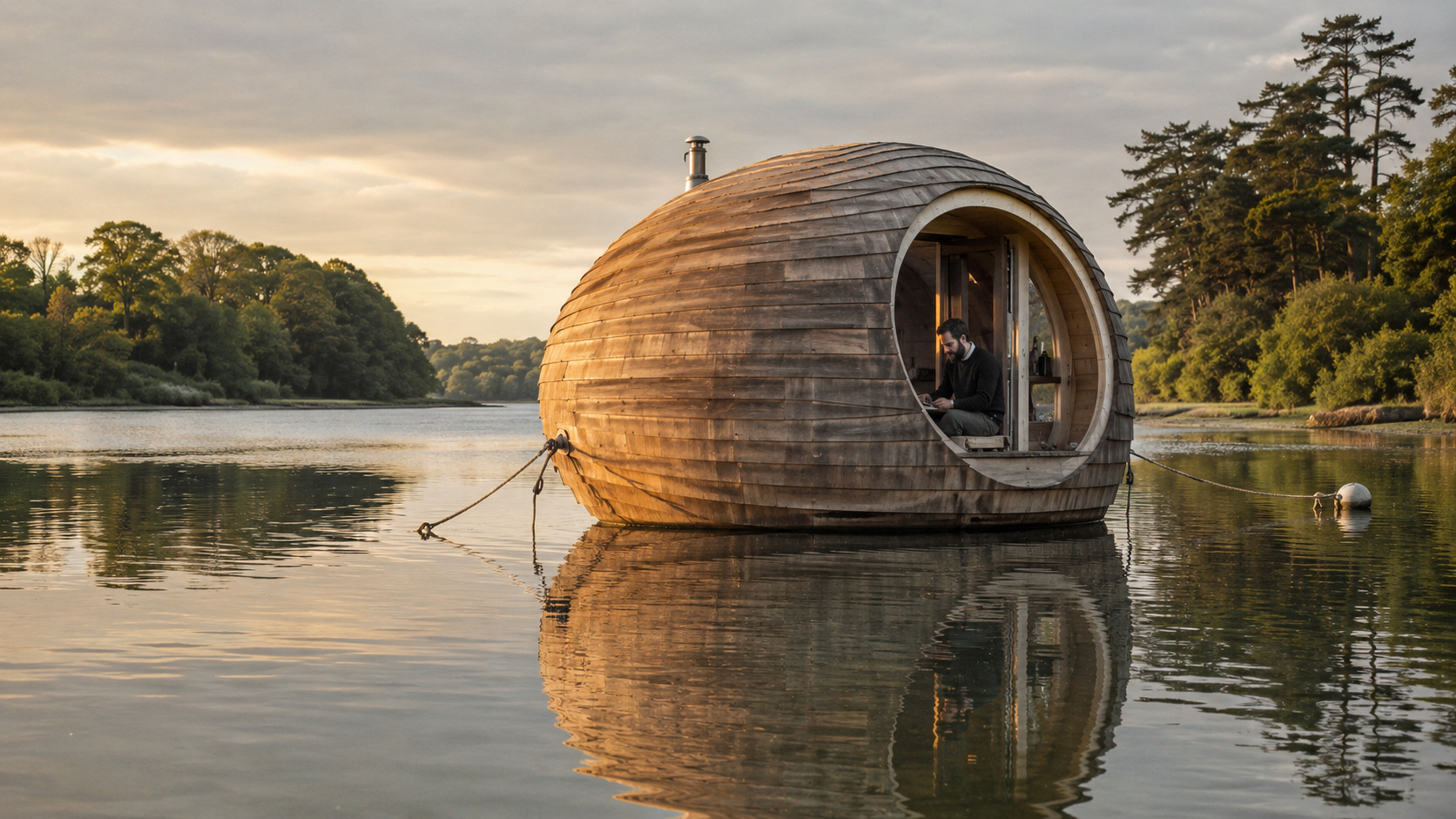

On the Beaulieu River, the giant egg, Exbury Egg, demonstrated how a floating shelter can unite wood, minimal living, art, and environmental observation without becoming a common house
Between July 14, 2013 and July 13, 2014, artist Stephen Turner lived inside a giant wooden egg installed on the Beaulieu River in Hampshire, UK, with a bed, stove, and table, to monitor tides, weather, and environmental changes every day.
The experience, now concluded, was part of the Exbury Egg, an artistic residency in the form of a floating shelter. The information was released by PAD Studio, the architecture firm involved in the project.
The information was released by PAD Studio, the architecture firm involved in the project. The structure was named Exbury Egg, which can be understood as the Exbury egg, and functioned as a floating shelter and workspace.
-
Eight Artists Secretly Lived in a Hidden 70m² Apartment Inside a Shopping Mall in Brazil for Four Years

-
Over 20 Metal Drums Repurposed into School Transport Train Boost Attendance in Australian Aboriginal Community

-
Abandoned Coal Crane at Copenhagen’s Old Port Transformed into Luxury Waterfront Retreat with Spa and Ship Views
-
Couple Sold Everything to Restore a 300-Year-Old Abandoned Mansion, Uncovering Ancient Books and Untouched Rooms



The project draws attention because it was neither a traditional house nor a common boat. It was an experience in sustainable architecture, designed to observe nature closely and show how the environment changes when the water rises, falls, and marks the landscape.
The giant wooden egg was created to live, work, and observe the river
The Exbury Egg was born as a floating studio for Stephen Turner. He was the resident artist of the project, meaning the person chosen to live and produce in that space during the experience.


The shelter was developed in collaboration with SPUD and Stephen Turner himself. The proposal was to create a temporary, simple, and sustainable space where it was possible to live and work for one year.
The Beaulieu River was not just the setting. It was part of the routine. The structure was anchored like a boat, attached to the riverbed, and moved up and down with the tide.
This detail gave meaning to the project. The small dwelling made the artist perceive the environment without distance, with water, wind, humidity, and climate influencing life inside the shelter.
Bed, stove, table, and compact bathroom fit inside the 6 meters by 3 meters structure
The interior of the giant wooden egg was simple and straightforward. The space had a bed, stove, table, and compact bathroom, as well as enough energy for a laptop, cell phone, and digital camera.
The structure measured 6 meters by 3 meters, smaller than many rooms in a Brazilian house. Therefore, each item needed to have a clear function.
There was no luxury in the project. The idea was to live with the essentials, without transforming the shelter into a sophisticated residence. The experience valued the observation of the river and the relationship with the place.
For the reader to better imagine, the space resembled a minimal dwelling on the water, but with a different purpose. The main objective was not permanent comfort, but rather artistic and environmental research.
The tide decided part of the routine inside the floating shelter
The floating shelter was made to rise and fall with the tide. When the water level changed, the egg followed this movement without leaving the point where it was anchored.
PAD Studio, the architecture firm involved in the project, detailed that the structure was anchored like a boat on the bed of the Beaulieu River. This solution allowed it to float with the lower part hidden below the waterline.
This made Stephen Turner live in direct contact with the daily changes of the river. High tide and low tide ceased to be just natural phenomena and began to mark the routine.
The experience also involved observing the effects of global warming and the erosion caused by the tides. Erosion occurs when water, wind, or other agents slowly wear away the shore and landscape.
The wood made the project more connected to the landscape and the wear of time
The exterior of the Exbury Egg was clad in cedar. Part of this wood came from old barn and garage doors, reinforcing the idea of reducing waste.
The construction needed to be water-resistant but without losing its natural appearance. Therefore, the wood was used in layers, with an internal barrier to prevent water entry.
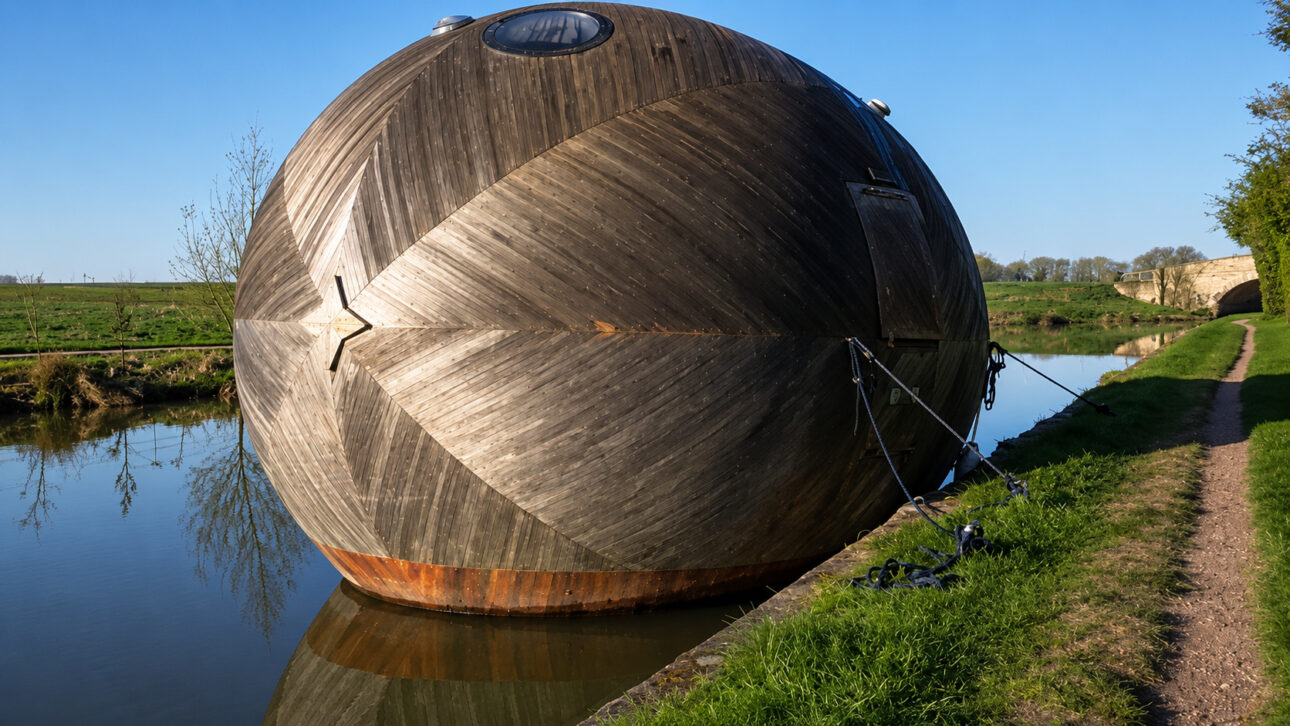
This point is important because the project wanted to show the effect of time on the material. The wood was exposed to the weather, wind, and humidity, gradually changing with the environment.
Instead of hiding the wear, the egg allowed this process to appear. The structure itself became part of the research, as if it also recorded the river’s marks.
Naval architecture helped the egg stay stable on the water
Creating an egg-shaped structure on a river is not simple. The rounded shape may look beautiful, but it makes balance and stability difficult.
Naval architecture, which is the area related to the design of boats and structures on water, helped solve this challenge. The shelter needed to float without spinning uncontrollably.
For this, solutions similar to those of a vessel were used. The structure had weighted pieces at the bottom, functioning as support to keep the egg more stable.
This care allowed the shelter to follow the tide and remain upright. The experience mixed art, science, and small-scale construction.
The project was not a popular housing solution, but an environmental experience
Despite looking like a curious house, the giant wooden egg was not created to solve housing shortages. It was an experimental installation, made for an artist to live and research for a limited time.
This difference avoids a wrong interpretation. A popular house needs to meet families’ needs, infrastructure, permanence, access, cost, and daily safety. The Exbury Egg had a different purpose.
The shelter served to bring Stephen Turner closer to the river and transform minimal living into observation. Living with little, in this case, was a way to pay attention to what usually goes unnoticed.
The structure also needed to respect a sensitive conservation area. Therefore, the project was designed to be temporary, discreet, and connected to the surrounding environment.
Living with little became a way to better see environmental changes
The Exbury Egg shows that a small construction can raise big questions. The shelter spoke about tides, weather, erosion, wood, and minimal living without needing large machines or huge buildings.
The image of an egg floating in the river seems strange at first glance. But this strangeness helped draw attention to something very concrete: the landscape changes every day, even when almost no one notices.
Stephen Turner’s experience does not provide a ready-made housing recipe. It shows a different way of thinking about the relationship between home, water, and nature.
In the end, the wooden egg on the Beaulieu River became known for combining shelter, art, and environmental observation in a single object. Small on the inside, but large in the debate it sparked.
Would you agree to live in such a small space for a year to closely observe the changes of a river, or does this type of experience only make sense as artistic research? Leave your opinion in the comments and share with those who like unconventional constructions.





