






 Portuguese
  Spanish


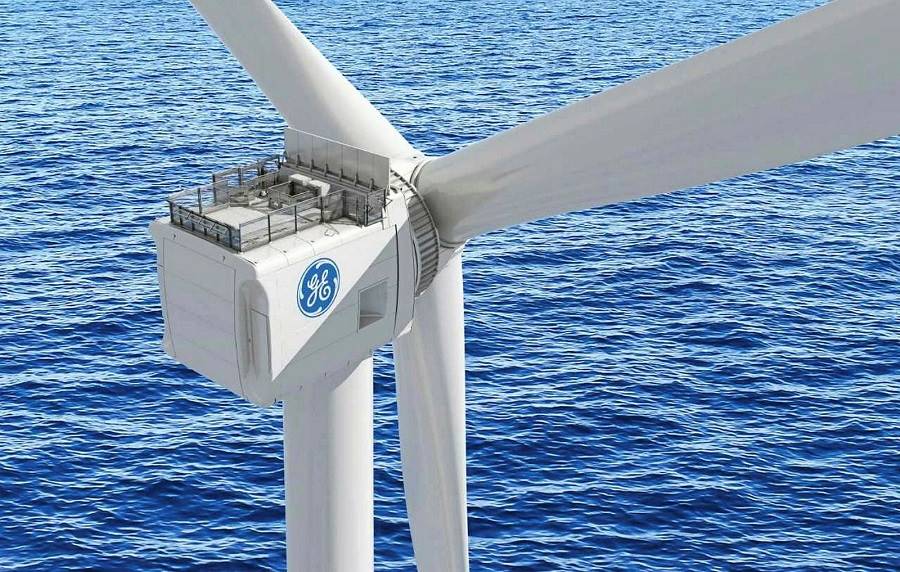

The Dutch Energy Company Eneco Has Started Buying Energy Produced by GE Renewable Energy’s 12 MW Haliade-X Wind Turbine Prototype.
The GE prototype was installed at the port of Maasvlakte-Rotterdam, in the Netherlands. The energy produced by the Haliade-X is being sold by Future Wind, a joint venture between Pondera Development and SIF Holding Netherlands.
See Other Projects by the Company in Renewables
- GE Signs Contract with Rio Energy to Provide 30 Onshore Wind Turbines in Bahia
- GE Announces Job Openings in the Northeast for Wind Energy in 2 States
- Many Job Openings in Construction Projects for Photovoltaic Project in Ceará
The scale of the turbine is considerable: it has a capacity of 12 megawatts (MW), a height of 260 meters, and a blade length of 107 meters. GE Renewable Energy has described it as the “most powerful offshore wind turbine in the world”.
In a statement released on Tuesday, GE said that the turbine recently produced 262 megawatt-hours of energy in a 24-hour period, enough to supply 30,000 households in the area. In November, it was announced that the turbine generated its first kilowatt-hour.
-
Brazil’s Offshore Wind Energy Potential Worth $1 Trillion Stalled by Long-Delayed Agreement

-
World’s Largest Engie Solar Plant in Brazil Highlights Billion-Dollar Energy Waste Issue: Company Considers Batteries and Bitcoin Mining to Avoid Wasting Production

-
Air Products Cancels $2.9 Billion Clean Hydrogen Megaproject in Louisiana, Shuts Down Arizona Unit, Highlighting High Costs of U.S. Energy Transition
-
Over 60 Tractors Take to the Streets in Lopera as Solar Parks Compete with Olive Groves, Affecting 13,000 to 100,000 Trees According to Conflicting Reports


Although designed for the offshore sector, GE Renewable Energy had previously stated that the Haliade-X 12 MW prototype would be installed on land to “simplify access for testing”. GE intends to commercialize the turbine by 2021, with mass production beginning in the second half of that year.
So far, the company says that the Haliade-X has been chosen as the preferred wind turbine for several offshore projects. This includes the 3,600 MW Dogger Bank scheme in the UK and the 1,100 MW Ocean Wind project in the US.
As technology develops, the size of wind turbines is increasing. In September 2018, MHI Vestas Offshore Wind launched what it described as “the first commercially available double-digit wind turbine in the wind sector”, the V164-10.0 MW. The turbine features blades that are 80 meters long, weighing 35 tons each, and a tip height of around 187 meters.
As a region, Europe is an important player in the offshore wind sector. It is home to large-scale projects like the Walney Extension. Officially opened in September 2018, it is located in the Irish Sea, has a total capacity of 659 MW, and generates electricity for nearly 600,000 households, according to Danish energy company Orsted.
The installation uses 87 turbines – 40 MHI-Vestas 8.25 MW and 47 Siemens Gamesa 7 MW – and covers an area equivalent to approximately 20,000 soccer fields.
The offshore sector in the US, on the other hand, is still relatively young. Its first offshore installation, the 30 MW Block Island Wind Farm, began commercial operations only in 2016. The project is located off the coast of Rhode Island and is operated by Orsted.


